





 Отправить статью по E-mail
 Роль наставничества в профессиональном развитии учителя
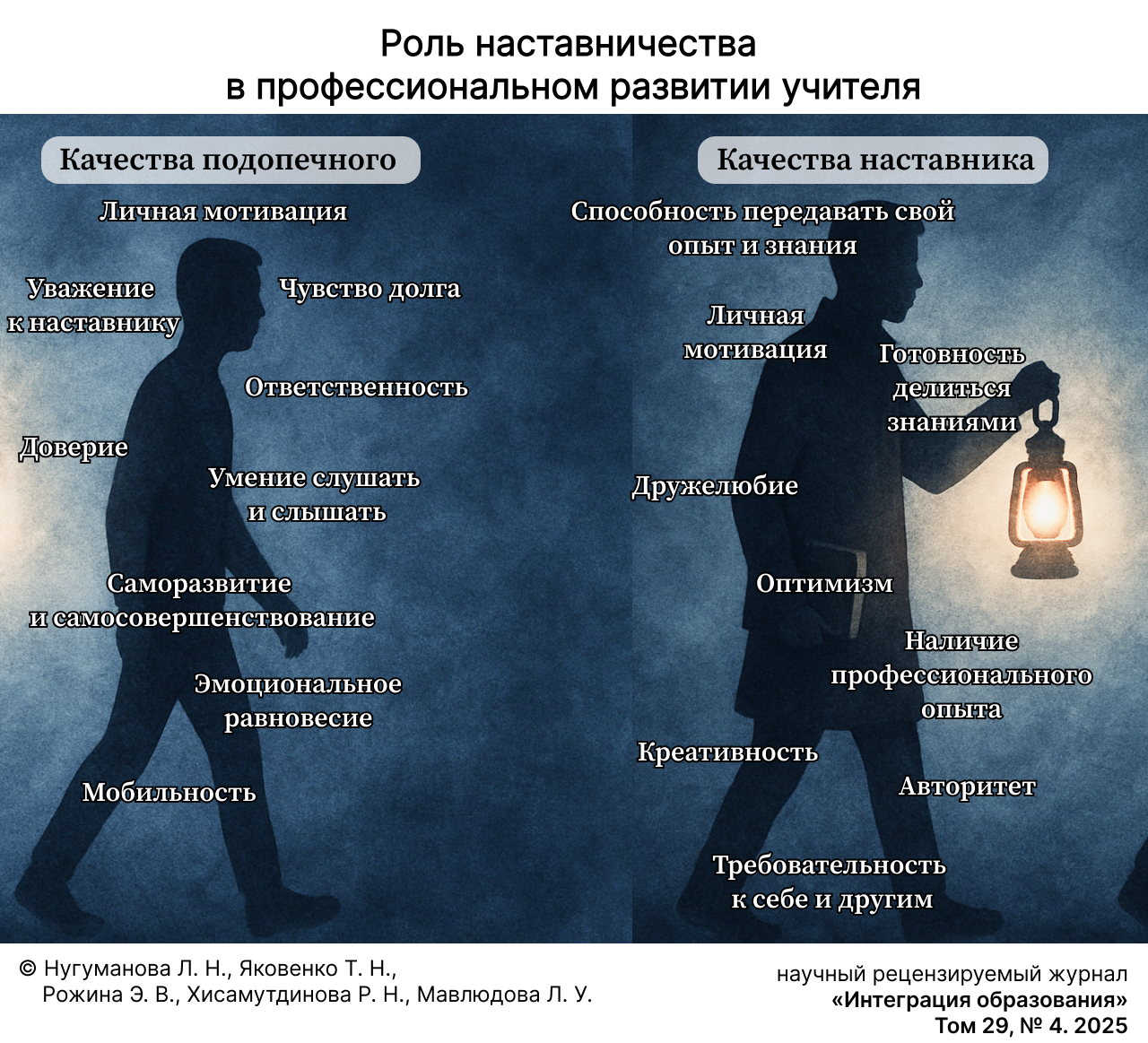
- Авторы: Рожина Э.В.1, Нугуманова Л.Н.2, Яковенко Т.В.1, Хисамутдинова Р.Н.3, Мавлюдова Л.У.1
-
Учреждения:
- Казанский (Приволжский) федеральный университет
- Институт развития образования Республики Татарстан
- Университет управления «ТИСБИ»
- Выпуск: Том 29, № 4 (2025)
- Страницы: 698-710
- Раздел: Педагогическая психология
- Статья получена: 30.04.2025
- Статья одобрена: 29.05.2025
- Статья опубликована: 18.12.2025
- URL: https://ogarev-online.ru/1991-9468/article/view/289888
- DOI: https://doi.org/10.15507/1991-9468.029.202504.698-710
- EDN: https://elibrary.ru/vdadig
- ID: 289888

Цитировать
Полный текст

Аннотация
Введение. Наставничество – важный элемент системы дополнительного профессионального образования, обеспечивающий непрерывное профессиональное развитие и совершенствование педагога. В условиях стремительных изменений в образовательной среде, внедрения цифровых технологий, обновления федеральных государственных образовательных стандартов и растущих требований к качеству преподавания роль наставничества становится особенно важной. Цель исследования – выявить и проанализировать мотивацию учителей к участию в программах наставничества, а также систематизировать факторы, определяющие эффективность данного процесса.
Материалы и методы. В исследовании приняли участие 321 чел. из различных образовательных организаций, что обеспечило репрезентативность данных и позволило провести сравнение по уровню опыта. Количественные и качественные данные о восприятии педагогами системы наставничества были получены с помощью гибридной анкеты, сочетающей закрытые и открытые вопросы, оценочные шкалы и демографические показатели. Значимые корреляции между профессиональным опытом, участием в программах наставничества и воспринимаемой эффективностью выявлялись с применением методов математической статистики (средние значения, стандартные отклонения, коэффициенты корреляции и процентное распределение).
Результаты исследования. Педагоги считают наставничество эффективным инструментом профессионального развития, способствующим росту компетенций, личностному совершенствованию и укреплению профессионального сообщества. Наибольшую удовлетворенность от наставнической деятельности отметили представители средней возрастной группы, что свидетельствует о гармоничном сочетании опыта и мотивации к передаче знаний. Эффективность данного процесса определяется личными качествами руководителя – ответственностью, трудолюбием, уважением к своим подопечным и внутренней мотивацией. При этом их социальное признание и поддержка остаются важными условиями для успешной реализации программ наставничества.
Обсуждение и заключение. Проведенное исследование позволило эмпирически подтвердить высокую значимость наставничества как эффективного механизма профессионального развития и передачи педагогического опыта. Практическая значимость работы заключается в возможности использования полученных данных для совершенствования моделей, разработки методических рекомендаций и программ профессионального развития преподавательского состава. Перспективы дальнейших исследований связаны с углубленным анализом влияния личностных и профессиональных характеристик наставников на эффективность взаимодействия, а также с разработкой диагностических инструментов и цифровых моделей процессов наставничества. Полученные результаты представляют интерес для исследователей в области педагогики, специалистов системы дополнительного профессионального образования и руководителей образовательных организаций.
Полный текст
Introduction
Mentoring has become a noticeable phenomenon in the education system around the world1, it has a huge positive impact on its participants, both on the wards and on the mentors themselves [1]. Mentoring programs are used to improve the personal and professional development of teachers, as studies have confirmed that effective (successful) teachers have a great influence on the academic success of students [2].
A special place in the preparation of a teacher for professional activity after studying at a university is given to the system of additional professional (pedagogical) education, which provides:
− creation of conditions for continuous professional development and improvement of teaching staff;
− satisfaction of professional interests, needs and requests;
− elimination of professional deficits of teaching staff;
− elimination of areas of low quality of education;
− advanced development of the human resources potential of the education system;
− stimulating the teacher’s need for professional self-improvement;
− motivation for professional self-realization [3].
Since 2019, a project has been implemented in the Republic of Tatarstan to introduce mentoring activities into the system of additional professional education. The online electronic platform “School of Mentoring” has been created. While functioning in a hybrid format, it allows to conduct professional discussions with participants of mentoring projects from different regions of the Russian Federation, holding webinars, workshops and other forms of professional development support, communicating with like-minded people on intellectual and professional topics, as well as interacting with project managers to receive comprehensive support. In 2022, all 48 municipal districts of the republic joined the project, which made it possible to support the implementation of individual strategies for professional improvement of pedagogical and managerial personnel in the region.
Monitoring the practice of mentoring should be considered important for understanding the processes that ensure the professional development of a teacher [4]. In our study, mentoring is considered from two positions: as an experienced person’s support for another person who needs guidance in a particular area [5] and as a mechanism for on-the-job training [6]. It should be noted that over the past few years, research interest in the characteristics of mentors has increased [7]. The purpose of this study is to identify key motivational factors influencing teachers’ participation in mentoring programs, as well as to determine the conditions that affect the effectiveness of the mentoring process.
Literature Review
Mentoring has become one of the mechanisms for achieving the strategic priorities of the system of additional professional pedagogical education at the present stage [8]. Numerous studies and publications on the problems of mentoring in education emphasize its importance in the processes of professional formation and development, consider the mentor as part of a structure that supports the training and professional development of a future teacher, and also includes emotional support and care [9]. The results published in the literature show that teachers who did not participate in mentoring programs tend to have low self-esteem, experience stress, frustration, and self-doubt, while teachers who had mentors developed self-confidence, acquired leadership and communication skills, and felt the appreciation and have the opportunity to act independently [10]. However, there are only a few studies on the problem of motivating mentors themselves and their decision to become a mentor for a teacher [11]. It should be noted that mentoring programs meet the needs of both mentors and mentees [12]. At the same time, a number of teachers take on the role of mentors, not having sufficient knowledge and tools to provide their wards with an appropriate level of support [13].
In foreign scientific literature, mentoring is considered to be the most important mechanism for the professional formation and development of teaching staff, ensuring the transfer of professional knowledge, the formation of pedagogical identity, and the improvement of the quality of educational activities. Starting with the classic studies by L.S. Kramer2 and D. Clutterbuck [14], the concept of mentoring has evolved from a model of one-way transfer of experience to an interactive system of mutual learning based on reflection, partnership, and support. Contemporary research [15–17] emphasize that mentoring contributes not only to the adaptation of novice teachers, but also to the development of metacognitive and reflective skills of mentors, the strengthening of the professional community, and the improvement of the sustainability of pedagogical practice.
Particular attention is paid to the institutional and psychological factors of mentoring effectiveness: the quality of preliminary training of mentors, the availability of organizational support and time resources, as well as the alignment of the goals and expectations of participants [18]. One of the current areas of research is the study of digital forms of mentoring (e-mentoring, blended mentoring), which provide flexibility of interaction and expand opportunities for interregional and interuniversity cooperation [19].
An analysis of domestic and foreign literature reveals that modern teachers work in conditions of constant change in pedagogical science, social transformations, and political initiatives. Unexpected events, such as a global pandemic, create an uncertain future for education, which requires teachers to be highly adaptable and ready for new challenges. Mentoring has traditionally been used to support teachers, especially novice teachers, helping them to cope with professional difficulties and develop their competencies [20]. However, in the current challenging educational environment, mentoring must go beyond the standard development of professional skills and contribute to the development of future orientations, including critical thinking, creative imagination, openness, and perseverance. Thus, research on the role of mentoring in the current reality for teachers from different regions and educational platforms is relevant.
Materials and Methods
Sampling Frame. Mentors participating in the VI All-Russian Scientific and Practical Conference “Mentoring in Education: Modern Theory and Innovative Practice” participated in the study. The answers to the questions were received from 321 respondents. The sample is presented by subject teachers of general education organizations at the level of basic general and secondary general education. Heads of educational organizations, teachers of primary general education, teachers of professional educational organizations and universities were excluded from the sample. All respondents were informed about their participation in the study.
Research Design. A hybrid questionnaire was used to conduct the study, which includes various question formats (closed and open), rating scales and demographic questions. To conduct the study, a survey was developed that contained 3 groups of questions.
Section 1. Socio-demographic data (region of residence, type of settlement, type of organization, age group, teaching experience).
Section 2. Attitude to the mentoring process (data on personal mentoring experience, personal attitude to mentoring as an effective form of professional development of teachers, the respondent’s involvement in the mentoring process).
Section 3 of the questions was aimed at identifying the qualities that a mentor and mentee should possess, determining favorable conditions for mentoring activities in the system of additional professional education.
The questionnaires were sent out by teachers via email and all data was collected using Yandex Docs. The analysis of the data obtained as a result of the analysis led to the use of the SPSS package. Categorical data were presented in the form of calculations and percentages. Mathematical statistics methods were used to analyze the data set and identify dependencies between the “Quality for improvement” parameter and the “Age” and “Work experience” parameters.
Data Analysis. In modern scientific practice, data analysis is considered a fundamental stage of research, ensuring the identification of patterns, testing of hypotheses, and formation of sound conclusions. The reliability and reproducibility of the results obtained are directly determined by the quality of preliminary data preparation and a thorough study of their structure and content. In short, the data analysis was conducted in the following steps:
- Load the dataset (dataset.csv) and inspect it to understand its structure and contents.
- Check for any missing values and handle them appropriately.
The provided dataset has the following structure and contents (Table 1).
Table 1. Overview of the dataset structure and variables
Column Name | Description |
Age | Age range of the respondent |
Working years | Number of years the respondent has worked |
Needs | Specific needs expressed by the respondent |
Mentor | Whether the respondent had a mentor |
Qualities to improve | Aspects the respondent wants to improve |
Source: Hereinafter in this article all tables were drawn up by the authors.
Qualitative data, by its nature, cannot have a normal distribution because it represents categorical or discrete values, not continuous numerical values like quantitative data. The normal distribution is a probability distribution that describes the distribution of continuous variables, not categorical variables.
Qualitative data, also known as categorical data, can take on a finite number of distinct categories or levels. These variables are often analyzed using methods such as contingency tables, Chi-square tests, or logistic regression, which are appropriate for categorical data analysis.
When working with qualitative data, we are typically interested in frequencies or proportions of each category, as well as relationships between different categories. It’s essential to choose appropriate statistical methods and visualizations that are suited to the nature of qualitative data and the specific research questions being addressed.
When determining the relationship between the indicators obtained during the survey, the following assumption was made: parameter “Qualities to improve” doesn’t depend on “Age” and “Working years”.
Statistical Analysis. To examine the relationships between the categorical variable "Qualities Needing Improvement" and the factors “Age” and “Working years” a Chi-square test of independence was conducted. This test determines whether overall frequency differences in the distribution characteristics expected under the assumption of independence are observed. For this definition of the variable, a p-value of less than 0.05 was considered significant, leading to rejection of the null hypothesis and confirming the presence of a primary relationship.
Results
This section presents the results of research on the role of mentoring as a key mechanism for teachers’ professional development and the formation of their professional identity. The socio-demographic data presented in section 1 have been analyzed descriptively. Table 1 shows the initial variables in both raw numbers and actual percentages. An analysis of the distribution of respondents by type of educational institution showed that the majority of the sample consisted of secondary school teachers – 261 people, which corresponds to 81.4% of the total number of participants in the study. Lyceum teachers are represented by 32 respondents (9.9%), and the teaching staff of gymnasiums includes 28 participants, or 8.7% of the sample. This distribution should be taken into account when interpreting the results of the study, as it reflects the structure of the sample and its representation by type of educational institution.
The sample is represented by 11 subjects of the Russian Federation, the distribution of the sample population is distributed among 5 districts of the Russian Federation is shown in Table 2.
Table 2. Distribution of the sample population by subjects of the Russian Federation, in % of the total number of respondents
Subjects of the Russian Federation | Respondents of the subject |
Volga Federal District | 69.9 |
Republic of Tatarstan | 46.3 |
Republic of Mordovia | 15.4 |
Kirov Region | 8.2 |
Far Eastern Federal District | 15.7 |
Republic of Sakha (Yakutia) | 13.9 |
Magadan Region | 1.8 |
Siberian Federal District | 5.4 |
Tomsk Region | 3.2 |
Novosibirsk Region | 2.2 |
Ural Federal District | 4.9 |
Khanty-Mansi Autonomous Area – Yugra | 2.7 |
Sverdlovsk Region | 2.2 |
Central Federal District | 4.1 |
Tambov Region | 2.8 |
Moscow Region | 1.3 |
The majority of respondents work in urban educational institutions 226 (71%), the smaller – in rural 95 (29%), the quantitative ratio of the group of respondents is 2/3, which is close to the proportions representing the population of the country according to the Federal State Statistics Service “Demographic data of the study participants”.
The distribution of the age groups of the sample respondents is shown in Table 3. The classification of the World Health Organization was used as the basis for the division into groups.
Table 3. Respondents Age Groups classified according to the World Health Organization
Age group of respondents | Number of respondents, units | Percentage of respondents, % |
Young age (18–44 years) | 90 | 28.03 |
20–24 | 6 | 1.88 |
25–29 | 14 | 4.40 |
30–34 | 19 | 5.91 |
35–39 | 24 | 7.42 |
40–44 | 27 | 8.42 |
Average age (45–59 years) | 193 | 60.13 |
45–49 | 92 | 28.68 |
50–54 | 57 | 17.75 |
55–59 | 44 | 13.70 |
Elderly age (60–74 years) | 38 | 11.84 |
60–64 | 18 | 5.61 |
65–69 | 12 | 3.74 |
70–74 | 8 | 2.49 |
Further, the survey participants were divided by teaching experience. An analysis of the distribution of respondents by length of service, conducted at the next stage of the study, showed that the largest share of study participants were teachers with 25 to 35 years of service, numbering 105 people, or 32.7% of the total sample. In second place were teachers with 15 to 25 years of experience – 82 respondents (25.5%), while teachers with 5 to 15 years of experience accounted for 56 participants (17.4%). Less experienced specialists with up to 5 years of experience accounted for 9 people (2.8%), and the group of teachers with more than 35 years of experience included 69 participants (21.6%). Thus, the sample under study is mainly represented by teachers with extensive professional experience, which must be taken into account when interpreting the results and conclusions about the practical aspects of mentoring.
At the time of the survey, all (100%) of respondents were included in mentoring programs implemented at different levels: at the level of an educational organization: 73.1% at the municipal level, 20% at the republican level (subject of the country), 6.9% at the state level. At the same time, 25.3% of respondents have no personal experience of participating in mentoring projects during their professional development, and 74.7% have such experience, and 20.6% had an officially appointed mentor, 54.1% of respondents themselves chose the person to whom they turned for support and help.
The next stage of the study analyzed the motives that prompted respondents to become mentors. The most significant for respondents were: improving professional knowledge and skills (50.1%), gaining new practical experience (48.9%), and pedagogical interaction with young professionals (44.5%). A ranked list of respondents’ opinions is presented in Table 4.
Table 4. Distribution of respondents’ opinions
Reasons | Number of respondents, in units | Frequency of selection, in % |
Improving knowledge and skills | 161 | 50.1 |
Getting new work experience | 157 | 48.9 |
Interaction with a young teacher | 143 | 44.5 |
Creative approach | 136 | 42.3 |
The opportunity for professional growth | 131 | 40.8 |
The possibility of self-realization | 84 | 26.1 |
Example of colleagues | 52 | 16.1 |
The management’s instructions | 18 | 5.6 |
Note: In tables 4, 6 the total does not equal 100% because respondents could select more than one answer.
The overwhelming majority of respondents have an internal motivation and strive to help other colleagues, while simultaneously satisfying their own professional needs [21] and only a small part of the external – “the management’s instructions”. It should be noted that there is little empirical evidence on the relationship between the quality of mentoring and the motivation of mentors, but some evidence suggests that voluntary performance of the role of mentor has a positive impact on the results of mentoring [22].
To determine the degree of satisfaction of respondents from mentoring activities, they were offered a scale from 0 to 10, so 10 points are “fully satisfied” and descending to 0 points are “completely dissatisfied”. For the convenience of the assessment, the scale step was 0.5. The results of the self-assessment are presented in the table (Appendix 1)3.
To display the data, the respondents’ answers were combined, scores from 0 to 5.0 as “not satisfied with the result”, 5.5 to 10 as “satisfied with the result”. It should be noted that the overwhelming majority of 79.7% of respondents are satisfied with the results of mentoring activities to varying degrees.
Analyzing the results obtained, we compared the satisfaction of mentors working in rural and urban areas (Table 5).
Table 5. Satisfaction with mentoring activities of respondents by age group
Age group of respondents | Quantity, per unit | City | Village | ||
Quantity, per unit | Percentage, in % of the age group | Quantity, per unit | Percentage, in % of the age group | ||
Young age | 90 | 45 | 50.0 | 16 | 17.7 |
Average age | 193 | 140 | 72.5 | 49 | 25.3 |
Advanced age | 38 | 23 | 60.5 | 5 | 13.1 |
Respondents’ satisfaction with mentoring activities in the city is significantly higher than that of mentors working in rural areas in all age groups. The average age group of mentors working in the city demonstrates the highest satisfaction from mentoring activities, which amounted to 72%. The respondents (83.8%) consider mentoring as an effective form of professional development of a teacher, 13.4% found it difficult to answer this question, as they have both positive and negative experience, 2.8% had negative experience, their ward did not achieve the goal. Interestingly, the respondents’ experience included both positive and negative feedback about mentors’ relationships with their wards. In the case of a positive experience, mentors reported how their experience inspired them, when the experience was negative, they often described a desire to change the situation and save the wards from such a negative experience [23]. The success of a mentor can be measured through the dynamics of personal and professional competencies, acquired experience and the ability to move towards a chosen goal by transferring the skills and knowledge necessary to achieve individual goals [24].
The third group of questions was presented by a group of open-ended questions, and respondents had the opportunity to name more than one quality. This question revealed the respondents’ opinion about the qualities that mentors should possess. The distribution of responses is shown in Table 6.
Table 6. Mentor qualities, choice of respondents by age group
Mentor Qualities | Quantity per unit | The choice of respondents | |||||
Young | Middle | Aged | |||||
unit | % | unit | % | unit | % | ||
The ability to transfer your experience and knowledge | 321 | 90 | 28 | 193 | 19 | 38 | 11 |
Having a successful professional experience | 301 | 88 | 29 | 175 | 58 | 38 | 12 |
Willingness to share experience and knowledge | 297 | 90 | 30 | 169 | 56 | 38 | 12 |
Personal desire and motivation | 207 | 81 | 39 | 88 | 42 | 38 | 18 |
Sociability and friendliness | 166 | 89 | 53 | 56 | 33 | 21 | 12 |
Positive attitude and optimism | 105 | 58 | 55 | 36 | 34 | 11 | 10 |
Creativity and intelligence | 92 | 57 | 61 | 34 | 36 | 1 | 1 |
Emotional balance | 81 | 38 | 46 | 9 | 11 | 34 | 41 |
Demanding of oneself and others | 34 | 6 | 17 | 21 | 61 | 7 | 20 |
The authority of colleagues | 19 | 11 | 57 | 5 | 26 | 3 | 15 |
The respondents also mentioned such qualities as dedication to the profession, patience, empathy, self-development, openness, mobility, responsibility. The responses were not included in the report, as they had a value of less than 1%.
The qualities of an ideal mentor include: sociability, accessibility, mutual respect, trust, independence, cooperation [25], enthusiasm, compassion, dedication [26]. Good mentors share their experiences about the difficulties and frustrations they faced and how they overcame them. And they always do it sincerely and carefully, which inspires confidence4.
To find out the mentors’ opinion about the qualities of the ward that contribute to productive interaction, an open question was proposed where the mentors listed these qualities. The vast majority of respondents 274 (85.3%) indicated such qualities as “responsibility”, “personal motivation for professional interaction” 251 (78.1%), more than half of respondents 186 (57.9%) indicated such qualities as “diligence”, important qualities include “respect for the mentor and his work”, this quality more than a third of the respondents chose 119 (37.1%), respondents also indicated such qualities of mentors as “self-confidence” – and 103 (32.1%), “the ability to listen and hear” 73 (22.7%), trust 44 (13.7%), the ability and desire for self-development and self-improvement 18 (5.6%), emotional balance 14 (4.3%); mobility.
The results obtained coincide with the previously published work of X. Lindquist, where mentors believe that wards should take the position of a mentor [27]. Researchers S. Aderibigbe, D.S. Gray and L. Colucci-Gray conclude in their work that mentors should be interested in understanding and accepting the position of the ward [28]. Additionally, our data are confirmed by methods of mathematical statistics.
To test the hypothesis that “Qualities that need to be improved” do not depend on “Age” and “Work experience”, we can use the Chi-square independence criterion. This test determines whether there is a significant relationship between two categorical variables. If the chi-squared p-value is less than the selected significance level (usually 0.05), we reject the null hypothesis, assuming that there is a significant relationship between the variables. There is a significant relationship between age and qualities requiring improvement (p ≤ 0.05). There is a significant relationship between the duration of work and the qualities that need to be improved (p ≤ 0.05).
These visualizations will provide insights into the relationship between “Age”, “Work experience” and “Qualities to improve” (Figure). Visualization of the results was carried out using Python with Matplotlib, a step-by-step plan for performing the analysis is specified in the support materials (Appendix 2). The intensity of the color of the cells reflects the number of respondents belonging to a particular age group or work experience category who selected the corresponding option.

Figure. Visualization of the distribution of responses using a diagram, %
Source: Compiled by the authors in Python with Matplotlib.
Based on our calculations we detected significant association between “Age” and “Qualities to improve” (p ≤ 0.05) and “Working years” and “Qualities to improve” (p ≤ 0.05).
So, “Qualities to improve” strongly depends on “Age” and “Working years”.
Discussion and Conclusion
In our study, answering the question of who is the leader in the mentor-ward pair in determining goals, forms of interaction and the number of meetings, 294 (91.5%) respondents indicated a mentor, and only 27 (8.5%) of them identified a mentor as the leader, because it is precisely his/her goals and professional requests that the mentor’s activity is directed at.
The answers to the third open question revealed problems hindering the implementation of the mentoring program, for example, the lack of financial incentives (94.7%). However, the results of this survey showed that social recognition is also an important stimulating factor that increases the social status of a mentor (awarding departmental awards, diplomas, letters of thanks, as well as taking into account participation in mentoring programs during pedagogical certification. Another factor for the respondents (67.6%) was the insufficient readiness of the mentor himself to perform the role of mentor. Thus, the conducted research showed that mentors are aware of the relevance and high importance of mentoring activities, for most respondents, participation in mentoring programs is attractive, as it allows them to improve professional skills and abilities, provides new experience and the opportunity for intergenerational interaction. The analysis of the respondents’ answers showed that professional qualities are the most important for the respondent, and only after them – personal ones. Thus, the mentor must have professional experience, a set of personal qualities and a desire to accompany the process of professional development.
Scientists believe that mentoring is associated with career and psychological benefits for participants in mentoring activities [29] for both the mentor and the ward [30]. They will report greater satisfaction from interaction through the exchange of knowledge and skills [31].The Russian education system has a rich experience and tradition of mentoring and is a popular form used in educational organizations to improve the personal and professional development of teachers. It should be noted that in order to make informed decisions on the development of mentoring and the training of mentor teachers, it is necessary to conduct a comprehensive analysis of existing mentoring projects and their participants. The conducted research revealed the presence of personal positive experience and internal motivation among mentors, their rather high satisfaction with the results of their activities. The qualities of the “ideal” mentor and ward are determined, the key positions belong to personal characteristics.
Consequently, this study has achieved its goal by identifying key motivational factors and organizational conditions that influence the effectiveness of mentoring as a tool for professional development of teachers. It has been empirically confirmed that the mentoring system in Russian education is characterized by a pronounced asymmetry of responsibility, where the initiative to set goals and choose forms of work belongs primarily to the mentor. The overwhelming majority of respondents (91.5%) indicated that it is the mentor who determines the goals, forms, and frequency of interaction.
It has been established that the effectiveness of mentoring largely depends on the internal motivation of teachers – it is an opportunity for professional growth, professional self-realization, and exchange of experience. The high level of satisfaction with the results of mentoring (79.7%) confirms the value of this process for participants. Qualitative analysis revealed a set of barriers hindering the implementation of mentoring, primarily insufficient resources, a lack of special training for mentors themselves, and low levels of financial incentives. Social recognition, including departmental awards and consideration of mentoring activities in teacher certification, is particularly important in overcoming these barriers.
The practical significance of the work lies in the possibility of using the data obtained to create a comprehensive mentoring support system, including: designing a system for the professional growth of teachers; developing a multi-level training system for mentors; introducing a flexible system of non-material and material incentives; In addition, an urgent task is to develop diagnostic tools for assessing the quality of mentoring activities and evaluating the effectiveness of existing mentoring programs, as well as preparing methodological recommendations for educational organizations implementing mentoring projects. This will optimize the processes of transferring experience, forming pedagogical identity, and improving the quality of education.
Prospects for further research are linked to studying the influence of mentors’ personal and professional characteristics on the effectiveness of interaction, which will allow for more accurate determination of criteria for selecting and training mentors, studying the long-term effects of mentoring on teachers’ career trajectories, analyzing digital models of pedagogical support, and conducting comparative studies of regional mentoring models in the Russian Federation.
1 Mayers S.D., Anderson C.W. Dimensions in Mentoring: A Continuum of Practice from Beginning Teachers to Teacher Leaders. Rotterdam: Sense Publishers; 2012. https://doi.org/10.1007/978-94-6091-870-4
2 Kramer L.S., Reid D., Barney W.L. Learning History in America: Schools, Cultures, and Politics. University of Minnesota Press; 1994.
3 Appendices 1–2 [Electronic resource]. https://doi.org/10.15507/1991-9468.029.202504.704
4 Rowley J.B. The Good Mentor. Educational Leadership. 1999;56(8):20–22. Available at: https://carolpelletierradford.com/wp-content/uploads/2015/07/M1-good_mentor-article.pdf (accessed 29.03.2025).
Об авторах
Эльвира Вячеславовна Рожина
Казанский (Приволжский) федеральный университет
Автор, ответственный за переписку.
Email: rozhinaelvira@gmail.com
ORCID iD: 0000-0002-6237-3828
SPIN-код: 5389-2819
Scopus Author ID: 56664478300
ResearcherId: F-5600-2014
кандидат биологических наук, ведущий научный сотрудник Центра аналитической биофотоники и инженерии клеточной поверхности Института фундаментальной медицины и биологии
420008, Российская Федерация, г. Казань, ул. Кремлевская, д. 18Людмила Николаевна Нугуманова
Институт развития образования Республики Татарстан
Email: lyudmila.nugumanova@tatar.ru
ORCID iD: 0000-0002-0112-6700
доктор педагогических наук, доцент, ректор
420015, Российская Федерация, г. Казань, ул. Большая Красная, д. 68Татьяна Владимировна Яковенко
Казанский (Приволжский) федеральный университет
Email: ytv@list.ru
ORCID iD: 0000-0002-8378-9080
SPIN-код: 5884-4480
Scopus Author ID: 57191171650
ResearcherId: P-6113-2015
кандидат педагогических наук, доцент кафедры биологического образования
420008, Российская Федерация, г. Казань, ул. Кремлевская, д. 18Регина Наилевна Хисамутдинова
Университет управления «ТИСБИ»
Email: webregin@gmail.com
ORCID iD: 0009-0005-2781-2484
начальник отдела по международным связям
420012, Российская Федерация, г. Казань, ул. Муштари, д. 13Ляйля Усмановна Мавлюдова
Казанский (Приволжский) федеральный университет
Email: leilausmanovna2019@gmail.com
ORCID iD: 0000-0002-5718-6833
SPIN-код: 4124-3014
Scopus Author ID: 56814996600
ResearcherId: Z-1030-2018
кандидат биологических наук, доцент, заведующий кафедрой биологического образования
420008, Российская Федерация, г. Казань, ул. Кремлевская, д. 18Список литературы
- Mathur S.R., Gehrke R., Kim S.H. Impact of a Teacher Mentorship Program on Mentors’ and Mentees’ Perceptions of Classroom Practices and the Mentoring Experience. Assessment for Effective Intervention. 2012;38(3):154–162. https://doi.org/10.1177/1534508412457873
- Wong H.K. Induction Programs That Keep New Teachers Teaching and Improving. NASSP Bulletin. 2004;88(638):41–58. https://doi.org/10.1177/019263650408863804
- Yakovenko T.V. [Continuous Professional Development of a Teacher]. Problems of Modern Pedagogical Education. 2021;(70–3):291–294. (In Russ.) Available at: https://gpa.cfuv.ru/attachments/article/5155/Выпуск%2070%20часть%203,%202021%20год.pdf (accessed 29.03.2025).
- Orland-Barak L. Mediation in Mentoring: A Synthesis of Studies in Teaching and Teacher Education. Teaching and Teacher Education. 2014;44:180–188. https://doi.org/10.1016/j.tate.2014.07.011
- Abetang M.A., Oguma R.N., Abetang A.P. Mentoring and the Difference it Makes in Teachers’ Work: A Literature Review. European Journal of Education Studies. 2020;7(6):301–323. http://dx.doi.org/10.46827/ejes.v7i6.3146
- Eby L.T., Lockwood A. Protégés’ and Mentors’ Reactions to Participating in Formal Mentoring Programs: A Qualitative Investigation. Journal of Vocational Behavior. 2005;67(3):441–458. https://doi.org/10.1016/j.jvb.2004.08.002
- Butz A.R., Spencer K., Thayer-Hart N., Cabrera I.E., Byars-Winston A. Mentors’ Motivation to Address Race/Ethnicity in Research Mentoring Relationships. Journal of Diversity in Higher Education. 2019;12(3):242–254. https://doi.org/10.1037/dhe0000096
- Hobson A.J., Ashby P., Malderez A., Tomlinson P.D. Mentoring Beginning Teachers: What We Know and What We Don’t. Teaching and Teacher Education. 2009;25(1):207–216. https://doi.org/10.1016/j.tate.2008.09.001
- Lindqvist H., Weurlander M., Barman L., Wernerson A., Thornberg R. Lack of Progression is the Dividing Line: Mentoring Teachers’ Perspectives on Student Teachers’ Emotional Challenges during Work Placement Education. Teacher Development. 2024;28(1):1–18. https://doi.org/10.1080/13664530.2023.2229788
- Opara I., Metzger I.W., Dawoud S., Pierre K., Assan M.A., Garcia-Reid P., et al. “It Makes Me Feel like I Can Make a Difference”: A Qualitative Exploration of Peer Mentoring with Black and Hispanic High School Students. Youth. 2023;3(2):490–501. https://doi.org/10.3390/youth3020034
- Ivey G.W., Dupré K.E. Workplace Mentorship: A Critical Review. Journal of Career Development. 2020;49(3):714–729. https://doi.org/10.1177/0894845320957737
- Aspfors J., Fransson G. Research on Mentor Education for Mentors of Newly Qualified Teachers: A Qualitative Meta-Synthesis. Teaching and Teacher Education. 2015;48:75–86. https://doi.org/10.1016/j.tate.2015.02.004
- Rekha K.N., Ganesh M.P. Factors Influencing Mentors’ Learning from Mentoring Relationships: Insights from a Serial Mediation Study in India. International Journal of Training and Development. 2019;23(3):221–239. https://doi.org/10.1111/ijtd.12159
- Clutterbuck D. Making the Most of Informal Mentoring: A Positive Climate is Key. Development and Learning in Organizations: An International Journal. 2004;18(4):16–17. https://doi.org/10.1108/14777280410544574
- Edwards-Groves C.J. Learning Teaching Practices: The Role of Critical Mentoring Conversations in Teacher Education. Journal of Education and Training Studies. 2014;2(2):151–166. https://doi.org/10.11114/jets.v2i2.343
- Glover A., Jones M., Thomas A., Worrall L. Finding the Joy: Effective Mentoring in Teacher Education. Mentoring & Tutoring: Partnership in Learning. 2024;32(4):377–394. https://doi.org/10.1080/13611267.2024.2360605
- Nuis W., Lundquist R., Beausaert S. Exploring Master’s Students’ Perceptions of Mentoring Support for Reflection in a One-Year Employability-Oriented Mentoring Program. Higher Education. 2025. https://doi.org/10.1007/s10734-025-01449-5
- Rowland T.R., Delaney K.K., Slutsky R., Pope V.M., Krepps K., Boyden C. The Value of Tiered Mentorship for Teacher Candidates Committed to Working in Under-Resourced Schools and Communities. Teaching and Teacher Education. 2025;161:105061. https://doi.org/10.1016/j.tate.2025.105061
- Bell K. Affordances, Constraints and Collaborative Potential of e-Mentoring Platforms and Their Features for K–12 Educators: A Systematic Literature Review. International Journal of Mentoring and Coaching in Education. 2024;13(3):346–360. https://doi.org/10.1108/IJMCE-07-2023-0056
- Larsen E., Jensen-Clayton C., Curtis E., Loughland T., Nguyen H.T.M. Re-Imagining Teacher Mentoring for the Future. Professional Development in Education. 2023;51(4):683–697. https://doi.org/10.1080/19415257.2023.2178480
- Beck C., Kosnik C. Associate Teachers in Pre-service Education: Clarifying and Enhancing Their Role. Journal of Education for Teaching. 2000;26(3):207–224. https://doi.org/10.1080/713676888
- Çiftcioğlu D.H., Aras S. Role of Mentoring as a Pathway for Professional Growth in Early Childhood Teacher Education. European Early Childhood Education Research Journal. 2025;1–16. https://doi.org/10.1080/1350293X.2025.2576754
- Kuhn C., Hagenauer G., Gröschner A. “Because You Always Learn Something New Yourself!” An Expectancy-Value-Theory Perspective on Mentor Teachers’ Initial Motivations. Teaching and Teacher Education. 2022;113:103659. https://doi.org/10.1016/j.tate.2022.103659
- Pfund C., Byars-Winston A., Branchaw J., Hurtado S., Eagan K. Defining Attributes and Metrics of Effective Research Mentoring Relationships. AIDS and Behavior. 2016;20:238–248. https://doi.org/10.1007/s10461-016-1384-z
- Eller L.S., Lev E.L., Feurer A. Key Components of an Effective Mentoring Relationship: A Qualitative Study. Nurse Education Today. 2014;34(5):815–820. https://doi.org/10.1016/j.nedt.2013.07.020
- Cho C.S., Ramanan R.A., Feldman M.D. Defining the Ideal Qualities of Mentorship: A Qualitative Analysis of the Characteristics of Outstanding Mentors. The American Journal of Medicine. 2011;124(5):453–458. https://doi.org/10.1016/j.amjmed.2010.12.007
- Mkhomi M.S., Mokobane Z., Gqeba N., Mhlanga N. Mentorship Challenges: Reflections from Mentor-Teachers in Pre-Service Teacher Programs. International Journal of Asian Education. 2025;6(1):100–112. https://doi.org/10.46966/ijae.v6i1.443
- Aderibigbe S., Gray D.S., Colucci-Gray L. Understanding the Nature of Mentoring Experiences between Teachers and Student Teachers. International Journal of Mentoring and Coaching in Education. 2018;7(1):54–71. https://doi.org/10.1108/IJMCE-04-2017-0028
- Denard Thomas J., Gail Lunsford L., Rodrigues H.A. Early Career Academic Staff Support: Evaluating Mentoring Networks. Journal of Higher Education Policy and Management. 2015;37(3):320–329. https://doi.org/10.1080/1360080X.2015.1034426
- Yeung M., Nuth J., Stiell I.G. Mentoring in Emergency Medicine: The Art and the Evidence. Canadian Journal of Emergency Medicine. 2010;12(2):143–149. https://doi.org/10.1017/s1481803500012173
- Dolan E., Johnson D. Toward a Holistic View of Undergraduate Research Experiences: An Exploratory Study of Impact on Graduate/Postdoctoral Mentors. Journal of Science Education and Technology. 2009;18(6):487–500. https://doi.org/10.1007/s10956-009-9165-3
Дополнительные файлы

