
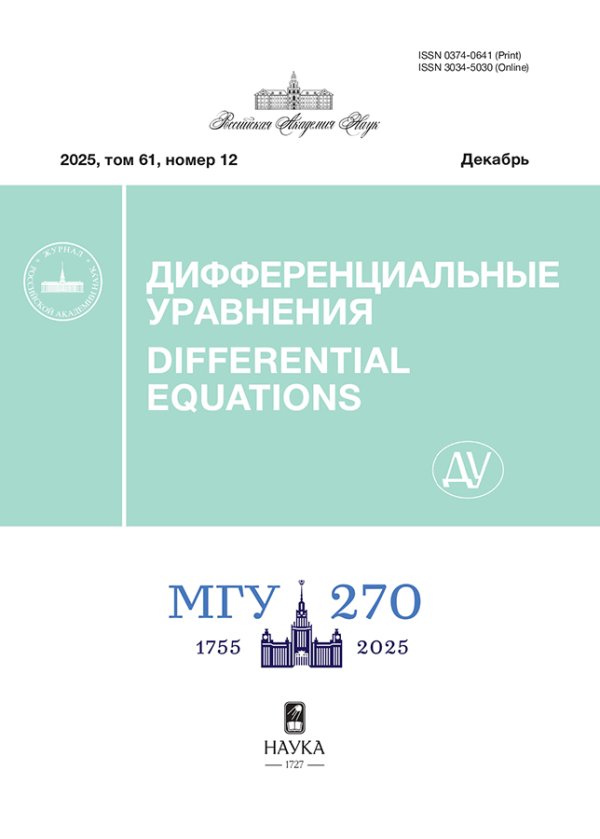
Differential Equations

The journal publishes articles and reviews, chronicles of scientific life, anniversary articles and obituaries.

The journal is aimed at mathematicians, scientists and engineers who use differential equations in their research, at teachers, graduate students and students of natural science and technical faculties of universities and universities.

The journal is peer-reviewed and is included in the List of the Higher Attestation Commission of Russia for publishing works of applicants for academic degrees, as well as in the RISC system.

The journal was founded in 1965.


ISSN (print)0374-0641

Media registration certificate№ 0110211 от 08.02.1993

Founder: Department of Informatics, Computer Science and Automation of the Russian Academy of Sciences, Russian Academy of Sciences (RAS)

Editor-in-Chief: Sadovnichii Victor Antonovich, Member of RAS, Doctor Phys.-Math.  Sciences, Rector of Lomonosov Moscow State University

Number of issues per year: 12

IndexationRISC, Higher Attestation Commission list, RISC core, RSCI, White list (1st level)

Edição corrente

Acesso aberto Acesso aberto  Acesso é fechado Acesso está concedido  Acesso é fechado Somente assinantes

Volume 61, Nº 12 (2025)

Capa

Edição completa

Acesso aberto Acesso aberto
Acesso é fechado Acesso está concedido
Acesso é fechado Somente assinantes

ORDINARY DIFFERENTIAL EQUATIONS

GREEN’S FUNCTION TO A STURM TYPE BOUNDARY VALUE PROBLEM FOR A FRACTIONAL ORDER DIFFERENTIAL EQUATION WITH DELAY
Mazhgikhova M.
Resumo
In this paper, a boundary value problem with generalized boundary conditions of the Sturm type is studied for a linear ordinary delay differential equation with the Dzhrbashyan–Nersesyan derivative of arbitrary order. The solution to the problem is written out in the terminology of the Green function. The existence and uniqueness theorem of the solution to the problem is formulated and proved.
Differential Equations. 2025;61(12):1587-1602
pages 1587-1602 views

PARTIAL DERIVATIVE EQUATIONS

SOLVABILITY OF A BOUNDARY VALUE PROBLEM FOR STATIONARY HEAT AND MASS TRANSFER EQUATIONS WITH VARIABLE COEFFICIENTS
Alekseev G., Soboleva O.
Resumo
A new boundary value problem for stationary heat and mass transfer equations with variable coefficients is considered. It is assumed that the leading coefficients of viscosity, thermal conductivity, and diffusion, as well as the buoyancy force included in the original equations, depend on the temperature and the concentration of the substance dissolved in the base medium. A mathematical framework is developed to study the mentioned boundary value problem based on a variational approach. Using the developed framework, the global existence of a weak solution to the boundary value problem under study is proved, and sufficient conditions on the problem data are established that ensure the local uniqueness of the weak solution with the additional smoothness property of the temperature and concentration.
Differential Equations. 2025;61(12):1603-1619
pages 1603-1619 views
ON MULTIDIMENSIONAL EXACT SOLUTIONS OF HYPERBOLIC EQUATION WITH MONGE–AMP`ERE OPERATOR
Kosov A., Semenov E.
Resumo
A reduction method using additive, multiplicative, and functional separation of variables is applied to a hyperbolic equation with the Monge–Ampère operator. Multidimensional exact solutions are obtained, explicitly expressed in terms of elementary and special functions and/or solutions of ordinary differential equations. Examples of exact solutions anisotropic with respect to spatial variables are given.
Differential Equations. 2025;61(12):1620-1632
pages 1620-1632 views
FUNDAMENTAL SOLUTION OF B-HYPERBOLIC EQUATION WITH WEAKLY NEGATIVE PARAMETERS
Lyakhov L., Bulatov Y.
Resumo
The B-hyperbolic operator □γ = ∂2/∂t2 − a2ΔBγ is considered, with the operator ΔBγ = ∑i=1 n Bγi , where Bγi are Bessel operators with parameters γi > −1. The definition of the δ−γ-Dirac distribution is introduced and the formula for the Bessel transform of the δ−γ-Dirac distribution is obtained. Three types of fundamental solutions of the B-hyperbolic operator are given. A solution to the inhomogeneous B-hyperbolic equation is given.
Differential Equations. 2025;61(12):1633-1647
pages 1633-1647 views

УРАВНЕНИЯ В КОНЕЧНЫХ РАЗНОСТЯХ

RELATION BETWEEN SELECTION CONCEPTS FOR SYSTEMS OF DIFFERENTIAL AND DIFFERENCE EQUATIONS ON THE STANDARD SIMPLEX
Kapitanov D., Kuzenkov O., Fomichev V.
Resumo
The conditions linking the strict selection property in continuous and discrete dynamic systems on a standard simplex are investigated. These conditions allow for the correct selection of the integration step without losing the strict selection property in the system. An attempt is made to link the concepts of selection for difference systems with the corresponding differential analog. It is shown that, when the solution of a difference system converges uniformly to the vertex of the simplex, the original differential systems also possess the selection property and are widely used in constructing mathematical models of various real-world processes.
Differential Equations. 2025;61(12):1648-1664
pages 1648-1664 views
ASYMPTOTICS OF THE SOLUTION OF DISCRETE LINEAR-QUADRATIC OPTIMAL CONTROL PROBLEMS WITH A SMALL STEP AND WEAK CONTROL IN THE CRITICAL CASE
Kurina G., Hoai N.
Resumo
An algorithm is proposed for constructing an asymptotic approximation to the solution of a discrete time weakly controlled linear-quadratic optimal control problem with a small step size in the critical case. The asymptotic expansion consists of a sum of a regular series and two boundary-layer series containing boundary functions in neighborhoods of two fixed end points. The construction of the asymptotic expansion is based on the decomposition of the state space into orthogonal sums of subspaces and the use of the corresponding orthogonal projectors. Explicit relations for determining the terms of the asymptotic expansion of any order are provided. An example illustrating the proposed method is presented.
Differential Equations. 2025;61(12):1665-1685
pages 1665-1685 views

CONTROL THEORY

STABILIZATION OF STATE FEEDBACK LINEARIZABLE DYNAMICAL SYSTEMS UNDER STATE CONSTRAINTS
Golubev A.
Resumo
The problem of stabilizing the origin is solved for dynamical systems written in a form that admits state feedback linearization, taking into account the magnitude constraints on the state variable values. Based on known results on the possibility of obtaining identical control laws when using the integrator backstepping and the state feedback linearization methods to design stabilizing feedbacks, sufficient conditions are proposed for the gain coefficients and roots of the characteristic polynomial of the closed-loop system that ensure fulfillment of the specified constraints. The derived conditions guaranteeing that the constraints hold are based on the results obtained using the integrator backstepping method combined with logarithmic barrier Lyapunov functions. As an example, a solution to the problem of a generalized coordinate regulation is considered for a mechanical system, whose dynamics with respect to the selected generalized variable can be represented as a chain of fourth-order integrators, taking into account the constraints on the values of the generalized coordinate, velocity, acceleration, and jerk.
Differential Equations. 2025;61(12):1686–1698
pages 1686–1698 views
SOLUTION OF THE CONTROL PROBLEM FOR A SINGULARLY PERTURBED DYNAMICAL SYSTEM WITH PARTIAL DERIVATIVES
Raetskaya E.
Resumo
A controllability criterion for a partial differential system with a small parameter at the second-order derivative was obtained. The equivalence of the obtained criterion to the Kalman criterion was proven. Control and state functions were constructed explicitly, and the solution to the limit problem was analytically determined. The problem of constructing a control that generates a boundary layer phenomenon near two boundaries of a rectangular domain of variable values was solved.
Differential Equations. 2025;61(12):1699–1718
pages 1699–1718 views

Articles

AVTORSKIY UKAZATEL' TOMA 61, 2025 g.
Differential Equations. 2025;61(12):1719–1728
pages 1719–1728 views

Согласие на обработку персональных данных с помощью сервиса «Яндекс.Метрика»

1. Я (далее – «Пользователь» или «Субъект персональных данных»), осуществляя использование сайта https://journals.rcsi.science/ (далее – «Сайт»), подтверждая свою полную дееспособность даю согласие на обработку персональных данных с использованием средств автоматизации Оператору - федеральному государственному бюджетному учреждению «Российский центр научной информации» (РЦНИ), далее – «Оператор», расположенному по адресу: 119991, г. Москва, Ленинский просп., д.32А, со следующими условиями.

2. Категории обрабатываемых данных: файлы «cookies» (куки-файлы). Файлы «cookie» – это небольшой текстовый файл, который веб-сервер может хранить в браузере Пользователя. Данные файлы веб-сервер загружает на устройство Пользователя при посещении им Сайта. При каждом следующем посещении Пользователем Сайта «cookie» файлы отправляются на Сайт Оператора. Данные файлы позволяют Сайту распознавать устройство Пользователя. Содержимое такого файла может как относиться, так и не относиться к персональным данным, в зависимости от того, содержит ли такой файл персональные данные или содержит обезличенные технические данные.

3. Цель обработки персональных данных: анализ пользовательской активности с помощью сервиса «Яндекс.Метрика».

4. Категории субъектов персональных данных: все Пользователи Сайта, которые дали согласие на обработку файлов «cookie».

5. Способы обработки: сбор, запись, систематизация, накопление, хранение, уточнение (обновление, изменение), извлечение, использование, передача (доступ, предоставление), блокирование, удаление, уничтожение персональных данных.

6. Срок обработки и хранения: до получения от Субъекта персональных данных требования о прекращении обработки/отзыва согласия.

7. Способ отзыва: заявление об отзыве в письменном виде путём его направления на адрес электронной почты Оператора: info@rcsi.science или путем письменного обращения по юридическому адресу: 119991, г. Москва, Ленинский просп., д.32А

8. Субъект персональных данных вправе запретить своему оборудованию прием этих данных или ограничить прием этих данных. При отказе от получения таких данных или при ограничении приема данных некоторые функции Сайта могут работать некорректно. Субъект персональных данных обязуется сам настроить свое оборудование таким способом, чтобы оно обеспечивало адекватный его желаниям режим работы и уровень защиты данных файлов «cookie», Оператор не предоставляет технологических и правовых консультаций на темы подобного характера.

9. Порядок уничтожения персональных данных при достижении цели их обработки или при наступлении иных законных оснований определяется Оператором в соответствии с законодательством Российской Федерации.

10. Я согласен/согласна квалифицировать в качестве своей простой электронной подписи под настоящим Согласием и под Политикой обработки персональных данных выполнение мною следующего действия на сайте: https://journals.rcsi.science/ нажатие мною на интерфейсе с текстом: «Сайт использует сервис «Яндекс.Метрика» (который использует файлы «cookie») на элемент с текстом «Принять и продолжить».