





 Enviar artigo por via de e-mail
 Students Readiness to Design Their Own Educational Trajectory at the University
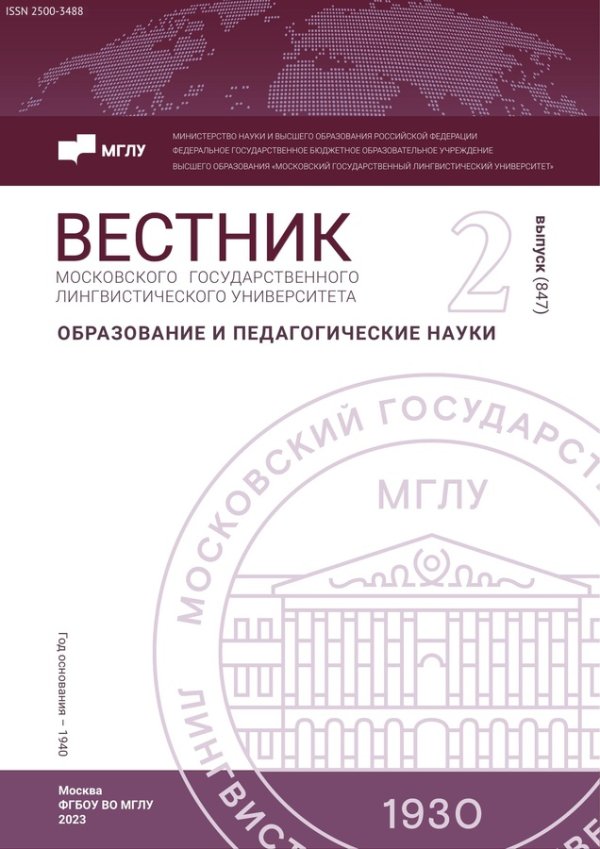
- Autores: Evdokimova M.G.1, Baydikova N.L.1, Davidenko E.S.1
-
Afiliações:
- National Research University of Electronic Technology (MIET), Moscow
- Edição: Nº 2 (847) (2023)
- Páginas: 40-46
- Seção: Pedagogical Studies
- URL: https://ogarev-online.ru/2500-3488/article/view/348342
- ID: 348342
Citar

Resumo
The article is devoted to the study of students’ readiness to consciously choose the elements of their individual curriculum, and educational trajectory. The authors present the results of a survey of undergraduate students of the Institute of Linguistic and Pedagogical Education (LPE) of the National Research University (MIET), conducted in order to determine whether students are ready to act as autonomous co-authors of their own educational trajectories and curricula. The analysis of the results shows that not all students cope with the performance of these functions, and there is a need for systemic formation of students’ ability to make conscious choice of the target, content, and technological aspects of their education.
Sobre autores
Mary Evdokimova
National Research University of Electronic Technology (MIET), Moscow
Autor responsável pela correspondência
Email: me49@mail.ru
Doctor of Pedagogy (Dr. habil), Associate Professor, Director of Institute of Linguistic and Pedagogical Education, National Research University of Electronic Technology (MIET)
RússiaNatalia Baydikova
National Research University of Electronic Technology (MIET), Moscow
Email: nataleon22@list.ru
PhD (Pedagogy), Associate Professor, Institute of Linguistic and Pedagogical Education, National Research University of Electronic Technology (MIET)
RússiaElena Davidenko
National Research University of Electronic Technology (MIET), Moscow
Email: des_kr@mail.ru
PhD (Pedagogy), Associate Professor, Institute of Linguistic and Pedagogical Education, National Research University of Electronic Technology (MIET)
RússiaBibliografia
- Iansiti M. Real world R&D: Jumping the product generation gap // Harvard Business Review. 1993. May-June. P. 138–147. URL: https://hbr.org/1993/05/real-world-rd-jumping-the-product-generation-gap
- Succeeding through service innovation: A service perspective for education, research, business and government. University of Cambridge Institute for Manufacturing (IfM) and International Business Machines Corporation (IBM). 2008. URL: https://www.ifm.eng.cam.ac.uk/uploads/Resources/080428cambridge_ssme_whitepaper.pdf
- Ramping for Campus T-Vitality and T-Success. T-ACADEMY. Michigan State University, 2018. URL: https://tsummit.org/t/
- Mulder F. Mass-individualization of higher education facilitated by the use of ICT // Conference DeLFI & GMW. Germany, Rostock. 2005. https://www.researchgate.net/publication/221273258_Mass-individualization_of_higher_education_facilitated_by_the_use_of_ICT
- Cullen R., Harris M., Hill R. Learner-Centered Curriculum: Design and Implementation. Hoboken, NJ: John Wiley & Sons, 2012.
- Brooman S., Darwent S., Pimor A. The student voice in higher education curriculum design: is there value in listening? // Innovations in Education and Teaching International. 2015. Vol. 52. №6. P. 663–674. doi: 10.1080/14703297.2014.910128.
Arquivos suplementares

