

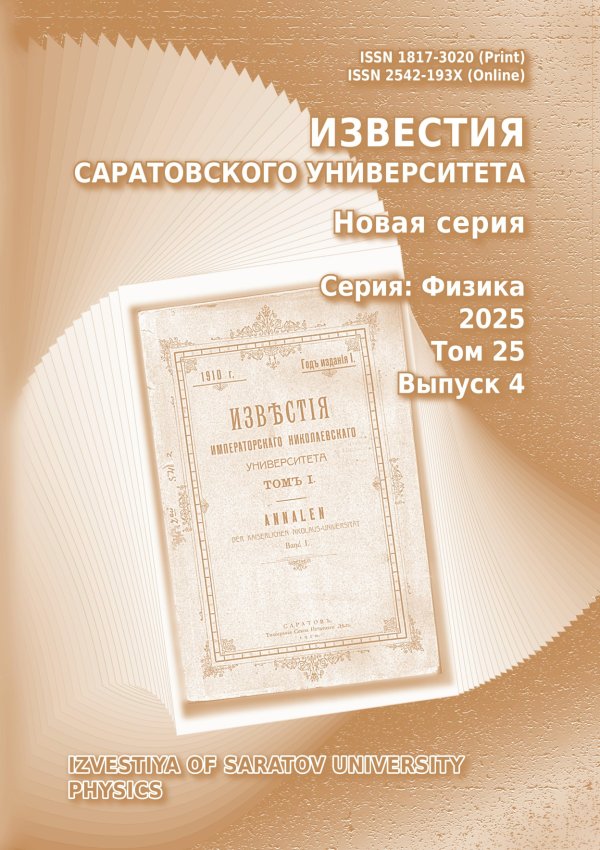
Izvestiya of Saratov University. Physics

ISSN (print): 1817-3020, ISSN (online): 2542-193X

Founder: Saratov State University

Editor-in-Chief: Koronovsky Alexey Alexandrovich, Doctor of Physics and Mathematics. sciences, professor

Frequency / Access: 4 issues per year / Open

Included in: White List (4th level), Higher Attestation Commission List, RISC, Scopus

Registration PI № FS77-76653 of 26 August, 2019.

The electronic version of the journal is open access.

The journal subscription index is 36015. The subscription is available in online catalogue Ural-Press Group of  Companies (ural-press.ru). The price is not fixed.

 All journal articles are published under a licence Creative Commons Attribution 4.0 International (CC BY 4.0)

History of the journal

The journal "Izvestiya of Saratov University. New series" (ISSN 1814-733Х) was published since 2001. Its predecessors were the journals "Izvestiya of Saratov University" (1910-1918) and "Scientific notes of Saratov State University" (1923-1962). In 2005  the journal "Izvestiya of Saratov University. New series"  launched  a separate series "Izvestia of Saratov University.  New series. SeriesPhysics", in 2021 the title changed for "Izvestia of Saratov University. Physics" (ISSN 1817-3020 print, ISSN 2542-193X online).

The journal is intended for readers involved in the field of physics and engineering education, physical science research workers, University professors, undergraduate and graduate students and organizers of production.

The purpose and objectives of the journal

The purpose of the journal is to reflect modern ideas about the physical picture of the world, contributing to the development of educational and research activities in the field of physics and its applications.

The objectives of the journal are:

  • publication of original scientific papers in various areas of physical science and its applications (including nanotechnology and other critical technologies) in accordance with the content of passports of specialties of scientists in theoretical physics, radiophysics, physical electronics, solid state electronics, optics, laser physics, biophysics;
  • publication of scientific and methodological materials that contribute to the improvement of the educational process in the physical and engineering-physical areas of training;
  • publication of scientific reviews on priority areas of science and high technologies;
  • publication of historical information about Saratov University, its mission in the field of physical education and physical science.

Articles should be prepared according to the rules of the journal.

The languages of publications are Russian and English.

Publications are free of charge.

Ағымдағы шығарылым

Том 25, № 4 (2025)

Мұқаба

Бүкіл шығарылым

Theoretical and Mathematical Physics

On the properties of stationary configurations of a rotating self-gravitating ideal fluid with a vortex gravitational field
Krechet V., Oshurko V., Kisser A.
Аннотация
Background and Objectives: Within the framework of Einstein’s general-relativistic theory of gravity, that is, the general theory of relativity (GR), the properties of stationary distributions of a self-gravitating rotating continuous medium in the form of an ideal liquid with a barotropic equation of state p = wε are considered. Here, w = const, p is the pressure, and ε is the energy density of an ideal liquid. Materials and Methods: A stationary space-time compatible with a self-gravitating rotating continuous medium is described by a stationary cylindrical metric ds2 = A(x)dx2 + B(x)dφ2 + C(x)dz2 + 2E(x)dtdφ – D(x)dt2 , 0 ≤ φ ≤ 2π, where the metric coefficients A, B, C, D, E are functions of the radial coordinate x. This metric corresponds to a rotating space-time in which there is a vortex gravitational field. The latter is determined by means of the angular velocity ω of the field of tetrads ei(a) (xk), which are tangent to the considered Riemannian space. Here, the indices i, k are the world indices corresponding to the coordinates of the Riemannian space (base), and the index (a) is a local Lorentz index. For a vortex gravitational field, in contrast to a total gravitational field, it is possible to determine an energy-momentum tensor Tik(ω) satisfying the local conservation law ∇iTik(ω) = 0 relative to the metric of the corresponding static space in which ω = 0 (in the case under consideration, at a coefficient of E = 0). The tensor Tik(ω) has very exotic properties. For example, a weak energy condition is violated in it, since a p(ω) + ε(ω) < 0. For ordinary matter p + ε > 0. This property Tik(ω) contributes to the formation of wormholes in space-time. To study the properties of the considered configuration of a self-gravitating rotating ideal fluid and a vortex gravitational field, the corresponding Einstein gravitational equations are solved. Results: Solutions of Einstein’s gravitational equations in stationary space-time have been obtained with the metric presented above, that is, with a vortex gravitational field and with wormholes in the presence of a self-gravitating rotating ideal fluid with a limiting equation of state p = ε. At the same time, the obtained solutions describe the geometry of space-time of the so-called traversable wormholes, inside which gravitational forces Fg have a finite magnitude. A solution with a passable wormhole, in which Fg = 0,that is, without gravitational force, has also been obtained. In addition, solutions of Einstein’s vacuum equations Rik = 0 in space-time with the metric presented above have been obtained, that is, in the absence of a rotating continuous medium in the presence of only vortex gravitational field. The resulting solution describes the geometry of the wormhole space-time. Conclusion: Since the above-mentioned solution of gravitational equations with a wormhole is a solution to vacuum equations, that is, for empty space without matter, it is possible to suggest the presence of wormholes in outer space that exist a priori and also exist near the Earth.
Izvestiya of Saratov University. Physics. 2025;25(4):396-407
pages 396-407 views

Radiophysics, Electronics, Acoustics

On peculiarities of application of the auxiliary system approach for the generalized chaotic synchronization regime detection
Gubenko P., Koronovskii A., Moskalenko O.
Аннотация
Background and Objectives: In this paper we consider the peculiarity that arises during the generalized chaotic synchronization regime detection in systems with a complex attractor topology having internal symmetry. Materials and Methods: As the system under study we consider two modified Guckenheimer – Holmes discrete maps coupled unidirectionally. To detect the presence of generalized synchronization we calculate the spectrum of Lyapunov exponents and propose the modification of auxiliary system approach. Results: Considering that the symmetry in the dynamics of the autonomous response system can lead to multistability due to the drive system signal, the correct detection of generalized synchronization with the help of the auxiliary system approach may be complicated. Modification of the generalized synchronization criterion, which allows increasing the reliability of the method in such cases, has been proposed. Conclusion: The results obtained with the help of modified auxiliary system approach are in a good agreement with the calculation of Lyapunov exponents.
Izvestiya of Saratov University. Physics. 2025;25(4):408-413
pages 408-413 views
Development of a prototype of flexible antennas with a passivation layer for electrical impedance sensors
Serdobintsev A., Kozhevnikov I., Ryabov E., Gusliakova O., Prikhozhdenko E.
Аннотация
Background and Objectives: The need for flexible electronics for biomedical and communications applications has completely transformed the field of antenna design and has given rise to the development of flexible antennas. The materials used to create antennas are diverse, but there remains a need to define a design that provides both durability and high performance. Materials and Methods: The test samples were flexible polyimide substrates 500 μm thick, on which layers of Cu and Ti or Ni were formed by vacuum magnetron sputtering. A Robvac VSM300 vacuum setup equipped with three magnetron sources with 50 mm diameter disk targets was used for this purpose. The Cu layer thickness on all samples was 1 μm. The thickness of the Ti and Ni layers was 100 nm. Demetallization was performed using a pulsed laser of a Minimarker 2 setup. The main characteristics of the laser: the wavelength of laser radiation is 1064 μm, the maximum laser pulse energy is 1 mJ, the software and hardware resolutions are 2.5 μm, the scanning device is a 2-axis galvanoscanner. The parameters of the laser demetallization mode were as follows: power 2.6 W, beam speed 1000 mm/s, pulse frequency 99 kHz, pulse duration 8 ns. The demetallization template, which is a flexible loop antenna with the geometry optimized for resonance in the 3.75 GHz range. Two versions of the antenna were manufactured with the conductor line width d equal to 1 mm and 3 mm. Results: It has been found that an additional layer of metal on the surface of the Cu thin-film coating of flexible polyimide substrates improves the quality of demetallization. Without it, areas with defects in the form of an unremoved Cu film short-circuiting individual antenna elements are observed. On samples with an additional passivation metal layer, demetallization occurs exactly according to the template without defects. It has also been found that significantly fewer drops of molten metal remain on samples with a passivation Ni layer. The results of experiments with ready-made antennas have demonstrated a significant sensitivity of the resonance frequency to bending in the range of angles from −60º to +60º, which opens up the possibility of using such antennas as microdisplacement sensors. At the same time, the developed antenna prototypes have a reflection coefficient less than −17 dB in the bending angle range from −100º to +100º. Conclusion: The work has assessed the influence of an additional layer of passivating metal on the quality of laser demetallization (ablation) of a Cu thin-film coating of flexible polyimide substrates. The experimental results obtained allow us to count on the applicability of the developed antennas as micro-displacement sensors. At the same time, the low reflection coefficient of flexible antennas in a wide range of bending angles allows them to be used as the basis of electroimpedance sensors. 
Izvestiya of Saratov University. Physics. 2025;25(4):414-424
pages 414-424 views

Optics and Spectroscopy. Laser Physics

Hydrogen bonding in saturated acids triglyceride monohydrates: MD and DFT modeling
Berezin K., Stepanovich E., Dvoretsky K., Antonova E., Likhter A., Yanina I.
Аннотация
Background and Objectives: Triglycerides, as the primary components of fats and oils, play a crucial role in various scientific and industrial fields, including food production, energy, and pharmaceuticals. Their interaction with water molecules is particularly significant, yet many aspects of these interactions remain poorly understood. This study aims to investigate hydrogen bonding in monohydrates of saturated fatty acid triglycerides using molecular dynamics (MD) and density functional theory (DFT) simulations. The objectives include determining the thermodynamic parameters of association, analyzing the influence of hydrocarbon chain length on hydration, and identifying the most stable hydration configurations. Materials and Methods: The study employed classical molecular dynamics (GROMACS) with the AMBER-03 force field and DFT calculations (B3LYP/6-31+G(d) and wB97XD/6-311+G(d,p)) to model hydrogen bonds in monohydrates of triglycerides ranging from triacetin to tristearin (chain lengths of 0 to 16 methylene groups). The MD simulations involved a 4×4×4 nm periodic boundary cell with a triglyceride molecule surrounded by water, run for 500 ps at 300 K and 1 bar. Hydrogen bonds were identified using geometric criteria (distance ≤ 3.5 Å, angle ≤ 30°). DFT calculations optimized molecular structures and calculated thermodynamic parameters, including association energies, enthalpies, and equilibrium constants. Results: The results have revealed that carbonyl groups of the central ester chain are the primary sites for hydrogen bond formation. Monohydrates involving the central chain (Type 1) have exhibited a greater stability than those involving side chains (Type 2). The association energy for Type 1 monohydrates has saturated starting from tricaprylin (chain length of 6). A linear relationship has been observed between the thermodynamic parameter TΔS and the equilibrium constant Kα for Type 1 monohydrates, attributed to the loss of conformational entropy upon hydration. Non-classical hydrogen bonds (C-H···O) have also contributed to the stability of monohydrates, influencing their spatial structure. The study has found that hydration of longer chains requires higher energy to overcome entropy losses. Conclusion: The study has demonstrated that the central carbonyl group of triglycerides is the primary hydration site, with Type 1 monohydrates being more stable than Type 2. The association energy and enthalpy reach saturation for chains longer than tricaprylin, while linear dependencies of TΔS and Kα on chain length highlight the role of conformational entropy in hydration. These findings enhance the understanding of triglyceridewater interactions, providing insights relevant to food science, pharmaceuticals, and the development of lipid-based delivery systems. The combined use of MD and DFT has proved effective for analyzing these complex molecular interactions.
Izvestiya of Saratov University. Physics. 2025;25(4):425-437
pages 425-437 views
Design of a terahertz radiation modulator based on the effect of multi-wave interfence in a layered structure consisting of a large number of liquid crystal π-cells
Mulamahawsh A., Simonenko G.
Аннотация
Background and Objectives: An original design of a liquid crystal THz radiation modulator is proposed based on computer modeling. It consists of a stack of identical “classical” π--cells located one after another. Materials and Methods: Based on a computer model and by using the matrix method, the characteristics of the proposed device are studied: dependence of the device transmission on the control voltage, contrast ratio, and the modulator transmission value when the maximum control voltage is applied to it. Results: It has been shown that the modulator contrast ratio decreases with increasing wavelength of the modulated radiation, and the modulator transmission in the state with the maximum value of the control voltage does not exhibit such a dependence. It has been found that the decimal logarithm of the modulator contrast ratio linearly depends on the number of elementary π-cells included in its design. The slope coefficient of this linear function decreases with increasing wavelength of the modulated radiation. It has been shown that the described design of the THz radiation LC modulator is critical to the technological spread in the thickness of the elementary LC cell. However, the magnitude of this spread fits into the simple technology of manufacturing elementary π-cells and does not require improvement.
Izvestiya of Saratov University. Physics. 2025;25(4):438-448
pages 438-448 views

Biophysics and Medical Physics

Comparison of coarse-grained and all-atom “membrane-solvent” systems as models of memcapacitors under alternating electric field
Zlochevskiy I., Zav’yalov D.
Аннотация
Background and Objectives: The lipid membrane is one of the most important structures of a living cell, representing a barrier with selective permeability. Many biological processes are associated with changes in the concentration of positive and negative ions inside and outsidethe cell. Inthis regard, themembrane ismore widely represented as an electric capacitor. Inmodern studies onthe effect of an alternating field on biomolecular lipids, the existence of a nonlinear capacitance-voltage dependence is also mentioned, which makes the lipid membrane a promising candidate for the role of amemcapacitor. Since the use of practicalmembranemodels is associated with their instability, themolecular dynamics method has become widespread. A similar memory effect was obtained in studies using a coarse-grained model. On all-atom systems, this effect is poorly represented in the literature. The all-atom model more fully describes the interaction of particles, so it would be relevant to compare the coarse-grained and all-atomic membrane-solvent system as models of a memcapacitor under the influence of an alternating electric field. Materials and Methods: The studied system consisted of a lipid membrane immersed in an aqueous KCl solution. Two quantitatively similar systems consisted of 512 lipid molecules, such as dipalmitoylphosphatidylcholine (1,2-Dipalmitoyl-sn-Glycero-3-Phosphocholine), two water compartments of 40 Å and 3 M salt. Two types of force fields were used in the work, a all-atom charmm36m, as well as coarse-grained force fields martni22p and a modified force field – v2.2refPOL+refION. An alternating electric field with a strength of 0.5, 1.0 and 1.5 V/nm with a frequency of 1 GHz was applied to the systems. Molecular dynamics simulations were performed using GROMACS. Results: Under the action of the field, each system has behaved as a “classical” capacitor, where oppositely charged particles have been accumulated on opposite sides of the membrane. The nature of the ion distribution is also similar for the studied systems, positive particles are able to penetrate into the membrane, located inside the hydrophilic structures, and the charge peaks of negative particles are outside the membrane. A significant difference between the all-atom and coarse-grained models is the numerical value of the accumulated charge. Based on the results obtained, we can also talk about the nonlinear dependence of the total charge value in relation to the field strength value and the existence of the hysteresis effect. Conclusion: In this regard, the presented systems can be used to study the memcapacitive properties. 
Izvestiya of Saratov University. Physics. 2025;25(4):449-459
pages 449-459 views
Thermal imaging of microhemodynamics and integrated mapping of sweat gland activity as a method for diagnosing autonomic neuropathy
Sagaidachnyi A., Antonov A., Zaletov I., Mayskov D., Fomin A., Potakhin S., Skripal A.
Аннотация
Background and Objectives: Dynamic infrared thermography is a promising method for imaging physiological processes, including not only microhemodynamics but also the activity of eccrine sweat glands. Impaired sweat gland activity in the examined areas may primarily indicate damage to cholinergic nerve fibers. This study aims to develop and apply a novel approach for analysing dynamic thermograms, which is based on the separation of the original temperature signal into two independent components–vasomotor (microhemodynamics) and sudomotor (sweat gland activity)–for the detection of neuropathy in patients with type 2 diabetes mellitus. Materials and Methods: Dynamic thermograms were recorded using a cooled camera with a temperature sensitivity of 0.02°C during a breathing test, which involved three sharp inhalations performed at 2-minute intervals. Thermograms were obtained from 11 healthy subjects and 11 patients with type 2 diabetes mellitus; the mean age of the participants was 58 ± 7 years. Thermogram pixels were classified into two categories: in the first category, temperature dynamics were influenced solely by microhemodynamics, while in the second category, they were influenced by the combined effect of microhemodynamics and sweat gland activity. To classify thermogram points, the values of the modulus of the derivative of temperature fluctuations with a threshold above 0.03°C/s were used. Visualization of regions with active sweat glands was achieved by integrating the information obtained over the entire duration of the experiment. Results: The use of the obtained integrated maps has made it possible to determine the relative area occupied by active sweat glands in the group of patients with type 2 diabetes mellitus (5.25%) and in the group of healthy subjects (22.25%). The results indicate a statistically significant decrease in the area of active sweat glands in the group of patients with diabetes mellitus compared to the control group. This finding may be a sign of impaired cholinergic sympathetic innervation and the presence of diabetic neuropathy in the upper limbs. Conclusions: The integrated map of functioning sweat glands enables a clinician to identify the body surface area with impaired autonomic function in the limbs, particularly for assessing the severity of peripheral neuropathy in patients with type 2 diabetes mellitus.
Izvestiya of Saratov University. Physics. 2025;25(4):460-473
pages 460-473 views
Estimation of the stationarity time of infra-slow oscillations of brain potentials using electroencephalogram signals
Borovkova E., Vasilieva D., Karavaev A., Ishbulatov Y., Ponomarenko V., Bezruchko B., Prokhorov M.
Аннотация
Background and Objectives: Infra-slow oscillations of brain potentials with a frequency of less than 0.5 Hz, reflect the activity of the autonomic regulation centers and are markers of the psychophysiological state of a person. Such oscillations are characterized by non-stationary dynamics, which complicates their experimental study. Materials and Methods: We have proposed a method for estimating the characteristic time of stationarity of infra-slow oscillations of brain potentials based on the analysis of experimental time series of electroencephalograms. The method includes the stages of dividing the time series into segments, constructing approximating polynomials for each segment, calculating the matrix of Euclidean distances between the coefficients of the polynomials, clustering the segments to determine areas of quasi-stationary dynamics, and analyzing the durations of the combined segments to obtain statistical characteristics. The proposed method can be used to estimate the stationarity time of other electroencephalograms rhythms, as well as the frequency components of the sequence of RR-interval. The method was used to analyze electroencephalograms signals and RR-intervals of 50 healthy volunteers at rest. Results: It has been shown that oscillations in different frequency ranges of the studied signals have different durations of quasi-stationary behavior. In the frequency ranges of 0.05–0.15 Hz and 0.15–0.50 Hz, reflecting the activity of the sympathetic and parasympathetic branches of regulation, respectively, the stationarity time of infra-slow oscillations in electroencephalograms signals was 30 s and 36 s, respectively. Conclusion: The durations of quasi-stationary sections of infra-slow oscillations in electroencephalograms correspond well to the durations of sections of quasi-stationary dynamics of the sequence of RR-interval in the frequency ranges associated with the processes of sympathetic and parasympathetic regulation of the heart rhythm. 
Izvestiya of Saratov University. Physics. 2025;25(4):474-484
pages 474-484 views

Nanotechnologies, Nanomaterials and Metamaterials

Sensor properties of thin films of perforated graphene functionalized with COOH groups: DFTB study
Barkov P., Slepchenkov M., Glukhova O.
Аннотация
Background and Objectives: Currently, perforated graphene is one of the most discussed representatives of porous 2D nanomaterials from the standpoint of their promising properties and prospects for application in nanoelectronics and nanosensors. In this paper, we consider perforated graphene films with almost round holes with a diameter of 1.2 nm, functionalized with carboxyl (COOH) groups. The aim of the work was to study the chemoresistive response of such films to NO2 gas molecules, which is one of the air pollutants. Materials and Methods: To conduct the study, we used the quantum density functional method in the tight-binding approximation with self-consistent charge calculation. Calculations of the chemoresistive response were carried out in the presence of water molecules on the surface of the functionalized perforated graphene film at a temperature of 300 K. Results: It has been found that the film response value is 87–93% depending on the number of NO2 molecules adsorbed on the surface of the perforated graphene (from 1 to 6). The high chemoresistive sensitivity of the studied films is explained by a sharp decrease in its resistance (by an order of magnitude) when NO2 molecules are deposited. The observed decrease in resistance is explained from the standpoint of changes in the electronic structure of the film and the laws of quantum electron transport in it. Conclusion: The results obtained indicate promising prospects for the use of functionalized perforated graphene films in a gas sensor for detecting pollutants in the air.
Izvestiya of Saratov University. Physics. 2025;25(4):485-494
pages 485-494 views
Investigation of the conductive properties of composite polymer materials based on polyvinylpyrrolidone doped with single and double-walled nanotubes
Elbakyan L., Zaporotskova I.
Аннотация
Background and Objectives: Today, conductive polymers are one of the most dynamically developing fields of materials science, combining chemistry, physics and nanotechnology. Conductive polymers are particularly in demand in the fields of flexible electronics, energy, and biomedicine. In this regard, there has been a sharp increase in interest in polymer nanocomposites based on carbon nanotubes due to their unique combination of properties unattainable by traditional polymers. The new materials will be able to combine high conductivity with lightness and biocompatibility. This will create new opportunities for innovative technologies. In this work, the well-known polymer polyvinylpyrrolidone and carbon nanotubes are selected as the main objects. A theoretical study has been conducted on the possibility of creating the stable complex “Polymer – Carbon nanotubes”. Materials and Methods: In this paper, the quantum chemical method of density functional theory is used to study the structural features, interaction mechanisms, and electron-energy structure of a polyvinylpyrrolidone-based nanocomposite doped with carbon nanotubes. A hybrid approximation method, namely the B3LYP method, was chosen to study the system. The calculations were performed using a valence-split 3-21G type basic set. Results: The effect of CNT layering on the adsorption interaction of a complex consisting of a fragment of a polyvinylpyrrolidone polymer and a molecular cluster of a carbon nanotube has been studied. For this purpose, single- and double-walled carbon nanotubes were used. The analysis of maps of electrostatic potentials and charge distributions in the considered systems has made it possible to explain the mechanism of interaction between the components of polymer composites for the selected polymer and nanotubes. Next, the electron-energy structure of the obtained polymer nanocomposites has been analyzed. Based on the data obtained, a conclusion has been made about the conductive properties of the resulting complex. Conclusion: The results obtained demonstrate the prospects of using carbon nanotubes for targeted modification of the electrophysical properties of polymer matrices and the creation of functional nanocomposite materials with specified conductive characteristics. 
Izvestiya of Saratov University. Physics. 2025;25(4):495-504
pages 495-504 views

From the History of Physics

Academician Lev P. Pitaevskii: Saratov years of life, family aura
Churochkina S., Churochkin D., Anikin V.
Аннотация
Background and Objectives: The article covers the Saratov period in the life of Academician of the Russian Academy of Sciences Lev P. Pitaevskii (1933–2022) in the context of the genealogical line of several generations of Pitaevskiis from the beginning of the 19th century, when L. P. Pitaevskii’s great-great-grandfather Trofim Efimovich bore the surname Pitaev. Detailed biographical information is provided about the academician’s close relatives: Petr I. Pitaevskii, father, Anna S. Feigelson, mother, Lubov’ L. Lukashinskaya, wife. All of them received higher education at Saratov State University. The article provides original materials about L. P. Pitaevskii’s school years and his studies at the Physics Department of Saratov University. Materials and Methods: When writing this article, data from the State Archive of the Russian Federation, the Russian State Archives of Socio-Political History, the State Archive of the Saratov Region, the State Archive of the Modern History of the Saratov Region, the Archive of the Saratov State University, as well as the recollections of people who knew L. P. Pitaevskii closely were used. Conclusion: The high intellectual level of the family in which the future academician was born and raised, his early, clearly expressed desire for scientific creativity have been observed. The political and social peculiarities of the country in the 20th century have been reflected in the biographies of the Pitaevskii’s.
Izvestiya of Saratov University. Physics. 2025;25(4):505-518
pages 505-518 views

Personalia

In memory of Professor Nikolay Ivanovich Sinitsyn (June 1, 1937 – November 2, 2025)
Editorial T.
Аннотация

-

Izvestiya of Saratov University. Physics. 2025;25(4):519-521
pages 519-521 views
In memory of Professor Raouf Zagidovich Bakhtizin (January 20, 1943 – September 10, 2025)
Editorial T.
Аннотация

-

Izvestiya of Saratov University. Physics. 2025;25(4):522-523
pages 522-523 views

Согласие на обработку персональных данных с помощью сервиса «Яндекс.Метрика»

1. Я (далее – «Пользователь» или «Субъект персональных данных»), осуществляя использование сайта https://journals.rcsi.science/ (далее – «Сайт»), подтверждая свою полную дееспособность даю согласие на обработку персональных данных с использованием средств автоматизации Оператору - федеральному государственному бюджетному учреждению «Российский центр научной информации» (РЦНИ), далее – «Оператор», расположенному по адресу: 119991, г. Москва, Ленинский просп., д.32А, со следующими условиями.

2. Категории обрабатываемых данных: файлы «cookies» (куки-файлы). Файлы «cookie» – это небольшой текстовый файл, который веб-сервер может хранить в браузере Пользователя. Данные файлы веб-сервер загружает на устройство Пользователя при посещении им Сайта. При каждом следующем посещении Пользователем Сайта «cookie» файлы отправляются на Сайт Оператора. Данные файлы позволяют Сайту распознавать устройство Пользователя. Содержимое такого файла может как относиться, так и не относиться к персональным данным, в зависимости от того, содержит ли такой файл персональные данные или содержит обезличенные технические данные.

3. Цель обработки персональных данных: анализ пользовательской активности с помощью сервиса «Яндекс.Метрика».

4. Категории субъектов персональных данных: все Пользователи Сайта, которые дали согласие на обработку файлов «cookie».

5. Способы обработки: сбор, запись, систематизация, накопление, хранение, уточнение (обновление, изменение), извлечение, использование, передача (доступ, предоставление), блокирование, удаление, уничтожение персональных данных.

6. Срок обработки и хранения: до получения от Субъекта персональных данных требования о прекращении обработки/отзыва согласия.

7. Способ отзыва: заявление об отзыве в письменном виде путём его направления на адрес электронной почты Оператора: info@rcsi.science или путем письменного обращения по юридическому адресу: 119991, г. Москва, Ленинский просп., д.32А

8. Субъект персональных данных вправе запретить своему оборудованию прием этих данных или ограничить прием этих данных. При отказе от получения таких данных или при ограничении приема данных некоторые функции Сайта могут работать некорректно. Субъект персональных данных обязуется сам настроить свое оборудование таким способом, чтобы оно обеспечивало адекватный его желаниям режим работы и уровень защиты данных файлов «cookie», Оператор не предоставляет технологических и правовых консультаций на темы подобного характера.

9. Порядок уничтожения персональных данных при достижении цели их обработки или при наступлении иных законных оснований определяется Оператором в соответствии с законодательством Российской Федерации.

10. Я согласен/согласна квалифицировать в качестве своей простой электронной подписи под настоящим Согласием и под Политикой обработки персональных данных выполнение мною следующего действия на сайте: https://journals.rcsi.science/ нажатие мною на интерфейсе с текстом: «Сайт использует сервис «Яндекс.Метрика» (который использует файлы «cookie») на элемент с текстом «Принять и продолжить».