
Izvestiya of Saratov University. New series. Series: Chemistry. Biology. Ecology

ISSN (print): 1816-9775, ISSN (online):  2541-8971

Founder: Saratov State University

Editor-in-Chief: Goryacheva Irina Yurievna, Doctor of Chemistry. sciences, professor

Frequency / Access: 4 issues per year / Open

Included in: Higher Attestation Commission List, RISC

The certificate of registration of mass media: PI № FS77-76649 of 26 August, 2019.

The journal subscription index is 36013. The subscription is available in online catalogue Ural-Press Group of  Companies (ural-press.ru). The price is not fixed.

Aims @ Scope. The main aim of the journal is reflection of modern trends in the complex development of chemistry, ecology and biology, their interpenetration and joint development. The journal publishes the results of original research, short messages on current topics, reviews and mini reviews

The objectives of the journal:

familiarization of the Russian and international scientific community with priority fundamental works, as well as works of a practical orientation;
presentation of methodological and practical works in modern breakthrough areas of research;
creation of an information environment for the development of innovative areas of science, a platform for testing the results of young scientists and scientific schools.
The Journal is intended for researchers, teachers and postgraduate students.


Topics of the journal:

chemistry, including analytical, organic, physical chemistry;
physico-chemical biology, including biophysics (biological sciences);
general biology, including botany, zoology, entomology, ecology (biological sciences).


Languages of publications - Russian, English.

Previously published materials and materials submitted for publication in other journals will not be accepted.

Articles should be in agreement with Notes for Authors of the journal.

The manuscripts received by the editorial office are reviewed (see Manuscripts Review Procedure), then the editorial board takes the decision on the publication of the article in the journal.

Ағымдағы шығарылым

Том 25, № 3 (2025)
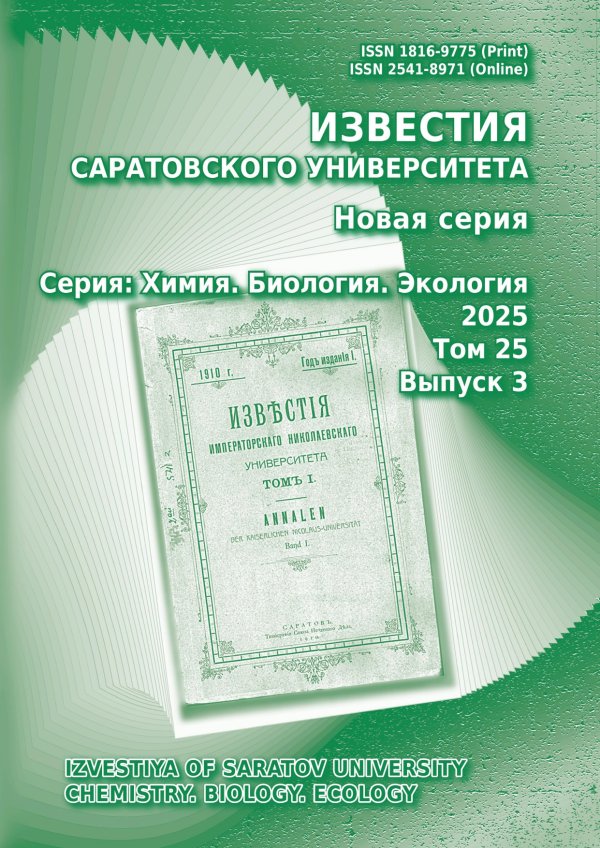
Мұқаба

Бүкіл шығарылым

Chemistry

Article Establishment of the structure of hydrate-solvate complexes of iodine extracted from model aqueous solutions in the system I2 – NaCl – Н2О – tributylphosphate /isooctane
ponomareva p., Peshkov S.
Аннотация
The equilibrium parameters of the extraction of iodine from aqueous model solutions of various compositions have been determined and the infl uence of the background mineralization of the raffi nate has been revealed. The eff ect of the isooctane/tributylphosphate (TBP) ratio on the extraction of iodine from aqueous solutions with diff erent ionic strengths has been determined by the isomolar series method. The hypothetical composition of hydrate-solvate complexes has been established both experimentally and using computer modeling tools. For quantum chemical calculations, optimization of the geometric parameters of the constructed structures has been carried out within the framework of the density functional theory (DFT) method, with the exchange-correlation functional B3LYP, with the LANL2DZ basis. A synergistic eff ect has been revealed in the system iodine – isooctane – TBP – water, which is achieved through the interaction of iodine with TBP through a mixed mechanism: solvate and hydrate-solvate. The composition of hydrate-solvate complexes in this case should look like: [H3 O(H2 O)3 ∙ТBP]+ I 2 Cl− or [H3 O(H2 O)3 ∙ТBP]+ ICl2 − . 
Izvestiya of Saratov University. New series. Series: Chemistry. Biology. Ecology. 2025;25(3):244-253
pages 244-253 views
Flow-through photometric cell for online determination of the biomass content of microalgae Nannochloropsis sp. in the cultural environment
Bazarnov E., Error E.
Аннотация
One of the promising directions of carbon-neutral energy development is the development of technologies for biofuel production from microalgae. Eff ective control of biotechnological processes in the fi eld of cultivation of such microalgae requires express and eff ective methods of process control. In this study, a fl ow-through photometric cell has been designed and fabricated for online determination of the biomass content of the microalgae Nannochloropsis sp. in the culture medium. The microalgae biomass has been cultured in a custom-made photobioreactor. Using the fabricated cell, a series of photometric measurements of solutions of the grown biomass in the culture medium have been made. A linear dependence of absorbance on biomass content has been obtained from the results of measurements. The possibility of online determination of the biomass content of microalgae Nannochloropsis sp. in the culture medium using the developed fl ow-through photometric cell based on a laser with a working wavelength of 650 nm has been shown.
Izvestiya of Saratov University. New series. Series: Chemistry. Biology. Ecology. 2025;25(3):254-263
pages 254-263 views
Determination of flavonoids in the aerial parts of lemon balm and catnip using capillary electrophoresis
Tolochilin N., Kuraeva Y., Onuchak L., Kurkin V.
Аннотация
An important aspect of modern analytical chemistry is the study of multicomponent objects, including medicinal plants with clinically proven pharmacological activity, and promising plants from the point of view of pharmacy, which are not offi cinal, but belong to the same family. In addition, it is of interest for pharmacy to determine the content of valuable types of fl avonoids (rutin, cynaroside, luteolin) in these plants, due to their high antitumor activity. In this study, lemon balm (Melissa officinalis L.) and catnip (Nepeta cataria L.), both belonging to the Lamiaceae family, have been chosen as research objects. These plants have been collected from the botanical garden at Samara National Research University named after S. P. Korolev. The aim of the research was to quantify fl avonoids such as rutin, cynaroside, and luteolin in dried samples of these plants. Using standard samples of rutin, cynaroside, and luteolin, we demonstrated the possibility of separating them selectively through capi llary zone electrophoresis with UV detection at a wavelength of 355 nm using a borate buff er as an electrolyte with a pH of 9,2 . A method for the determination of rutin, cynaroside, and luteolin, in dried botanical plant samples after extraction using an aqueous ethanol solution has been proposed. It has been found that the peaks of the main components of plants in electrophoregram spectra are located after the peaks of the studied fl avonoids, and they do not interfere with the determination of these fl avonoids at low concentrations in the plant samples under investigation. The content of fl avonoids in lemon balm samples per 1 g of dry raw material is, mg/g: rutin – 0,351, luteolin – 0,011, cynaroside has not been detected. In catnip, the content of fl avonoids is, mg/g: rutin – 0,218, luteolin – 0,027, cynaroside – 0,026.
Izvestiya of Saratov University. New series. Series: Chemistry. Biology. Ecology. 2025;25(3):264-272
pages 264-272 views
Multivariate principal component analysis of beer quality with addition of triticale grain and malt
Kozhukhov A., Babakov N., Error E., Bakharev V.
Аннотация
Expanding the beer assortment by partially replacing barley malt with new types of raw materials based on grain crops is a promising direction for the industry development. A promising grain crop that can partially replace barley malt is triticale. The aim of the work is to study the possibility of using triticale grain and malt for partial replacement of barley malt in beer production and to evaluate the eff ect of this raw material on the physicochemical and organoleptic quality indicators using the principal component analysis (PCA). Barley malt, Spica triticale grain, granulated hops and bottom-fermenting yeast have been used as raw materials. Physicochemical and organoleptic indicators have been determined for grain percent mixtures 90/10, 85/15, 80/20, 75/25 barley malt/triticale grain (or triticale malt). Beer has been produced using decoction and infusion methods. The mass fraction of ethyl alcohol, acidity, color, isohumulone content, diacetyl content, mass fraction of protein and organoleptic indicators were determined for the beer samples. The PCA has been used to assess the main factors aff ecting the quality of beer. It has been shown that with an increase in the proportion of triticale in grain mixtures, the protein content increases, extractivity decreases, and the color and viscosity of the extract increase. Replacing part of the barley malt with triticale grain and malt does not violate the correlation between extractivity and the mass fraction of ethyl alcohol. Adding triticale grain reduces the color index of beer, while adding malt increases it. Total protein increases slightly with an increase in the share of triticale. According to organoleptic indicators, the highest score has been given to the sample with 15% triticale malt. The use of PCA revealed the relationship between the taste characteristics of beer and the data of its physicochemical analysis. The PCA model shows the multivariate nature of the data, when the overall organoleptic assessment consists of the combined contribution of several factors (up to four). According to the physicochemical parameters, the obtained beer samples using triticale grain and malt fully correspond to light beer with an initial wort extract of 11–13% according to GOST 31711-2012. The proposed principal component analysis can be used to optimize fermentation and other food production.
Izvestiya of Saratov University. New series. Series: Chemistry. Biology. Ecology. 2025;25(3):273-286
pages 273-286 views
Modeling of chemical interaction in the ternary reciprocal system K+,Cd2+|| F- ,Cl
Garkushin I., Lavrenteva O., Zamaldinova A., Istomova M.
Аннотация
The substances that make up the three-component reciprocal system of fl uorides and chlorides of potassium and cadmium have various applications, both individually and in mixtures. The faceting elements of the ternary reciprocal system include in binary systems the formation of compounds KF∙CdF2 , KCl∙CdCl2 of congruent and compound 4KCl∙CdCl2 of incongruent melting. The crystallization tree is constructed. Taking into account the compounds, a crystallization tree has been constructed that has a linear structure and includes fi ve stable secondary triangles. The triangles are separated from each other by four stable secants, of which three secants have a quasi-binary character. The crystallization tree allows one to predict crystallizing phases in secondary phase triangles. In four secondary phase triangles, the formation of triple points of invariant four-phase equilibria is noted. The secondary phase triangle KCl–K4 CdCl6 –KCdF3 does not contain an invariant point. The system of fl uorides and chlorides of potassium and cadmium belongs to the adiagonal triangulate type. Chemical interaction under standard conditions is described. Modeling of chemical interaction for fi gurative points of composition corresponding to intersections of stable and unstable secants has been carried out using thermodynamic data of the starting materials and binary compounds. The formation of three equivalence points is noted on two stable secants. On the other two stable secants, two equivalence points are noted. According to thermodynamic calculations, for two mixtures out of ten, reactions cannot be realized under standard conditions. The proposed technique for describing chemical interactions can be used for other types of ternary reciprocal systems with exchange reactions with both diagonal and diagonal types of partitioning. Mixtures corresponding to equivalence points on unstable secants with a heat eff ect of reactions greater than 50 kJ can be used as single-action exothermic mixtures. 
Izvestiya of Saratov University. New series. Series: Chemistry. Biology. Ecology. 2025;25(3):287-293
pages 287-293 views
Removal of non-stoichiometric aspartic acid from an aqueous dispersion of chitosan aspartate nanoparticles
Error E., Ushakova O., Shipenok X., Shipovskaya A.
Аннотация
In the traditional method of removing excess acid used to obtain the salt form of chitosan, not only a reaction with neutralizing bases proceeds, but also partial deprotonation of macrochains. Since charged amino groups are responsible for the biological activity of the aminopolysaccharide, it seems important to develop methods for optimizing the acid–base composition of a chitosan-containing system without proton elimination. The paper presents the results of our study on the removal of non-stoichiometric aspartic acid from an aqueous dispersion of chitosan aspartate nanoparticles obtained by in situ self-assembly during counterion association on charged polymer chains and stabilized by a polysiloxane shell coating using isohydric and isothermal crystallization approaches. It is shown that a temperature decrease in the range of 50–4°C in combination with water distillation by 50–85% leads to supersaturation of the nanodispersion and crystallization of the poorly soluble component of the dispersion medium with precipitation. The infl uence of the acid/polymer molar ratio (1.3–1.7 mol/mol of NH2 ) in the target substance of the dispersed phase, the cooling rate (10 and 30°C/h) and the dispersion concentration degree (50–85%), as well as the temperature (22±2 and 4°C) and holding time (1–200 days) on the morphostructure, chemical composition, crystalline ordering and quantitative yield of the solid phase has been estimated. The correspondence of the air-dry form of the isolated precipitate to crystals of the zwitterionic form of aspartic acid has been proven by IR spectroscopy, X-ray structural analysis, dialysis, potentiometry and gravimetry. It has been found that the most optimal option for preparative removal of non-stoichiometric double bipolar ions is the concentration of nanodispersion by 85% followed by supercooling from 50 down to 4°C at a rate of 10°C/h. The developed approach to combining isohydric and isothermal crystallization of non-stoichiometric aspartic acid has been successfully tested on moderately concentrated solutions of the complex salt of chitosan hydrochloride–aspartate.
Izvestiya of Saratov University. New series. Series: Chemistry. Biology. Ecology. 2025;25(3):294-307
pages 294-307 views

Biology

Results of the study of vegetative propagation of representatives of the genus Hemerocallis L. in the South Ural Botanical Garden-Institute of the Ufa Federal Research Center of the Russian Academy of Sciences
Pyatina I., Kryukova A., Reut A.
Аннотация
 The article summarizes the results of the study of the ability of some species and varieties of the genus Hemerocallis L. to vegetative reproduction, introduced into the South Ural Botanical Garden-Institute, a separate structural division of the Federal State Budgetary Scientifi c Institution of the Ufa Federal Research Center of the Russian Academy of Sciences, as a valuable economic trait of plants when used in landscaping. The objects of the study were 6 species and 43 varieties of the genus Hemerocallis L. As a result of the studies, it was found that in the conditions of the forest-steppe zone of the Bashkir Cis-Urals, one year after planting the vegetative reproduction coeffi cient of daylily species is 6.12±0.77, two years later – 14.07±1.98, and three years later – 20.65±2.92. In daylily varieties, this indicator after one year is 3.50±0.28, after two – from 7.73±0.51, after three – from 11.31±1.05. Among species, the maximum vegetative reproduction coeffi cient is possessed by H. middendorfi i, the minimum – by H. fulva, among the varieties ‘Mini Stella’ and ‘Always Liberty’, respectively. It was found that the number of vegetative and generative shoots of daylily species and varieties are reliably associated with the factor of the year of vegetation and the genetic characteristics of the plants.
Izvestiya of Saratov University. New series. Series: Chemistry. Biology. Ecology. 2025;25(3):308-317
pages 308-317 views
The study of heterogeneity and the specificity of prolamins of the varieties of winter wheat and their connection with economic values
Brailova I., Yurieva N., Belousova Y., Belyaeva E.
Аннотация
Based on the Voronezh ANC named after V. V. Dokuchaev of the Department of Genetics and Immunity, electrophoretic studies were conducted, based on detailed study and analysis of polymorphism of prolamins of 5 varieties of winter wheat and their conjugation with economic and valuable features. Studies were conducted in 2022–2024 in the conditions of the southeast of the Central Black Earth Region. In the process, gliadin biotypes were identifi ed by electrophoresis in 6.5% polyacrylamide gel. On the basis of each variety of reference spectra, containing all possible components of this protein, it was found that in the structure of the genome of the studied varieties there is: black soot 115 – 2 biotype, black soot 130 – 2 biotype, basalt 2 – 3 biotype, sickening – 2 bio -biotype (Polymorphic varieties), dish – 1 biotype (monomorphic variety). The dedicated biotypes for 3 years have been propagated, analyzed and evaluated by the indicators of the structural analysis of the main elements of productivity, quality and resistance to adverse environmental factors. Based on this, their economic and biological characteristics were given. The analysis of the data showed that the most valuable in the elements of productivity distinguished: the second biotype of the Black – School 115 varieties, the second biotic Black – eating variety 130, the fi rst and third biotypes of the Basalt 2 variety, the fi rst and second biotypes of the variety sorted. According to quality indicators, the selected biotypes were at the standard level. Over all the years of research on stability to brown leaf rust, all the biotype packs studied have shown themselves as moderately resistant and moderate. The most stable stability over the entire period of the study to the solid head showed the second biotype of the variety of sorting, it belongs to the group of poorly permissible. The best biotypes can be selected as donors of economic and valuable features, and in breeding programs when selecting parental forms for hybridization, taking into account their phenotypic features.
Izvestiya of Saratov University. New series. Series: Chemistry. Biology. Ecology. 2025;25(3):318-328
pages 318-328 views

Ecology

Water spider Argyroneta aquatica (Clerck, 1757) (Aranea: Dictynidae) in the Samara region
Kuzovenko A., Kuzovenko O., Belosludtsev E., Baltushko A.
Аннотация
The diving bell spider or water spider Argyroneta aquatica (Clerck, 1757) is the only spider species in the world that lives in the water column. From the territory of the Samara region, the spider was known only from two isolated fi nds – from the Kinelsky and Stavroposky districts. The purpose of this work is to analyze data on the water spider in the Samara region, on its habitats and factors limiting its distribution and abundance. Our work presents new spider fi nds made in reservoirs (rivers, lakes, and swamps) in Bolshechernigovsky, Kinelsky, Bogatovsky and Isaklinsky districts of the Samara Region, as well as an analysis of the distribution of Argyroneta aquatica (Clerck, 1757) in adjacent regions. The authors analyzed the traditional methods of collecting aquatic invertebrates, and, in particular, the methods of collecting Argyroneta aquatica, and proposed the author’s eco-friendly method of trapping aquatic invertebrates living among macrophyte thickets. The authors have identifi ed factors limiting the occurrence of the silver spider: the presence of submerged macrophytes, the absence of a fast current, the presence of heated shallow water areas, the habitat of aquatic gastropods in the reservoir, as well as compliance with the quality of water in habitats not lower than “satisfactorily clean”. The authors believe that the conservation status of A. aquatica in the regional Red List of the Samara region should be changed from category 3 – rare species to category 4 – undetermined species. The paper presents the author’s photographs of the habitats of the silver spider and shells of gastropods used by the spider as wintering chambers.
Izvestiya of Saratov University. New series. Series: Chemistry. Biology. Ecology. 2025;25(3):329-341
pages 329-341 views
Age and vitality structure of natural and reintroduced populations of Calophaca wolgarica
Kuliseva Y., Shilova I., Grebenyuk L., Kashin A.
Аннотация
The results of the analysis of ontogenetic and vitality structure of Сalophaca wolgarica (L. fi l.) DC. – a rare relict plant species, a paleoendemic to South-Eastern Europe – are presented. As part of the monitoring of the condition of this species’ populations, 21 natural populations on the territories of Volgograd and Rostov regions, the Republic of Kalmykia, Stavropol Krai, as well as fi ve reintroduced populations on the territory of Saratov region were studied in 2024. The ontogenetic conditions of the plants were determined. Based on age group ratio, the population types were stated by L. A. Zhivotovsky system. 14 morphological parameters of the plants were measured. The vitality structure of the individuals and the populations was assessed using IVC and Q indexes. Mature generative plants prevailed in most natural populations of C. wolgarica. Predominance of the other age groups in a few populations was related to impact of the external factors. All possible types of the ontogenetic structure were observed, except a transitional one. All the reintroduced populations were young, most natural ones were mature. Considering the large vitality values, it is stated that the large majority of the natural populations and all the reintroduced populations are prosperous, only two populations are evaluated as depressive. In some prosperous mature populations there is no self-reproduction, which can lead potentially to death of those populations in the following years. It is shown that, among the natural populations, those placed in the north-west of the species area are in the best condition, and a few south-eastern populations are in the worst condition. The negative infl uence of fi re and overgrazing on some populations was noted.
Izvestiya of Saratov University. New series. Series: Chemistry. Biology. Ecology. 2025;25(3):342-353
pages 342-353 views
Xerophilization as a formation vector of the postpyrogenic complex of hemipteran insects (Heteroptera) in the conditions of the Eastern European forest-steppe (on the example of the Usman forest, Voronezh region)
Soboleva V., Melkumov G.
Аннотация
The article analyses the current composition of the complex hemipteran insects (Heteroptera) after the fi re in 2010 in the Usman pine forest (Voronezh region) based on materials collected and counted at the post-pyrogenic succession monitoring polygon with an area of 84 hectares in 2021–2022. The infl uence of microrelief and phytocenotic heterogeneity on the structure of Heteroptera communities was assessed within three accounting areas, 100 sq. m each, located on three lines of the polygon. The total composition of hemipteran species includes 91 species from 15 families, 67 species from 12 families in 2021 and 68 species from 13 families in 2022. More than 50% of the species composition's are mesoxerophiles and xerophiles. The absolute dominant species in all the surveyed test areas of both years of the study was living on cereals, phytophage Dimorphopterus spinolae (Lygaeidae). Subdominants are phytophages from the families Miridae, Lygaeidae, Rhopalidae, Piesmatidae and Pentatomidae, which are trophically associated with cereals and goosefoots. Accounting area № 1 demonstrates maximum α-diversity (species richness, diversity, and evenness) with a predominance of mesophilic and mesoxerophilic species. This composition of subdominants correlates with microclimatic conditions (shading) and the ecotone eff ect (proximity to the forest mass). The ecological specifi city of plots № 2 and № 3 is characterized by a pronounced xerophilic orientation of the hemipteran communities, which is attributed to the xerophytic nature of the phytocenoses (dominance of Poaceae) and the open character of the habitats. In general, ten years after the forest fi re, a stable hemipteran complex has formed in areas with natural forest regeneration, with its structure determined by moisture levels and vegetation composition.
Izvestiya of Saratov University. New series. Series: Chemistry. Biology. Ecology. 2025;25(3):354-364
pages 354-364 views

Согласие на обработку персональных данных с помощью сервиса «Яндекс.Метрика»

1. Я (далее – «Пользователь» или «Субъект персональных данных»), осуществляя использование сайта https://journals.rcsi.science/ (далее – «Сайт»), подтверждая свою полную дееспособность даю согласие на обработку персональных данных с использованием средств автоматизации Оператору - федеральному государственному бюджетному учреждению «Российский центр научной информации» (РЦНИ), далее – «Оператор», расположенному по адресу: 119991, г. Москва, Ленинский просп., д.32А, со следующими условиями.

2. Категории обрабатываемых данных: файлы «cookies» (куки-файлы). Файлы «cookie» – это небольшой текстовый файл, который веб-сервер может хранить в браузере Пользователя. Данные файлы веб-сервер загружает на устройство Пользователя при посещении им Сайта. При каждом следующем посещении Пользователем Сайта «cookie» файлы отправляются на Сайт Оператора. Данные файлы позволяют Сайту распознавать устройство Пользователя. Содержимое такого файла может как относиться, так и не относиться к персональным данным, в зависимости от того, содержит ли такой файл персональные данные или содержит обезличенные технические данные.

3. Цель обработки персональных данных: анализ пользовательской активности с помощью сервиса «Яндекс.Метрика».

4. Категории субъектов персональных данных: все Пользователи Сайта, которые дали согласие на обработку файлов «cookie».

5. Способы обработки: сбор, запись, систематизация, накопление, хранение, уточнение (обновление, изменение), извлечение, использование, передача (доступ, предоставление), блокирование, удаление, уничтожение персональных данных.

6. Срок обработки и хранения: до получения от Субъекта персональных данных требования о прекращении обработки/отзыва согласия.

7. Способ отзыва: заявление об отзыве в письменном виде путём его направления на адрес электронной почты Оператора: info@rcsi.science или путем письменного обращения по юридическому адресу: 119991, г. Москва, Ленинский просп., д.32А

8. Субъект персональных данных вправе запретить своему оборудованию прием этих данных или ограничить прием этих данных. При отказе от получения таких данных или при ограничении приема данных некоторые функции Сайта могут работать некорректно. Субъект персональных данных обязуется сам настроить свое оборудование таким способом, чтобы оно обеспечивало адекватный его желаниям режим работы и уровень защиты данных файлов «cookie», Оператор не предоставляет технологических и правовых консультаций на темы подобного характера.

9. Порядок уничтожения персональных данных при достижении цели их обработки или при наступлении иных законных оснований определяется Оператором в соответствии с законодательством Российской Федерации.

10. Я согласен/согласна квалифицировать в качестве своей простой электронной подписи под настоящим Согласием и под Политикой обработки персональных данных выполнение мною следующего действия на сайте: https://journals.rcsi.science/ нажатие мною на интерфейсе с текстом: «Сайт использует сервис «Яндекс.Метрика» (который использует файлы «cookie») на элемент с текстом «Принять и продолжить».