



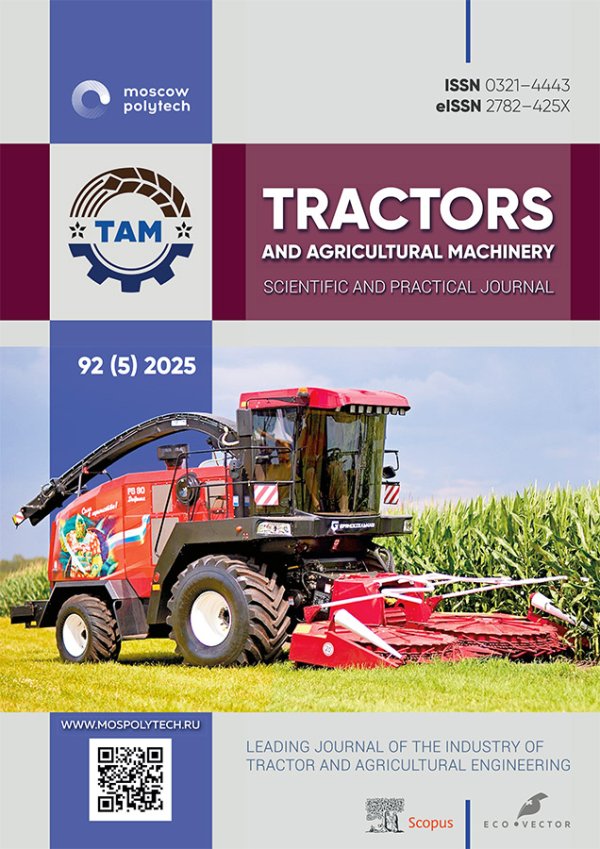
Traktory i sel hozmashiny
The peer-reviewed journal "Tractors and Agricultural Machinery" publish six times a year (bimonthly).
About
Leading journal of tractor and agricultural machinery industry, which acquired a reputation of impartial, reliable and informative edition.
Mission of the journal is to keep experts informed of the latest achievements of scientific and engineering thought, to familiarize them with the results of tests of new tractors and agricultural machines, as well as with new trends of development of the agroindustrial complex.
Main themes:
- agricultural machinery market;
- environmentally friendly technologies and equipment;
- new machines and equipment;
- theory, designing, testing;
- quality, reliability;
- agricultural service;
- foreign agricultural technologies and equipment;
- economics, organization and technology of production;
- exhibitions, fairs, conferences.
Publisher
- Eco-Vector
Editor-in-Chief
Valery Kaminsky, Ph.D., Professor
ORCID iD: https://orcid.org/0000-0002-1449-6479
Indexation
- Russian Science Citation Index
- Google Scholar
- WorldCat
- Ulrich's Periodicals Directory
Distribution
- Open Access
- No APC
- СС BY-NC-ND 4.0 International
Current Issue
Vol 92, No 5 (2025)
- Year: 2025
- Articles: 11
- URL: https://ogarev-online.ru/0321-4443/issue/view/25994
- DOI: https://doi.org/10.17816/0321-4443-2025.92.5
Full Issue
Environmentally friendly technologies and equipment
Method for synthesizing optimal parameters of a hybrid powertrain with an electrochemical generator and a rechargeable energy storage system
Abstract
BACKGROUND: Due to the rapid growth of the electrified transport sector, one of the key issues in designing electrified vehicles is determining the optimal parameters of hybrid powertrains. This paper contains the study of an extra-large class urban passenger vehicle equipped with a hybrid powertrain (HPT) consisting of a rechargeable electrical energy storage system and an electrochemical generator. In order to define optimal parameters of a HPT, the method for synthesis of optimal parameters that accounts for the main design requirements and operational features of the studied vehicle is proposed.
AIM: Determination of the optimal parameters of a hybrid powertrain for a vehicle, taking into account technical and operational parameters and the actual operating modes of an extra-large class urban passenger vehicle.
METHODS: Optimization of the hybrid powertrain parameters is performed using a global search optimization algorithm included in the GlobalToolbox package of the MATLAB software. Simulation modeling methods in the Simulink software are used to calculate the optimization criterion.
RESULTS: The paper presents a formulation of the optimization problem for the hybrid powertrain parameters, a description of the simulation mathematical model in the Simulink software, verification of the mathematical model using the experimental data, and the results of synthesis of optimal parameters for various cell chemistries of the rechargeable electrical energy storage system.
CONCLUSION: As the study result, optimal parameters of the HPT of the extra-large class urban passenger vehicle were defined considering main technical and operational parameters. The practical value of this study lies in the possibility of using the proposed method for determining optimal parameters of hybrid powertrains in the design of commercial vehicles, in particular extra-large class passenger vehicles with a hybrid powertrain based on an electrochemical generator and a rechargeable electrical energy storage system.
 438-451


New machines and equipment
Tillage unit for subsidiary farms
Abstract
BACKGROUND: In a market economy, farms are the main alternative for rural development. One of the conditions for obtaining a good harvest is high-quality soil cultivation. A feature of farms is their small size. Therefore, it is necessary to use small-sized power units to mechanize the processes of cultivating agricultural crops.
AIM: Development of a small-sized traction and transport vehicle for primary soil cultivation in small subsidiary farms and determination of its traction indicators.
METHODS: A design of a small-sized soil-cultivating unit based on a walk-behind tractor has been developed. The proposed small-scale mechanization tool is driven by a motorcycle engine and is equipped with combined working tools: a cutter is located in the front, and a disk gang is at the back. A power analysis was carried out to assess the energy consumption of the proposed unit, including the resistance of the cutter and the disc working element.
RESULTS: As a result, the power costs for the resistance of the cutter and disk working bodies were determined. The dependencies of the total traction resistance on the unit velocity and the depth of soil tillage were obtained.
CONCLUSION: As a result, the operability of the proposed unit for primary soil tillage in small farms has been confirmed.
452-459
Theory, designing, testing
Specifics of operation of a lead-in of a grain harvester with an axial threshing and separation system
Abstract
Modern agricultural machinery enterprises produce combine harvesters of various design solutions, including those with an axial threshing and separation design. The development, improvement and optimization of the parameters of the elements of rotary threshing and separating devices is a relevant technical task.
The aim is to study the working process in the lead-in of various grain harvesters with an axial threshing and separation system in order to identify the problems that arise during their operation and to establish methods for solving them.
The research conducted is based on a comprehensive analysis of the information available on the websites of both domestic and foreign manufacturers of self-propelled grain harvesters. In addition, the research involved studying data from various literature sources regarding changes in the physical and mechanical properties of agricultural plant stems during threshing and the results of assessing the condition of the receiving chambers during industrial operation in agricultural conditions.
The technological process of grain harvesters with an axial threshing and separation system of various manufacturers has been considered. The most loaded element has been identified, which is the intake chamber of the lead-in, as it receives the entire volume of the threshed mass with the maximum mechanical properties of the crop stems. When operating in production conditions, various manufacturers’ grain harvesters have shown through wear of the intake chamber due to the high load. The existing solutions for reducing wear have been found to be insufficiently effective. To reduce wear, it is proposed to optimize the technological process by changing the geometric shape of the receiving chamber.
The practical value of this research lies in identifying the wear of the receiving chamber during operation of grain harvesters with an axial threshing and separation system from various manufacturers in production conditions. The most promising approach to overcome this issue is to modify the technological process by optimizing the geometric shape.
460-467
Complex model of the dynamics of a multi-axle wheeled amphibious vehicle to improve stability and handling in transient and extreme conditions
Abstract
BACKGROUND: The dynamics of multi-axle amphibious wheeled transport and technological vehicles (AWTTV) remain poorly understood, especially under variable grip and extreme driving conditions. Existing studies focus primarily on two- and four-axle vehicles, ignoring complex nonlinear effects of tire slip and interaction between axles, which limit control accuracy for heavy multi-axle vehicles.
AIM: Development of a complex mathematical model of AWTTV dynamics that combines torque distribution between axles, real-time correction of wheel steering angles, and consideration of nonlinear effects of slip, to improve stability and handling in transient and extreme conditions.
METHODS: The following methods are used in the research: theoretical and analytical study based on the equations of vehicle dynamics, simulation modeling of the motion of an AWTTV with an 8x8 wheel arrangement, comparative analysis of two steering schemes (1-2-0-0 and 1-2-3-4), assessment of the influence of velocity, acceleration and steer angles on stability, verification of the model by means of the analysis of steady-state and transient modes.
RESULTS: It was found that the difference in the slip angles of the outer axles increases proportionally to the velocity and the steer angle, reaching 10 degrees at a velocity of 40 km/h. Deviation from the specified path for the 1-2-0-0 scheme reaches 40%, which is 1.6 times higher than for the 1-2-3-4 scheme. In transient modes, an increase in the difference in slip angles by 15-20% was observed compared to the steady-state mode.
CONCLUSION: The proposed model demonstrates that the integration of torque distribution and active steering reduces the path deviation and improves the stability of the AWTTV. The results highlight the need for adaptive algorithms for multi-axle vehicles, especially in transient conditions.
468-481
Improving the shape of the edge curve of rotary cultivator knives (Part 1: compliance of the edge curve with the condition of weeds coming off it)
Abstract
BACKGROUND: The cutting edge of a modern rotary cultivator knife has a complex shape of a spatial curved line and should perform the process of soil cutting with minimal energy consumption and without becoming clogged with weeds. Due to the complexity of the curve shape, a method for analyzing it for fulfilling the condition of weed removal has not been developed yet, which hinders the determination of directions for its improvement.
AIM: Development of a methodology for analyzing the shape of the edge curve of the blade of spatial knives of rotary cultivators to meet the condition of weeds coming off them.
METHODS: The design of the study included: development of a methodology for analyzing the shape of the edge curve of the blades of spatial knives of rotary cultivators; testing of the methodology during the analysis of standard Japanese and Chinese knives.
The objects of the study were the shapes of the edge curves of standard Japanese and Chinese knives. The studies were conducted during 2023 and 2024.
RESULTS: A method for analyzing the shape of the edge curve of the blade of spatial knives of rotary cultivators to meet the condition of weeds coming off them has been developed. Examples of its application for analyzing the shapes of the edge curves of the blades of standard Japanese and Chinese knives are given. A pattern of changes in the wedge angle along the length of their blades was found, and areas of the blades under study with difficulty in removing weeds from them were identified.
CONCLUSION: The proposed method allows quick analysis of the shape of the edge curve of the blades of rotary cultivators to meet the condition of weed removal from it, and identifying areas of the blade from which weed removal is difficult.
482-494
A highway road train motion model for prediction of its operational properties
Abstract
BACKGROUND: The modern methods of scientific research in the field of vehicle dynamics come down to the development of comprehensive complete models of ground vehicles motion and conducting the simulations using numerical methods. To predict the highway road train operational properties, it is necessary to develop a complex model of spatial movement along various types of support surfaces, taking into account the combined operation of its main components and assemblies systems in a modern software. The simulation object is a highway road train, riding on 1st and 2nd category roads during its operation, both with and without a semitrailer.
AIM: Development of the highway road train motion model in Multi-Body Dynamics environment for predicting the vehicle operational properties, analyzing design and engineering solutions, and selecting vehicle systems parameters.
METHODS: The study uses numerical simulation methods in the Simcenter AMESim, which offers capabilities of multibody dynamics analysis. The functioning adequacy of the developed motion model has been confirmed by experimental validation methods based on the results of field road tests of a real highway road train on the proving ground.
RESULTS: A comprehensive model of the highway road train spatial motion has been developed in the Simcenter AMESim to simulate its ride at various weight states on the 1st and 2nd category roads. The motion model ensures prediction of the operational properties of ride, stability, handling, traction and braking dynamics, for analyzing design and engineering solutions, and for selecting vehicle system parameters. The results of validation of the developed motion model show deviations of the simulation results within 10%.
CONCLUSION: The comprehensive spatial model of the highway road train motion and its software implementation for modeling its dynamics in order to predict the vehicle operational properties have been developed. The developed model is applicable for researches of vehicles dynamics indicators with simulation modeling methods with allowable simulation results deviations within 10%.
495-508
The digital twin of the grain cleaning and transportation system of a breeding combine harvester
Abstract
BACKGROUND: The paper discusses the process of modeling the motion of grain and foreign impurities carried by the air flow in the grain transportation and cleaning system of a breeding combine harvester, which is necessary to improve the quality of grain cleaning and to optimize the development and adjustment of such cleaning systems.
AIM: Building a digital twin of the transportation and cleaning system with the ability to simulate the motion of particles in the air flow.
METHODS: A digital model of the grain transportation and cleaning system was used as the object of study. Modeling of the process and study of particle movement in an air flow using the discrete element method was carried out at the Don Engineering Center as part of the SRW of the Federal Scientific Agroengineering Center VIM. The particle parameters were selected based on measurements of real impurities in the grain heap of the Anfisa wheat variety.
RESULTS: The composition of the grain heap was clarified, the geometric dimensions and masses of typical particles — grains, chaff, awns, etc. — were measured, their digital models were created. A digital model of the grain transportation and cleaning system of a breeding combine harvester was created, with the help of which a study of the motion of particles in the air flow was carried out, in particular - their paths, motion velocities. The grain heap motion route was modeled from the time it enters the grain intake from the sieves by the time it passes the cyclone filter of the cleaning system. Some air flow parameters were measured on a physical sample of the pneumatic grain transportation and cleaning system installed on a breeding combine harvester.
CONCLUSION: To improve the quality of grain cleaning in a selective combine harvester and optimize the development and configuration of such cleaning systems, the possibility of conducting research in a digital environment for a design requiring optimization of many parameters is considered, using the example of a digital twin of a grain transportation and cleaning system with the ability to simulate particle motion in an air stream.
509-522
Study of the stability of motion in water of amphibious wheeled transport and technological units in the hydroplaning mode
Abstract
BACKGROUND: Amphibious wheeled transport and technological units (AWTTU) are critically important for rescues and other special operations, but their velocity in water is limited due to high wheel resistance and suboptimal hydrodynamics. Existing studies do not take into account the hydroplaning mode in a comprehensive manner.
AIM: Development of a mathematical model of the motion in water of an amphibious vehicle in the hydroplaning mode, which takes into account both hydrostatic and hydrodynamic forces.
METHODS: Equations for determining excess pressure on the hull surface are derived based on the Cauchy-Lagrange integral, a calculation scheme for the interaction of a flat-bottomed hull with the water surface is developed. Analytical expressions for the lifting hydrodynamic force, resistance force, and hydrodynamic moment are obtained. An analysis of the stability of motion is carried out taking into account the position of the center of gravity, the magnitude of the traction force of the watercraft propeller, and the trim angle.
RESULTS: It was found that at Froude numbers Fr > 3.0, hydrodynamic forces ensure 95–97% of sustaining the AWTTU afloat. The criteria for the motion stability are obtained: with a negative arm of the propulsion force, the stability depends on the magnitude of the thrust, with a positive arm, the critical speed of motion is determined. It was found that the thickness of the “reverse jet” is proportional to the angle of attack, the resistance force has a quadratic dependence on the velocity, the arm of the hydrodynamic moment is linearly dependent on the trim angle.
CONCLUSION: The developed mathematical model allows analyzing the motion of the AWTTU in the hydroplaning mode taking into account key hydrodynamic factors. The obtained results create a theoretical basis for the design of high-velocity amphibious vehicles and require further experimental validation.
523-537
Analysis of finite element method models of semi-trailer frameworks
Abstract
BACKGROUND: Trailer chassis systems play a crucial role in ensuring the safety and efficiency of cargo transportation. Therefore, when designing the frame, it is necessary to conduct a detailed analysis of stress-strain state using the finite element method. In numerical analysis problems, an important step is to select a suitable finite element model of a semi-trailer frame that ensures an adequate representation of stress and strain distribution. This study conducts a comparative analysis of various approaches to constructing finite element models that differ from each other in terms of the method for transferring load from transported cargo, taking into account contact interactions between elements, as well as the way of modeling the fifth wheel coupling device.
AIM: Development and analysis of computational finite element models of the semi-trailer framework with various options of structural elements joints modeling, methods of load transfer from the truck and the transported cargo.
METHODS: The solution of the given task is carried out using the finite element method in the Siemens NX software package.
RESULTS: During the analysis of various finite element models, it has been found that:
- When transmitting load through pallets, the difference in stresses reaches 60%.
- The introduction of a coupling device into the calculation model reduces stresses by up to 25% due to the creation of an additional support surface for the front plate of the semi-trailer.
- Taking into account the contact between all the contacting elements of the frame and setting the tightening forces of the bolts reduces the stresses in the spars to 60%.
CONCLUSION: As a result of the study, a number of finite element models of the semi-trailer frame were developed and analyzed. The influence of various options for modeling the joints of structural elements, methods of transferring loads from the truck and the transported cargo on the strength characteristics of the frame has been studied. The analysis of the results revealed a significant impact of the addition of pallets, a coupling device and the contact interaction between the elements on the calculation results, which does not allow to conclude that the simplified and detailed models are equivalent. Therefore, when performing calculations using the finite element method, the absence of these elements should not be allowed, since such an assumption may lead to a significant difference in the calculation results.
538-547
Air-fuel ratio control method based on the modified proportional-integral controller and the Smith predictor
Abstract
BACKGROUND: To meet modern emission standards for spark-ignition engines, it is necessary to maintain a stoichiometric air-fuel ratio (α=1.000) or an enriched mixture (α=0.995–0.999). To improve the precision of air-fuel ratio (AFR) control, feedback controller utilizing data from a lambda sensor, which is mounted in the exhaust system of the internal combustion engine (ICE), is employed. For stable and fast operation of this controller, the use of a standard proportional-integral (PI) control law is limited. This is due to the significant time delay between changes in the AFR in the ICE cylinder and the lambda sensor response. The time delay leads to over-accumulation of the integral component and, as a result, incorrect operation of the regulator.
AIM: Improvement of the accuracy of maintaining the air-fuel ratio (AFR, α) in the cylinder of the internal combustion engine through closed-loop control using a lambda sensor during transient modes.
METHODS: To achieve this aim, the proportional-integral controller has been modified with an exhaust system model that predicts the air-fuel ratio response to control actions — changes in the fuel supply quantity. This control approach is known as the Smith predictor. The research methodology is comprehensive. The main theoretical provisions were obtained through an analytical review, then verified using computational modeling, implemented for the internal combustion engine control system, and tested during engine test-bench trials.
RESULTS: The main results were obtained for the two spark-ignition engines: 4.4-liter V8 and 1.5-liter 4 cylinder. Both engines equipped by turbocharger and direct injection fuel system. The possible values of the exhaust system’s dynamic properties were demonstrated. For example, the time constant and delay for the operating mode — n=1500 RPM and relative air charge 0.3 can be T=0.23 s and θ=0.21 s. This leads to prolonged transient processes and overshoot when changing the target air-fuel ratio. It was found that thanks to the controller developed during the research, it is possible to eliminate the overshoot completely as well as to reduce the transient process time by 1.6 times.
CONCLUSION: The developed method for controlling the air-fuel ratio has confirmed its functional safety and effectiveness through the engine tests. This method can be utilized for the ICE control system of a vehicle. The results are most relevant for turbocharged spark-ignition engines with a wideband lambda sensor, but they can also be applied to diesel engines or spark-ignition engines with a threshold lambda sensor.
548-559
Quality, reliability
Modelling of stress-strain state of samples with octagonal structure manufactured with the 3D-printing technology
Abstract
BACKGROUND: Currently, agricultural equipment faces the challenges of increased wear and tear and limited availability of conventional materials. To replace standard components, innovative solutions are required to improve the mechanical properties of parts while maintaining or reducing their mass. The use of metamaterials created using 3D printing technologies opens up new opportunities for the production of parts with adjustable internal structure, which helps to improve the durability and performance of machines.
AIM: Analysis of the influence of the octagonal correct and incorrect geometric configuration of metamaterials on their mechanical properties in order to develop the application of these materials for agricultural machinery parts that provide increased strength and resistance to deformation.
METHODS: The study was based on numerical modelling using computer-aided design and engineering system. The objects of the study were metamaterials with various configurations of octagonal cells differing in shape, size, number and orientation. A comparative analysis of regular and irregular octagonal structures was carried out as part of the experiment.
RESULTS: The analysis showed that the geometrical structure of metamaterials has a significant influence on their mechanical performance. Regular octagonal structures showed increased stiffness and resistance to deformation, whereas irregular structures were characterized by greater plasticity. Optimization of the internal structure of the materials improved the mechanical properties without significantly increasing the mass of the parts.
CONCLUSION: The study confirmed the feasibility of using 3D printing to create metamaterials with improved mechanical properties by changing the geometric structure. The developed materials can replace conventional counterparts in agricultural machines, ensuring their durability and performance.
560-566