





 Email this article
  Post a Comment
 Purtscher-like retinopathy in patients with exacerbation of chronic pancreatitis: case report
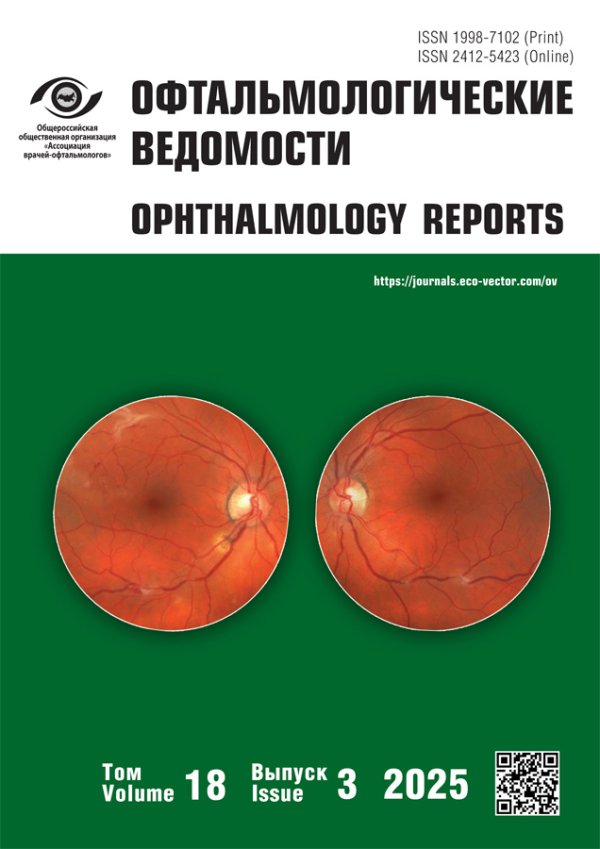
- Authors: Belov D.F.1,2, Zumbulidze N.G.3, Petukhov V.P.1, Vakhranev I.S.3, Gnatyuk Y.V.1
-
Affiliations:
- City Multifield Hospital No. 2, Saint Petersburg
- Saint Petersburg State University
- North-Western State Medical University named after I.I. Mechnikov
- Issue: Vol 18, No 3 (2025)
- Pages: 57-64
- Section: Case reports
- URL: https://ogarev-online.ru/ov/article/view/349527
- DOI: https://doi.org/10.17816/OV634945
- EDN: https://elibrary.ru/MVUUJQ
- ID: 349527
Cite item
 Open Access
 Access granted
 Subscription Access

Abstract
Purtscher retinopathy is a rare retinal disease, which is typically associated with severe injuries (head contusion, chest compression, pelvic bone fractures, etc.) and manifested by severe vision loss, multiple light lesions, and intraretinal hemorrhages. Purtscher-like retinopathy is (a type of Purtscher retinopathy) a rare and therefore poorly understood condition. Its most common cause is severe systemic conditions of solid organs. The pathophysiology of Purtscher-like retinopathy includes retinal vasculature microembolization resulting in arteriolar and precapillary occlusion. This leads to infarcts in the retinal nerve fiber layer and cotton-wool spots. Compression traumas cause an acute increase in venous pressure, leading to angiospasm and vascular endothelial damage, followed by vascular occlusion. Currently, there is neither a single diagnostic algorithm nor a unified treatment for this condition, which makes it an urgent issue. The article presents clinical observations and treatment outcomes in two patients with Purtscher-like retinopathy secondary to exacerbation of chronic pancreatitis.
Full Text
##article.viewOnOriginalSite##About the authors
Dmitrii F. Belov
City Multifield Hospital No. 2, Saint Petersburg; Saint Petersburg State University
Author for correspondence.
Email: belovd1990@gmail.com
ORCID iD: 0000-0003-0776-4065
SPIN-code: 2380-2273
MD, Cand. Sci. (Medicine)
Russian Federation, Saint Petersburg; Saint PetersburgNatalia G. Zumbulidze
North-Western State Medical University named after I.I. Mechnikov
Email: guramovna@gmail.com
ORCID iD: 0000-0002-7729-097X
SPIN-code: 4439-8855
MD, Cand. Sci. (Medicine)
Russian Federation, Saint PetersburgVladimir P. Petukhov
City Multifield Hospital No. 2, Saint Petersburg
Email: v.p.petukhov@gmail.com
ORCID iD: 0000-0003-4973-3937
SPIN-code: 2879-9313
MD
Russian Federation, Saint PetersburgIlia S. Vakhranev
North-Western State Medical University named after I.I. Mechnikov
Email: visiondoctor1@gmail.com
ORCID iD: 0009-0005-8370-6571
MD
Russian Federation, Saint PetersburgYury V. Gnatyuk
City Multifield Hospital No. 2, Saint Petersburg
Email: yuragnatyuk@yandex.ru
ORCID iD: 0009-0001-2061-0805
MD
Russian Federation, Saint PetersburgReferences
- Purtscher O. Noch unbekannte befunde nach schadeltrauma. Ber Dtsch Ophthalmol Ges. 1910;36:294–301. (In German)
- Agrawal A, McKibbin MA. Purtscher’s and Purtscher-like retinopathies: a review. Surv Ophthalmol. 2006;51(2):129–136. doi: 10.1016/j.survophthal.2005.12.003
- Kupriyanova IN, Orlova OL, Flyagina VI. Purtscher’s retinopathy in acute pancreatitis and newly diagnosed diabetes. RMJ. Clinical ophthalmology. 2016;(4):232–236. doi: 10.21689/2311-7729-2016-16-4-232-236 EDN: ZNOGHJ
- Kincaid MC, Green WR, Knox DL, Mohler C. A clinicopathological case report of retinopathy of pancreatitis. Br J Ophthalmol. 1982;66(4):219–226. doi: 10.1136/bjo.66.4.219
- Nautiyal A, Amescua G, Jameson A, et al. Sudden loss of vision: Purtscher retinopathy in multiple myeloma. CMAJ. 2009;181(12):E277. doi: 10.1503/cmaj.081968
- Blodi BA, Johnson MW, Gass JD, et al. Purtscher’s-like retinopathy after childbirth. Ophthalmology. 1990;97(12):1654–1659. doi: 10.1016/s0161-6420(90)32365-5.
- Miguel AI, Henriques F, Azevedo LF, et al. Systematic review of Purtscher’s and Purtscher-like retinopathies. Eye (Lond). 2013;27(1):1–13. doi: 10.1038/eye.2012.222
- Sadda SR, Schachat AP, Wilkinson CP, et al. Ryan’s retina. 7th edit. Vol. 2. Elseiver: 2023; P. 1877–1878.
- Nesmith BLW, Bitar MS, Schaal S. The anatomical and functional benefit of bevacizumab in the treatment of macular edema associated with Purtscher-like retinopathy. Eye (Lond). 2014;28(8):1038–1040. doi: 10.1038/eye.2014.85
Supplementary files


