




Towards the doctrine of constitutional anomalies of the female body. On infantilism and asthenia in gynecology and obstetrics. (Introductory Lecture)
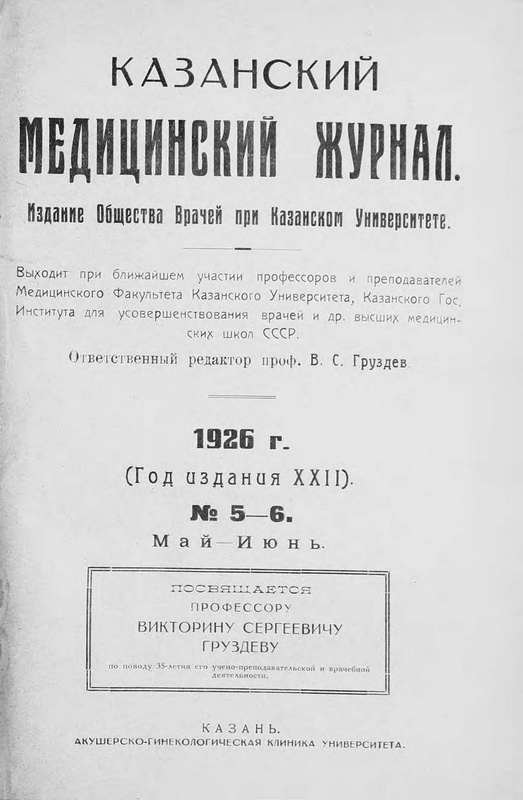
- Authors: Kozlov I.F.
- Issue: Vol 22, No 5-6 (1926)
- Pages: 714-722
- Section: Reviews
- URL: https://ogarev-online.ru/kazanmedj/article/view/64752
- DOI: https://doi.org/10.17816/kazmj64752
- ID: 64752
Cite item
Full Text

Abstract
The establishment in medicine of the concept of a constitution is usually associated with the name of Hippocrates, who distinguished between good and bad, strong and weak, wet and dry, sluggish and elastic constitutions. He pointed to the innate constitutional properties and took into account the importance of individual constitutional features both in the origin of diseases and in their prognosis and treatment. About 500 years later, Hippocratic "krazes" and "dyscrasias" were brought by Galen into a harmonious doctrine, which prevailed almost unchanged until the Renaissance (17th century). From this era - the era of the beginning of the study of human anatomy and physiology - additions, amendments and changes are made to the concept of the Hippocrates-Galen constitution, which, however, have put little real, scientifically substantiated into the intuitive concept of the constitution of the creator of the so-called. humoral pathology.
Full Text
##article.viewOnOriginalSite##About the authors
I. F. Kozlov
Author for correspondence.
Email: info@eco-vector.com
Prof.
Russian Federation, OmskReferences
Supplementary files

