





 Email this article
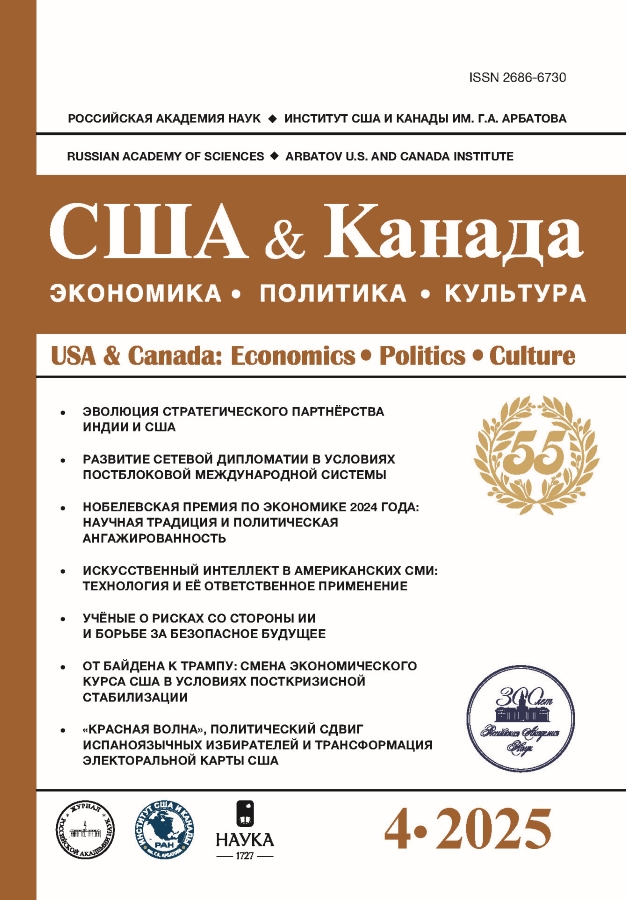
Artificial Intelligence in the US Media
- Authors: Nerentz D.V1
-
Affiliations:
- Institute of Mass Media and Advertising of Russian State University for the Humanities
- Issue: No 4 (2025)
- Pages: 79-92
- Section: The Current Discourse
- URL: https://ogarev-online.ru/2686-6730/article/view/290305
- DOI: https://doi.org/10.31857/S2686673025040064
- EDN: https://elibrary.ru/BWYSIB
- ID: 290305
Cite item
 Open Access
 Access granted
 Subscription Access

Abstract
The use of artificial intelligence (AI) in the media today can be called a familiar rather than an innovative phenomenon. In newsrooms, it is already a well-established practice to use AI to write short, templated news texts, prepare background information, come up with headlines for articles, and generate images. However, not everyone sees the opportunities as a boon. Increasingly, numerous moral and ethical conflicts, as well as legal questions about data protection and the nuances of authorship, are arising. This study examines various aspects of the application of neural networks in the work of media offices and journalists. Particular attention is paid to the history of AI development in the United States, the opportunities and dangers of its use, as well as the legal and ethical aspects of its application in American practice. This is especially important for the media, which, in the era of misinformation, more than ever should set an example of transparency and objectivity in their activities.
About the authors
D. V Nerentz
Institute of Mass Media and Advertising of Russian State University for the Humanities
Email: ya.newlevel@yandex.ru
ORCID iD: 0000-0002-6370-0157
Candidate of Sciences (Philology) Moscow, 125993, Russian Federation
References
- The Collins word of the year 2023 is AI. Collins Dictionary. Available at: https://www.collinsdictionary.com/woty (accessed: 16.12.2024).
- §2358. Research and development projects. 10 U.S.C. United States Code, 2014 Edition. Available at: https://www.govinfo.gov/content/pkg/USCODE-2014-title10/html/USCODE-2014-title10-subtitleA-partIV-chap139-sec2358.htm (accessed: 04.01.2025).
- Grundhauser, E., 2017. The Voder, the First Machine to Create Human Speech. Atlas Obscura. Available at: https://www.atlasobscura.com/articles/the-voder-thefirst-machine-to-create-human-speech (accessed: 30.12.2024).
- The Turing Test: Definition, History, and Examples. UMATechnology. Available at: https://umatechnology.org/the-turing-test-definition-history-and-examples/ (accessed: 03.01.2025).
- Stoll, J., 2024. Artificial intelligence (AI) and video streaming in the United States – statistics & facts. Statista. Available at: https://www.statista.com/topics/12669/artificial-intelligence-ai-and-video-streaming-in-the-united-states/#topicOverview (accessed: 20.12.2024).
- Gordon, C., 2021. AI Innovations in Media and Communications. Forbes. Available at: https://www.forbes.com/sites/cindygordon/2021/09/30/ai-innovations-inmedia-and-communications/ (accessed: 03.01.2025).
- The Sigma Awards. Available at: https://www.sigmaawards.org/ (accessed: 05.01.2025).
- The Washington Post leverages automated storytelling to cover high school football. The Washington Post. Available at: https://www.washingtonpost.com/pr/wp/2017/09/01/the-washington-post-leverages-heliograf-to-coverhigh-school-football/ (accessed: 25.12.2024).
- Introducing BloombergGPT, Bloomberg’s 50-billion parameter large language model, purpose-built from scratch for finance. Bloomberg. Available at: https://www.bloomberg.com/company/press/bloomberggpt-50-billion-parameterllm-tuned-finance/ (accessed: 27.12.2024).
- Three Laws of Robotics. Asimov Fandom. Available at: https://asimov.fandom.com/wiki/Three_Laws_of_Robotics (accessed: 30.12.2024).
- Nikoletti, L., Bass, D., 2023. Humans Are Biased. Generative AI Is Even Worse. Bloomberg. Available at: https://www.bloomberg.com/graphics/2023-generative-aibias (accessed: 20.12.2024).
- Barret, A., 2023. Standards around generative AI. Associated Press. Available at: https://blog.ap.org/standards-around-generative-ai (accessed: 20.12.2024).
- Grynbaum, M., Mac, R., 2023. The Times Sues OpenAI and Microsoft Over A.I. Use of Copyrighted Work. The New York Times. Available at: https://www.nytimes.com/2023/12/27/business/media/new-york-times-open-ai-microsoft-lawsuit.html (accessed: 05.01.2025).
- Гуреева Ю. Западные издания начали массово продавать свои материалы создателям ChatGPT. 2024. Российская газета. Available at: https://rg.ru/2024/05/30/zapadnye-izdaniia-nachali-massovo-prodavat-svoimaterialy-sozdateliam-chatgpt.html (дата обращения: 16.12.2024).
- Маск и Возняк попросили приостановить разработку систем ИИ, превосходящих по мощности GPT-4. Interfax. Available at: https://www.interfax.ru/world/893528 (дата обращения: 16.12.2024).
- Как в России и мире пытаются регулировать искусственный интеллект. РБК Тренды. Available at: https://trends.rbc.ru/trends/industry/65702c709a7947ae713e5fe2?from=copy (дата обращения: 16.12.2024).
- Guttmann, A., 2024. AI use in media and entertainment – statistics & facts. Statista. Available at: https://www.statista.com/topics/10606/artificial-intelligence-usein-media-and-entertainment/ (accessed: 04.01.2025).
- An Act. One Hundred Fifteenth Congress of the United States of America. At the Second Session. Congress.gov. Available at: https://www.congress.gov/115/bills/hr5515/BILLS-115hr5515enr.pdf (accessed: 05.01.2025).
- Gardner, A., Seddiq, O., Rozen, C., 2023. Biden Signs Sweeping Exrcutive Order Regulating Artificial Intelligence. Bloomberg. Available at: https://www.bloomberg.com/news/articles/2023-10-30/ai-executive-order-imposes-safety-securitymeasures-on-emerging-tech?sref=l3J6d079 (accessed: 28.12.2024).
- Artificial Intelligence 2024 Legislation. NSCL. Available at: https://www.ncsl.org/technology-and-communication/artificial-intelligence-2024legislation (accessed: 12.12.2024).
- Лукина М.М., Замков А.В., Крашенинникова М.А., Кульчицкая Д.Ю., 2022. Искусственный интеллект в российских медиа и журналистике: к дискуссии об этической кодификации. Вопросы теории и практики журналистики. № 4. С. 680–694.
- Berkeley, E., 1949. Giant brains or, Machines that think. US: John Wiley & Sons. 272 p.
- Dormehl, L., 2017. Thinking Machines. NY: TarcherPerigee. 288 p.
- Pickover, C., 2021. Artificial Intelligence: An Illustrated History: From Medieval Robots to Neural Networks. NY: Sterling Publishing Co., Inc. 224 p.
- Weizenbaum, D., 1976. Computer Power and Human Reason. From Judgment to Calculation. Cambridge: The Massachusetts Institute of Technology. 412 p.
Supplementary files
