





 Email this article
 Cybercrime as a threat to international security
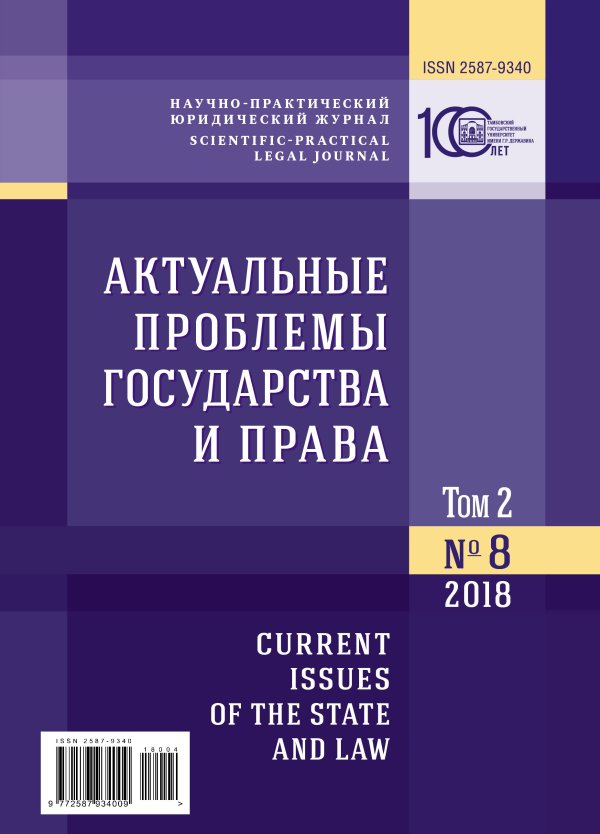
- Authors: Harin V.V.1, Plotnikova T.V.1
-
Affiliations:
- Tambov State University named after G.R. Derzhavin
- Issue: Vol 2, No 8 (2018)
- Pages: 96-107
- Section: Национальная безопасность
- URL: https://ogarev-online.ru/2587-9340/article/view/367557
- ID: 367557
Cite item

Abstract
With the advent of the first computer, human life changed forever. Virtual space has become an integral part of our lives. However, crime has evolved, a new specific species has emerged called cybercrime. In this study, we consider the features of a new type of crime. The history of the first criminal acts, the formation of the concept of cybercrime and its subsequent development are shown. Despite the rapid popularity among criminal circles, there is no clearly defined and generally accepted concept of cybercrime in science. These acts are characterized by very specific features. This encourages considering cybercrimes as not quite the standard of a crime. The classification and the main threats generated by these criminal acts are shown. The legislation of Russia and foreign countries is considered. In Russia, as in some foreign countries, the main focus is on fixing the responsibility for this act in the Criminal Code. At the same time, it should be noted that the states react rather quickly to the emergence of new threats and try to form relevant legislation. Identified and justified the problem of disclosure of cybercrime. These crimes are very relevant threats to human security, society and the state. Cybercrime is not only a national and regional threat, but also a threat to international security.
Keywords
About the authors
Vadim Vitalyevich Harin
Tambov State University named after G.R. Derzhavin
Author for correspondence.
Email: vadimka.va@mail.ru
Security Management Controller
Russian Federation, 33 Internatsionalnaya St., Tambov 392000, Russian FederationTatyana Vladislavovna Plotnikova
Tambov State University named after G.R. Derzhavin
Email: plotnikova-tmb@mail.ru
Candidate of Jurisprudence, Associate Professor, Associate Professor of Special Training and National Security Department, Deputy Director of the Institute of Law and National Security for Innovation and Production Work
Russian Federation, 33 Internatsionalnaya St., Tambov 392000, Russian FederationReferences
- Aykov D., Seyger K., Fonstorkh U. Komp’yuternyye prestupleniya. Rukovodstvo po bor’be s komp’yuternymi prestupleniyami [Computer Crimes. Guidelines for Combating Computer Crimes]. Moscow, Mir Publ., 1999, 351 p. (In Russian).
- Frolov M.D. Ugolovnaya otvetstvennost’ za moshennichestvo v sfere komp’yuternoy informatsii po zakonodatel’stvu stran Severnoy i Yuzhnoy Ameriki, Okeanii, Azii i Afriki [Criminal liability for computer fraud in the legislation of the countries of North and South America, Oceania, Asia and Africa]. Administrativnoye i munitsipal’noye pravo – Administrative and Municipal Law, 2015, no. 11 (95), pp. 1164-1168. doi: 10.7256/1999-2807.2015.11.16911. (In Russian).
- Vekhov V.B. Komp’yuternyye prestupleniya: sposoby soversheniya i raskrytiya [Computer Crimes: Commission and Disclosure Methods]. Moscow, Pravo i zakon Publ., 1996, 182 p. (In Russian).
Supplementary files

