






 Email this article
 A PATHWAY TO VACUUM ION-PLASMA WEAR-RESISTANT COATINGS
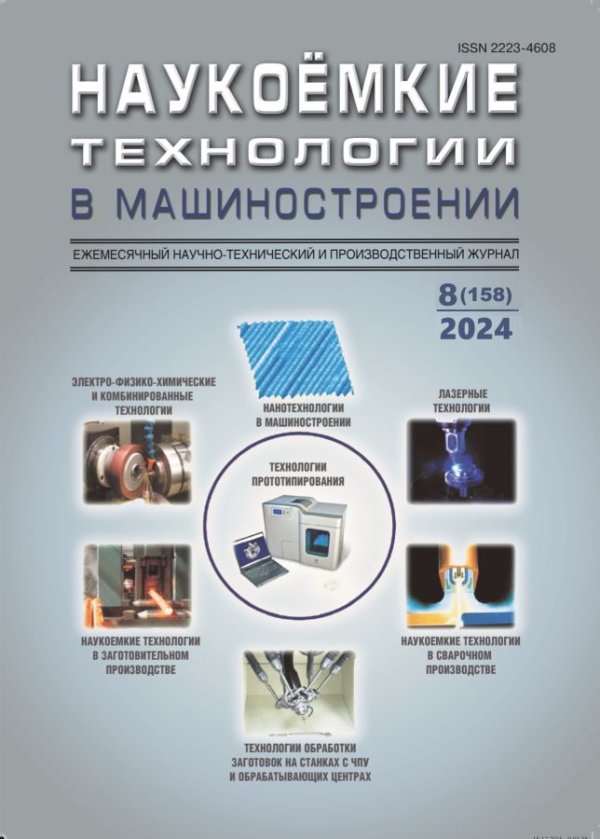
- Authors: Kudryakov O.V.1, Varavka V.N.1
-
Affiliations:
- Don State Technical University
- Issue: No 8 (158) (2024)
- Pages: 31-40
- Section: Science intensive technologies in coating, parts repair and recovery
- URL: https://ogarev-online.ru/2223-4608/article/view/285030
- DOI: https://doi.org/10.30987/2223-4608-2024-7-31-40
- ID: 285030
Cite item
Full Text

Abstract
A review of the technologies of vacuum ion plasma (VIP) coating spraying based on the reasonability of science intensity, its criteria and evaluation methods is carried out. The technological features of producing VIP coatings are viewed with the emphasis on the process of coating formation on a substrate, which occurs under the impact of the most powerful forces in nature, i.e. these are forces of interatomic interaction. This leads to a very high level of cohesive strength of the coatings, which results in wear resistance and corrosion resistance. This leads to a very high level of cohesive strength of the coatings, succeeding in wear and corrosion resistance. Methods of research, diagnosis and testing of VIP coatings, due to the peculiarities of their structure and properties, include, as a rule, equipment and techniques of leading world manufacturers in the field of electron microscopy, microrentgen spectral analysis, diffraction analysis, X-ray photoelectron spectrometry, continuous and dynamic indentation, bench testing of unique properties. With respect to scientific and practical activities of the authors, examples of coatings of various nature (nitride, carbon, metalloceramic), different architectures (monolayer – single-phase, multilayer – 2D composites, dispersed – 3D composites) and various applications (wear–resistant, tribotechnical, antierosion, thermal barrier) are given. In particular, some types of nitride coatings TiN, TiAlN, CrAlSiN, which are characterized by high hardness H 24 GPa and abrasive wear resistance, are in the focus. However, in conditions of relatively smooth sliding friction, only the multiphase nanostructured CrAlSiN coating retains wear resistance. In conditions of drop-impact erosion, nanocompositional multilayer VIP coatings of TiN/MoN composition demonstrate the highest resistance, which compete with the recognized champion in this field - welded plates of stellite VZK (WCoCr). Despite the fact that the thickness of the VIP coatings viewed in the paper is a film of 1...10 microns, whereas the stellite plates have a thickness of at least 4 mm. In conclusion, it is noted that VIP technology continues to develop new materials, for example, to create diamond-like coatings or coatings made of high-entropy alloys. VIP technology corresponds to a high level of science intensity, and VIP coatings are promising for putting to use in mechanical engineering.
About the authors
Oleg Vyacheslavovich Kudryakov
Don State Technical University
Email: kudryakov@mail.ru
ORCID iD: 0000-0002-1462-4389
Valeriy Nikolaevich Varavka
Don State Technical University
Email: varavkavn@gmail.com
ORCID iD: 0000-0003-4703-7372
References
- Кудряков О.В., Варавка В.Н. Мониторинг начальных стадий эрозионного износа ионно-плазменных покрытий при каплеударном воздействии // Упрочняющие технологии и покрытия. 2012. № 10 (94). С. 40–47.
- Kolesnikov V.I., Kudryakov O.V., Zabiyaka I.Yu., Novikov E.S., Manturov D.S. Structural aspects of wear resistance of coatings deposited by physical vapor deposition // Phys. Mesomech. 23(6), 570–583 (2020). DOI: https://doi.org/10.1134/S1029959920060132
- Kolesnikov V.I., Pashkov D.M., Belyak O.A., Guda A.A., Danilchenko S., Manturov D., Novikov E., Kudryakov O.V., Guda S.A., Soldatov A.V., Kolesnikov I.V. Design of double layer protective coatings: Finite element modeling and machine learning approximations // ACTA Astronautica, 204, 869–877 (2023). https://doi.org/10.1016/j.actaastro.2022.11.007
- Batkovsky A.M., Fomina A.V., Semenova E.G., Khrustalev E.Yu., Khrustalev O.E. Models and Methods for Evaluating Operational and Financial Reliability of High-Tech Enterprises. Journal of Applied Economic Sciences. 2016. V. 11. No 7. P. 1384–1394.
- Абрашкин М.С. Методика оценки наукоёмкости предприятий ракетно-космического машиностроения // Организатор производства. 2018. Т. 26. № 3. С. 74–84. doi: 10.25065/1810-4894-2018-26-3-74-84
- Ильин А.А., Плихунов В.В., Петров Л.М., Спектор В.С. Вакуумная ионно-плазменная обработка. М.: ИНФРА-М, 2014. 160 с.
- Варавка В.Н., Кудряков О.В. Прочность и механизмы разрушения высоко-пластичных материалов при воздействии дискретного водно-капельного потока // Вестник ДГТУ. 2011. Т.11. № 8 (59). Вып. 2. С. 1376–1384.
- Кудряков О.В., Варавка В.Н. Механизмы формирования эрозионного износа металлических материалов при высокоскоростных капельных соударениях: Часть 1 // Материаловедение. 2012. № 5. С. 36–43.
- Кудряков О.В., Варавка В.Н. Механизмы формирования эрозионного износа металлических материалов при высокоскоростных капельных соударениях: Часть 2 // Материаловедение. 2012. №6. С. 14–19.
- Варавка В.Н., Кудряков О.В. Особенности разрушения металлических сплавов в условиях устойчивой каплеударной эрозии // Известия вузов. Северо-Кавказский регион. Технические науки. 2012. № 3 (167). С. 45–50.
- Кудряков О.В., Варавка В.Н. Феноменология мартенситного превращения и структуры стали. Ростов-на-Дону: Издательский центр ДГТУ, 2004. 200 с.
- Сапунов С.Ю., Кудряков О.В., Фартушный Н.И. Строение и свойства никель-цинкового покрытия на стали // Сталь. 2003. № 11. С. 94–96.
- Кудряков О.В. Дислокационные квазидиполи и их роль в мартенситном превращении стали // Физика металлов и металловедение. 2002. Т. 94. № 5. С. 3–10.
- Кудряков О.В., Пустовойт В.Н. Структурный критерий коррозионной стойкости «белых слоев» // Материаловедение. 1998. №7. С. 33–39.
- Fang C.M., Cantor B. An Equiatomic 20-Element High Entropy Amorphous Alloy: Ab Initio Molecular Dynamics Investigations / Posted Date: 19 February 2024. doi: 10.20944/preprints202402. 1010.v1
Supplementary files
