




Vol 25, No 2 (2025)
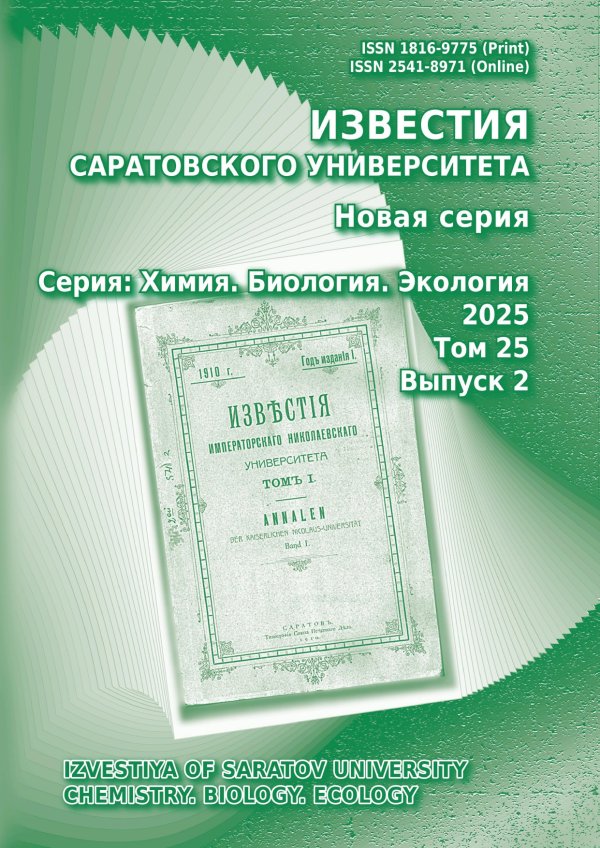

Chemistry
Carbonyl olefi nation of N-substituted tetrahydroquinoline-6-carbaldehydes
Abstract
Tetrahydroquinolines are important structural fragments of many biologically active compounds exhibiting antifungal, antitumor, antiviral and neurotropic properties. This paper presents methods for the synthesis of N-substituted tetrahydroquinoline-6-carbaldehydes and a study of the possibility of their olefi nation using the Wittig and Horner – Wadsworth – Emmons methods. As a result of the interaction of N-alkyl- and N-acylhydroquinolines with the Vilsmeier – Haack complex, N-substituted tetrahydroquinoline-6-carbaldehydes have been obtained in yields of 77–85%. Olefi nation of the obtained carbaldehydes by the Wittig reaction using triphenylalkylphosphonium salts has made it possible to obtain a number of N-substituted derivatives, including: (E)-3-(2,2,4-trimethyl-1,2,3,4-tetrahydroquinolin-6-yl)acrylonitriles, (E)-1-phenyl-3-(2,2,4- trimethyl-1,2,3,4-tetrahydroquinolin-6-yl)prop-2-en-1-ones, ethyl (E)-3-(N-benzoyl-7-methoxy-2,2,4-trimethyl-1,2,3,4-tetrahydroquinolin-6-yl) acrylate. It has been found that when this interaction is extended to N-benzyl-2,2,4-trimethyl-1,2,3,4-tetrahydroquinoline-6-carbaldehyde and N-benzyl-2,2,4-trimethyl-4-(4-chlorophenyl)-1,2,3,4-tetrahydroquinoline-6-carbaldehyde, diffi cult-to-separate mixtures are formed, which is explained by the presence of a methylene-active benzyl group in these compounds, which in the presence of sodium methylate can enter into condensation with the aldehyde fragment. The application of the Horner – Wadsworth – Emmons reaction for the olefi nation of N-methyl- and N-benzyl-1,2,3,4-tetrahydroquinoline-6-carbaldehydes using dimethyl (cyanomethyl) phosphonate has made it possible to synthesize (E)-3-(Nmethyl-2,2,4-trimethyl-1,2,3,4-tetrahydroquinolin-6-yl) acrylonitrile, (E)-3-(N-benzyl-2,2,4-trimethyl-1,2,3,4-tetrahydroquinolin-6-yl) acrylonitrile and (E)-3-(-N-benzyl-2,2,4-trimethyl-4-(4-chlorophenyl)-1,2,3,4-tetrahydroquinolin-6-yl) acrylonitrile with yields of 83–89%. Analysis of the ¹H NMR spectra has showed that all the synthesized olefi nation products are in the form of E-isomers. The obtained results demonstrate the potential of using the developed methods for the synthesis of new tetrahydroquinoline derivatives.
Izvestiya of Saratov University. New series. Series: Chemistry. Biology. Ecology. 2025;25(2):128-136
 128-136


A new variant of the Friedlander reaction in the synthesis of 7,8-dihydro-6H-furo[2,3-b] quinolin-5-ones
Abstract
Hydrogenated derivatives of acridine exhibit various types of biological activity – their antibacterial, antitumor, antiviral, psychoactive properties are known. Using the example of heteroanalogs of tacrine, a known cholinesterase inhibitor, it is shown that the replacement of the benzene ring in polycyclic systems with a fi ve-membered heterocycle leads to a decrease in the toxicity of the drug, but does not change the basic physiological activity. Thus, the synthesis of heteroanalogs of known benzannelated systems is an urgent task. This work is devoted to the development of eff ective approaches to the synthesis of some new furotetrahydroquinolines based on the condensation of 2-amino-3-cyanofurans with carbonyl compounds. A promising modifi cation of the Friedlander reaction is proposed, which involves the use of preparatively available cyclohexane-1,3-diones as a substrate. A two-step one-pot method for the synthesis of furoquinoline-5-ones is developed, suitable for precursors sensitive to acids. It was found that the interaction of 2-amino-3-cyano-5-arylfuran with 5-aryl- and 5-hetarylcyclohexane-1,3-diones under tin tetrachloride catalysis leads to the formation of 2-aryl-4-amino-7,8-dihydro-6H-furo[2,3-b]quinolin5-ones. The products are formed in medium yields (50–60%). It has been established that under the conditions of recording NMR spectra (DMSO-d6, 300K), the compounds exist in the tautomeric form of 4-imino-2,7-diaryl-6,7,8,9-tetrahydrofuro[2,3-b]quinolin-5-one. It has been shown that heating 2-amino-3-cyano-5-arylfurans with substituted cyclohexane-1,3-diones in toluene with azeotropic distillation of water in the presence of toluenesulfonic acid formed the corresponding Schiff bases, which cyclized only upon heating with tin tetrachloride. It has been established that during the interaction of 2-amino-3-cyano-5-arylfuran with camphor, both under catalysis by toluenesulfonic acid and in the presence of tin chloride, condensation of the intermediate into the expected 8,10,10-trimethyl-2-aryl-5,6,7,8-tetrahydro-5,8- methanofuro[2,3-b]quinoline-4-amine did not occur. The composition and structure of the synthesized compounds has been confi rmed using IR and NMR-1H spectroscopy.
Izvestiya of Saratov University. New series. Series: Chemistry. Biology. Ecology. 2025;25(2):137-142
137-142
Express determination of ceftriaxone using immobilized copper sulfate (II)
Abstract
Indicator papers based on immobilized copper (II) sulfate have been obtained for the determination of the β-lactam antibiotic ceftriaxone. The interaction of immobilized copper (II) sulfate with ceftriaxone has been assessed using diff use refl ectance spectroscopy. Methods have been developed for visual colorimetric and colorimetric determination of the antibiotic using a smartphone camera, Adobe Photoshop CS5® software, and a regression model built using the Python programming language. Color test scales for rapid assessment of ceftriaxone content have been obtained. Metrological characteristics of visual colorimetric determination of the antibiotic have been established: the range of determined contents is 0,50–64 mg/ml, the unreliability interval is 0,07–0,40 mg/ml, the detection limit is 0,40 mg/ml. For colorimetric assessment of ceftriaxone concentration, linear dependencies of the intensities of the color parameters RGBHSVCMYK on the decimal logarithm of the antibiotic concentration have been constructed. The profi les of petal diagrams in the coordinates of color parameters RGBHSV were obtained and the dependences of the parameters of areas and perimeters on the decimal logarithm of the concentration of the antibiotic have been established. The range of determined contents in colorimetric determination was 0,10–64 mg/ml. A decrease in the value of the detection limit in the colorimetric determination of ceftriaxone has been noted (DL = 0,05). An assessment of the correctness of the express-determination of ceftriaxone by the “introduced–found” method has been carried out, Sr does not exceed 0,08.
Izvestiya of Saratov University. New series. Series: Chemistry. Biology. Ecology. 2025;25(2):143-150
143-150
Influence of electrospinning conditions on the characteristics of a nonwoven material based on fl uoroplast P(VDF-TFE)
Abstract
Nonwovens produced through electrospinning technique have been successfully used in various fi elds due to their unique properties. It is essential to investigate the impact of the parameters in the manufacturing process on the resulting properties of these materials. This research focuses on nonwovens made from fl uoroplast P(VDF-TFE) using a horizontal spraying system with a vertically positioned collector. The parameters studied include the interelectrode distance, the electric fi eld strength, and the viscosity of the molding solution. The study aims to determine the optimal parameters for producing nonwovens with specifi c characteristics, such as size, fi ber diameter, and surface wettability. The results indicate that the interelectrode distance between 15 and 25 centimeters yields the best results. In this study, we have investigated the change in viscosity of the solution during the electrospinning process and have found that it should not exceed 5–7%. Additionally, we have observed changes in the structure of the polymer macromolecules, which depended on the rate of solvent evaporation during the fi ber stretching process. The results obtained in this research can be used to optimize the technological processes for industrial production of nonwoven fabrics made from fl uoroplast P(VDF-TFE) with specifi c properties.
Izvestiya of Saratov University. New series. Series: Chemistry. Biology. Ecology. 2025;25(2):151-162
151-162
The influence of pressure on the composition of products from the catalytic conversion of n-hexane
Abstract
At present, the most common industrial method for producing high-quality gasoline, characterized by high octane numbers and moderate aromatic hydrocarbon content, particularly benzene, is catalytic reforming. In the current trend of oil refi ning industry development, a promising method for improving straight-run motor fuels is co-processing, where the combination of the most optimal parameters allows for the production of high-octane gasolines with the best performance and environmental characteristics. This work studies the eff ect of pressure the conversion of n-hexane in a catalytic system in the range of 3 to 7 atm on the yield and composition of products. The process was conducted at a temperature of 450 °C in an inert atmosphere. A high molecular weight zeolite, ZSM-5, has been used as the support. n-Hexane has been used as the feedstock to study the activity of the new catalytic system. This feedstock has been chosen due to its ability to undergo aromatization reactions and its presence in the feed for producing motor fuels–co-processing. The obtained hydrocarbon gas contains carbon chain lengths from C1 to C5 . This study has determined that increasing the pressure on the used catalyst leads to an increase in the octane number from 95.4 to 100.3 by the research method and from 87.1 to 94.5 by the motor method, due to an increase in the composition of aromatic hydrocarbons and isomerized paraffi n hydrocarbons in the produced catalyst. The highest octane number is achieved at a pressure of 7 atm.
Izvestiya of Saratov University. New series. Series: Chemistry. Biology. Ecology. 2025;25(2):163-170
163-170
Polythermal study of phase behavior and extractive crystallization of salt in the ternary system ammonium sulfate – water – polyethylene glycol-1500
Abstract
Phase equilibria and solubility have been studied by the visual polythermal method in mixtures of components in nine sections of the composition triangle in the range of 10–70° C in the ternary system ammonium sulfate – water – polyethyleneglycol-1500 (PEG-1500). The dependence of the compositions of solutions corresponding to the critical solubility points of the stratifi cation region on temperature has been found using the liquid phase volume ratio method. Isothermal phase diagrams of the studied ternary system have been constructed at 10.0, 20.0, 40.0, 50.0 and 70.0°C, the solubility of the components has been determined. It has been found that in the range of 10.0–40.0° C, a triangle of the eutectic state exists on the isothermal diagrams. At all temperatures of the study range, a monotectic triangle with adjacent fi elds of saturated solutions and stratifi cation is realized on the isotherms. The coeffi cients of PEG-1500 distribution between the equilibrium liquid phases of the monotectic state have been calculated. It has been found that ammonium sulfate eff ectively salts out PEG-1500 in the range of 10.0–70.0° C, while the content of the organic component in the aqueous phase is minimal (0.1–0.2 wt.%). Mixtures of the components of the studied system can be recommended for the extraction of hydrophilic molecules without introducing other compounds. It has been found that PEG-1500 exhibits high effi ciency as an ammonium sulfate antisolvent, which allows this salt to be extracted with high yields from unsaturated aqueous solutions at temperatures close to the standard one. With a decrease in temperature and an increase in the content of PEG-1500 in the water-salt mixture, the yield of salt crystals increases. It has been found that for a 38 wt.% ammonium sulfate solution with the introduction of 60 wt.% PEG-1500, the maximum yield of salt crystals (96.4%) has been observed at 30.0° C.
Izvestiya of Saratov University. New series. Series: Chemistry. Biology. Ecology. 2025;25(2):171-183
171-183
Biology
Assessment of the ability of Bacillus velezensis bacteria to produce cyclic lipopeptides and characteristics of their growth-stimulating and bioremediation properties
Abstract
In recent years, agriculture has faced the problem of fi nding promising drugs that are eff ective in combating plant diseases, alternatives to synthetic pesticides that can have a negative impact on both living organisms and the environment as a whole. To solve this problem, the possibility of using biological methods of protecting agricultural crops is being studied. In particular, special attention is paid to the search for new strains of bacteria – natural antagonists of pathogenic microorganisms that could be used instead of synthetic chemicals. The aim of this study was to assess the ability of Bacillus velezensis HR13 bacteria to produce secondary metabolites with antagonistic and growth-stimulating properties. The cyclic lipopeptides identifi ed in the bacterial culture fl uid were characterized using matrix-assisted laser desorption/ionization time-of-fl ight mass spectrometry (MALDI-ToF MS). The positive eff ect of B. velezensis HR13 bacteria on the morphometric parameters of plant seedlings was shown when inoculated with the studied strain at a concentration of 106 – 107 m.c./ml. The ability of B. velezensis HR13 bacteria to use representatives of such groups of active substances of synthetic fungicides as triazoles and phenylpyrroles in various concentrations as the sole carbon source was determined.
Izvestiya of Saratov University. New series. Series: Chemistry. Biology. Ecology. 2025;25(2):184-194
184-194
Влияние солевого стресса на рост и развитие корневой системы проростков интрогрессивных линий яровой мягкой пшеницы
Abstract
The study of the resistance of plants obtained as a result of introgressive breeding to the action of various factors, including salinization, is an important stage of breeding work. The eff ect of salt stress on the growth and development of the root system of seedlings of introgressive lines of spring soft wheat has been studied. The objects of the study are seedlings of introgressive lines of spring soft wheat obtained with the participation of Triticum dicoccum Shuebl, Aegilops speltoides Tausch, Agropyron elongatum (Host) Beauv. Seedlings of the Saratov 76 variety are used as a standard. The objects were cultivated under laboratory conditions. As a substrate, isoosmotic solutions of NaCl, Na2 SO4 , their mixture in a ratio of 1:1 and H2 O (control) were used. The eff ect of salinization on growth was assessed according to the following criteria: the number of roots, their length, the values of the root index and the root-to-shoot ratio. The seedlings of the studied lines in the control version of the experiment are inferior to the standard variety in terms of root length and root availability. It was found that the least inhibitory eff ect of chloride and sulfate salinization of the substrate on root growth in length is manifested in seedlings of the L657 line: the length of the main root and the roots of the lower and upper tiers exceed similar indicators of seedlings of the standard variety. Salinization has a negative eff ect on the root index of seedlings of both the standard variety and the studied lines of soft wheat, while seedlings of lines L657 and L664 in terms of the root index are signifi cantly superior to the standard variety in all salinization variants. According to the number of roots in seedlings, there are no statistically signifi cant diff erences between lines containing foreign genetic material and the standard variety.
Izvestiya of Saratov University. New series. Series: Chemistry. Biology. Ecology. 2025;25(2):195-204
195-204
Ecology
From traditional adsorption processes to bioremediation: Modern technologies for purifying natural waters from pollutants
Abstract
The relevance of the study is determined by the fact that human activity has led to an increase in the anthropogenic impact on the environment. Various pollutants from a large number of discharges of municipal, industrial and medical wastewater are ubiquitous in the natural aquatic environment. Emerging pollutants are synthetic or naturally occurring chemicals or any microorganisms that are not normally monitored in the environment. But emerging pollutants may enter the environment and cause known or suspected adverse environmental or human health eff ects. The complexity of using traditional methods of natural water treatment is associated with the problems of scaling up treatment systems and regenerating or disposing of by-products. Most of the research on the purifi cation of natural water bodies in recent years has focused on the use of phase change processes, including adsorption in various solid matrices and ion exchange, the use of membrane fi ltration, phytotechnology, chemical and biological treatment methods, and advanced oxidation processes. High effi ciency is shown by adsorption purifi cation of water bodies using combined natural fi ltration systems, in which physical processes of sorption and chemical processes of biodegradation are combined. An eff ective ecological and engineering solution is the restoration of freshwater bodies using artifi cially created fl oating wetlands. The advantage of biological methods as the most used and successful, due to their high effi ciency and environmental friendliness, is shown. A review of current technologies available to remove emerging pollutants from water ecosystems showed that diff erent physical, chemical and biological processes are involved. The development of scientifi c research on the prevalence of hazardous pollutants in the environment is the result of the increased attention of scientists to environmental problems aimed at promoting a more rational use of natural resources.
Izvestiya of Saratov University. New series. Series: Chemistry. Biology. Ecology. 2025;25(2):205-234
205-234
Personalia
In Memory of Vladimir Vladimirovich Ignatov. On his 90th anniversary
Abstract
February 13, 2025 marks the 90th anniversary of the birth of Honored Scientist of the Russian Federation, Doctor of Biological Sciences, Professor Vladimir V. Ignatov (1935–2018) – a famous scientist who made a signifi cant contribution to the development of bacteriochemistry, to the study of the molecular mechanisms of Staphylococcus aureus resistance to antibiotics, as well as to the creation of a scientifi c school for the study of the molecular mechanisms of the formation of plant-bacterial associative symbiosis of cereals with rhizosphere bacteria, the research results of which are world famous. Vladimir V. Ignatov recreated the Department of Biochemistry and Biophysics at the university in 1977, and taught at the department from 1967 to 2016. In 1980, on the initiative of the Academy of Sciences of the USSR, he participated in the creation of the Saratov Scientifi c Center, organized and headed the Institute of Biochemistry and Physiology of Plants and Microorganisms of the Academy of Sciences of the USSR (now the IBPPM RAS) for about 30 years. Vladimir V. Ignatov was the author of more than 400 publications; 50 dissertations were defended under his supervision, 10 of which were doctoral.
Izvestiya of Saratov University. New series. Series: Chemistry. Biology. Ecology. 2025;25(2):235-240
235-240