





 Email this article
 Changes in cardiovascular indices and bioelectric activity of the brain in response to cold exposure in young men
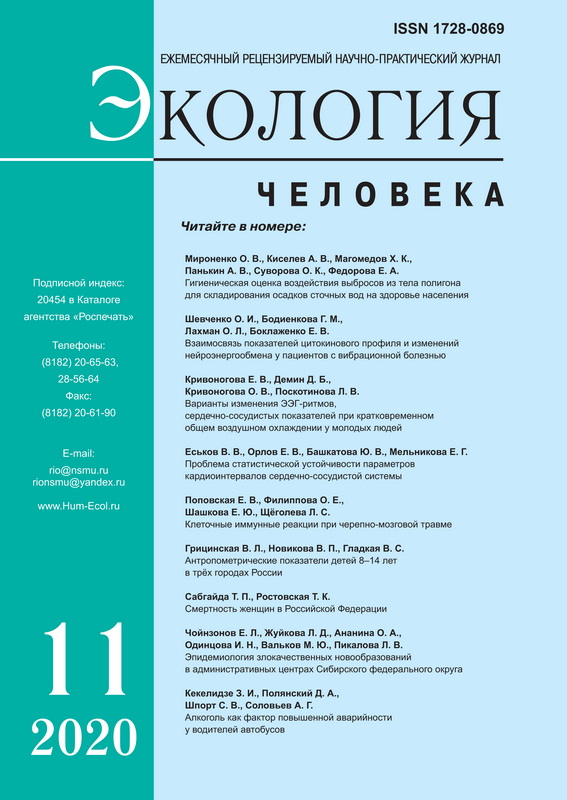
- Authors: Krivonogova E.V.1, Demin D.B.1, Krivonogova O.V.1, Poskotinova L.V.1
-
Affiliations:
- N. Laverov Federal Center for Integrated Arctic Research of the Ural Branch of the Russian Academy of Sciences
- Issue: Vol 27, No 11 (2020)
- Pages: 20-26
- Section: Articles
- URL: https://ogarev-online.ru/1728-0869/article/view/52798
- DOI: https://doi.org/10.33396/1728-0869-2020-11-20-26
- ID: 52798
Cite item
Full Text

Abstract
The aim was to study changes in cardiovascular indices and electroencephalogram (EEG) characteristics in response to short-term general air cooling of the body in young adults. Methods. The sample consisted of 13 healthy men aged 18-21 years who were permanent residents of the city of Arkhangelsk (Northwest Russia). The spectral power (SP) of EEG rhythms was assessed using an electroencephalograph (Neurosoft, Russia). Heart rate variability (HRV) was measured using Varikard equipment (Ramena, Russia). Temperature of the skin surface was measured with an electronic infrared thermometer B Well WF - 1000 (Switzerland). Blood pressure were recorded with an automatic tonometer A&D Medical UA-668 (Japan). All indicators were measured prior to the exposure, under cold exposure in the cold chamber "USF-25N" (-20C, 10 minutes) and 5 and 10 minutes after the exposure. Results. Two types of changes in the study parameters were identified. In type I reaction there was is a greater decrease in body surface temperature, an increase in blood pressure (BP), HRV indicators (RMSSD, pNN50%, TP) and minimal changes in the bioelectrical activity of the brain during the exposure. During the recovery period, systolic BP did not decrease and HRV indicators recovered slowly. In type II reaction, there was a smaller decrease in body surface temperature, an increase in the а-0 activity of the EEG in the anterotemporal regions of the brain and an increase in the 0-activity of the EEG in the frontal regions on the right combined with a increase in HRV (SDNN, pNN50%, RMSSD, TP), an increase in BP during exposure with return to initial values after the exposure. Conclusions. We identified two types of reactions to cold exposure in young men that may reflect the heterogeneity of adaptive reactions of the body's regulatory systems to cold.
Keywords
Full Text
##article.viewOnOriginalSite##About the authors
E. V. Krivonogova
N. Laverov Federal Center for Integrated Arctic Research of the Ural Branch of the Russian Academy of Sciences
Email: elena200280@mail.ru
кандидат биологических наук, старший научный сотрудник лаборатории биоритмологии Arkhangelsk, Russia
D. B. Demin
N. Laverov Federal Center for Integrated Arctic Research of the Ural Branch of the Russian Academy of SciencesArkhangelsk, Russia
O. V. Krivonogova
N. Laverov Federal Center for Integrated Arctic Research of the Ural Branch of the Russian Academy of SciencesArkhangelsk, Russia
L. V. Poskotinova
N. Laverov Federal Center for Integrated Arctic Research of the Ural Branch of the Russian Academy of SciencesArkhangelsk, Russia
References
- Баевский Р. М., Кириллов О. И., Кляцкин С. З. Математический анализ изменения сердечного ритма при стрессе. М.: Наука, 1984. 222 с.
- Бочаров М. И. Терморегуляция организма при холодовых воздействиях // Вестник Северного (Арктического) федерального университета. Серия: Медико-биологические науки. 2015. № 1. С. 5-16.
- Власова О. С., Бичкаева Ф. А., Скворцова В. Ю., Нестерова Е. В., Шенгоф Б. А. Содержание катехоламинов (адреналина, норадреналина) у детей и подростков Архангельской области в зависимости от географической широты проживания, пола и возраста // Адаптация человека к экологическим и социальным условиям Севера / отв. ред. Е. Р Бойко. Сыктывкар; Екатеринбург: УрО РАН, 2012. С. 108-115.
- Горенко И. Н., Типисова Е. В., Попкова В. А., Елфимова А. Э. Соотношение гормонов гипофизарно-тиреодной системы, дофамина и цАМФ у жителей Европейского и Азиатского Севера // Журнал медико-биологических исследований. 2019. Т. 7, № 2. С. 140-150.
- Грибанов А. В., Джос Ю. С., Рысина Н. Н. Изменение параметров биоэлектрической активности головного мозга у школьников-северян 16-17 лет в различных условиях естественной освещенности // Экология человека. 2013. № 6. С. 42-48.
- Гудков А. Б., Коробицына Е. В., Мелькова Л. А., Грибанов А. В. Реакция показателей гемодинамики на локальное охлаждение кисти и стопы у лиц юношеского возраста // Экология человека. 2015. № 11. С. 13-18.
- Кретова И. Г., Ведясова О. А., Комарова М. В., Ширяева О. И. Анализ и прогнозирование резервных возможностей организма студентов по параметрам вариабельности сердечного ритма // Гигиена и санитария. 2017. Т 96, № 6. С. 556-561.
- Максимов А. Л., Борисенко Н. С., Максимова Н. Н., Королев Ю. Н., Голубев В. Н. Индивидуальные следовые реакции показателей кардиоритма и температуры поверхности кисти после тренировок с ререспирацией при локальном охлаждении // Вестник Северо-Восточного научного центра ДВО РАН. 2015. № 4. С. 95-100.
- Михайлов В. М. Вариабельность ритма сердца (новый взгляд на старую парадигму). Иваново: ООО «Нейрософт», 2017. 516 с.
- Сороко С. И., Андреева С. С., Бекшаев С. С. Перестройки параметров электроэнцефалограммы у детей - жителей о. Новая Земля // Вестник Северо-Восточного научного центра ДВО РАН. 2009. № 2. С. 49-59.
- Сороко С. И., Бекшаев С. С., Рожков В. П. ЭЭГ корреляты генофенотипических особенностей возрастного развития мозга у детей аборигенного и пришлого населения северо-востока России // Российский физиологический журнал имени И. М. Сеченова. 2012. T. 98, № 1. С. 3-26.
- Chang P. F., Arendt-Nielsen L., Chen A. C. Dynamic changes and spatial correlation of EEG activities during cold pressor test in man // Brain Res. Bull. 2002. Vol. 57, N 5. P. 667-675.
- Hansen T. M., Mark E. B., Olesen S. S., Gram M., Frøkjær J. B., Drewes A. M. Characterization of cortical source generators based on electroencephalography during tonic pain // J. Pain Res. 2017. N 10. P. 1401 - 1409.
- Harinath K., Malhotra A. S., Pal K., Prasad R., Kumar R., Sawhney R. C. Autonomic nervous system and adrenal response to cold in man at Antarctica // Wilderness Environ. Med. 2005. Vol. 16, N 2. P. 81-91.
- Jung W., Jang K. I., Lee S. H. Heart and Brain Interaction of Psychiatric Illness: A Review Focused on Heart Rate Variability, Cognitive Function, and Quantitative Electroencephalography // Clin. Psychopharmacol. Neurosci. 2019. Vol. 17, N 4. Р 459-474.
- Levitt J., Choo H. J., Smith K. A., LeBlanc B. W., Saab C. Y. Electroencephalographic frontal synchrony and caudal asynchrony during painful hand immersion in cold water // Brain Res. Bull. 2017. N 130. Р. 75-80.
- Mäkinen T. M., Mäntysaari M., Pääkkönen T., Jokelainen J., Palinkas L. A., Hassi J., Leppäluoto J., Tahvanainen K., Rintamäki H. Autonomic nervous function during whole-body cold exposure before and after cold acclimation // Aviat. Space Environ. Med. 2008. Vol. 79, N 9. Р 875-882.
- Stewart J. C., France C. R. Cardiovascular recovery from stress predicts longitudinal changes in blood pressure // Biol. Psychol. 2001. Vol. 58, N 2. P. 105-120.
- Guo C. C., Sturm V. E., Zhou J., Gennatas E. D., Trujillo A. J., Hua A. Y., Crawford R., Stables L., Kramer J. H., Rankin K., Levenson R. W., Rosen H. J., Miller B. L., Seeley W. W. Dominant hemisphere lateralization of cortical parasympathetic control as revealed by frontotemporal dementia // Proc. Nat. Acad. Sci USA. 2016. Vol. 113, N 17:E2430-9.
Supplementary files

