





 Email this article
 Potential for effective treatment and prevention of periungual fibromas and angiofibromas in tuberous sclerosis
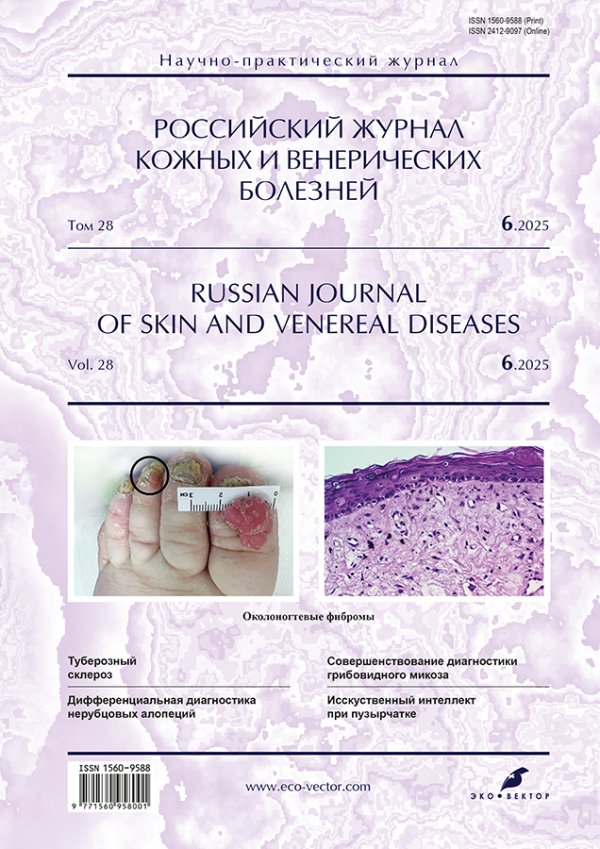
- Authors: Gaydina T.A.1,2, Sharova N.M.1, Dvornikov A.S.1, Kukalo S.V.1, Silin A.A.1,2, Ponkratova L.Р.1,2
-
Affiliations:
- The Russian National Research Medical University named after N.I. Pirogov
- Federal Center of Brain Research and Neurotechnologies
- Issue: Vol 28, No 6 (2025)
- Pages: 643-656
- Section: DERMATOLOGY
- URL: https://ogarev-online.ru/1560-9588/article/view/367122
- DOI: https://doi.org/10.17816/dv689930
- EDN: https://elibrary.ru/RFMMSN
- ID: 367122
Cite item
 Open Access
 Access granted
 Subscription Access

Abstract
Tuberous sclerosis is an orphan neurocutaneous hereditary disorder characterized by multisystem involvement and age-dependent manifestation of symptoms. The disease results from sporadic or inherited mutations in TSC1 (9q34, hamartin) or TSC2 (16p13.3, tuberin). Under normal conditions, TSC1 and TSC2 regulate cell proliferation and tumor growth by inhibiting the mTORC1 complex (mechanistic target of rapamycin complex 1). Mutations in TSC1 and TSC2 disrupt formation of the hamartin–tuberin complex, leading to persistent activation of mTORC1 and uncontrolled cellular proliferation.
A detailed description of cutaneous manifestations of tuberous sclerosis is crucial for early diagnosis. Angiofibromas and periungual fibromas are major diagnostic criteria for tuberous sclerosis. Although not life-threatening, these tumors significantly impair patients’ quality of life due to their size, bleeding upon trauma, and risk of secondary infection. Removal of angiofibromas and periungual fibromas substantially improves patients’ quality of life. Various removal techniques have been described in the scientific data, with laser modalities offering practical advantages over surgical excision.
We followed two adult patients with large facial angiofibromas and periungual fibromas. Angiofibromas and periungual fibromas were removed using a CO2 laser under local infiltration anesthesia, followed by wound resurfacing with the same device in pulsed mode. Laser output ranged from 2 to 4 W. Immediately after excision, facial angiofibromas were additionally treated intralesionally with a pulsed dye laser. Excised tissue was submitted for histopathologic examination. Outcomes were assessed at 1 month, and patients were subsequently monitored every 3 months for 2 years by a dermatovenereologist. No tumor recurrences were observed during follow-up, underscoring the practical value of this approach for effective fibroma removal and improved quality of life.
Keywords
About the authors
Tatiana A. Gaydina
The Russian National Research Medical University named after N.I. Pirogov; Federal Center of Brain Research and Neurotechnologies
Author for correspondence.
Email: doc429@yandex.ru
ORCID iD: 0000-0001-8485-3294
SPIN-code: 5216-2059
MD, Cand. Sci. (Medicine), Assistant Professor
Russian Federation, Moscow; MoscowNatalia M. Sharova
The Russian National Research Medical University named after N.I. Pirogov
Email: nataliasharova@inbox.ru
ORCID iD: 0000-0002-2239-7235
SPIN-code: 4105-3517
MD, Dr. Sci. (Medicine), Professor
Russian Federation, MoscowAnton S. Dvornikov
The Russian National Research Medical University named after N.I. Pirogov
Email: dvornikov_as@rsmu.ru
ORCID iD: 0000-0002-0429-3117
SPIN-code: 2023-5783
MD, Dr. Sci. (Medicine), Professor
Russian Federation, MoscowSvetlana V. Kukalo
The Russian National Research Medical University named after N.I. Pirogov
Email: svetlana_kukalo@inbox.ru
ORCID iD: 0000-0002-2639-6811
SPIN-code: 3711-3460
MD, Cand. Sci. (Medicine), Assistant Professor
Russian Federation, MoscowAlexey A. Silin
The Russian National Research Medical University named after N.I. Pirogov; Federal Center of Brain Research and Neurotechnologies
Email: silin_aa@rsmu.ru
ORCID iD: 0000-0003-0312-4853
SPIN-code: 5004-0378
Russian Federation, Moscow; Moscow
Lyudmila Р. Ponkratova
The Russian National Research Medical University named after N.I. Pirogov; Federal Center of Brain Research and Neurotechnologies
Email: Ponkratova_lp@rsmu.ru
ORCID iD: 0009-0003-6852-1531
SPIN-code: 6559-5647
Russian Federation, Moscow; Moscow
References
- Northrup H, Aronow ME, Bebin EM, et al.; International Tuberous Sclerosis Complex Consensus Group. Updated international tuberous sclerosis complex diagnostic criteria and surveillance and management recommendations. Pediatr Neurol. 2021;123:50–66. doi: 10.1016/j.pediatrneurol.2021.07.011 EDN: ILZBRU
- Kwiatkovski DJ, Whittemore VH, Thiele EA. Tuberous sclerosis complex: genes, clinical features and therapeutics. USA, Wiley-Blackwell; 2010. 432 р. ISBN 978-3-527-63007-3
- Varenova TN, Goshadze VA, Akutina DI, Pomerantsev ON. Long-term undiagnosed tuberous sclerosis. Vestnik dermatologii i venerologii. 2021;97(3):66–72. doi: 10.25208/vdv1237 EDN: CGRITJ
- Gómez MR. History of the tuberous sclerosis complex. Brain Dev. 1995;17Suppl:55–57. doi: 10.1016/0387-7604(94)00130-8
- Northrup H, Krueger DA; International Tuberous Sclerosis Complex Consensus Group. Tuberous sclerosis complex diagnostic criteria update: recommendations of the 2012 International Tuberous Sclerosis Complex Consensus Conference. Pediatr Neurol. 2013;49(4):243–254. doi: 10.1016/j.pediatrneurol.2013.08.001
- Wataya-Kaneda M, Uemura M, Fujita K, et al. Tuberous sclerosis complex: recent advances in manifestations and therapy. Int J Urol. 2017;24(9):681–691. doi: 10.1111/iju.13390 EDN: YGLIDX
- Keln AA, Semenova EV, Keln OL, Shvedskyi MS. Tuberous sclerosis with kidneys angiomyolipomas: a family case. Urology Herald. 2023;11(1):165–170. doi: 10.21886/2308-6424-2023-11-1-165-170 EDN: WCBBOH
- Hong CH, Tu HP, Lin JR, Lee CH. An estimation of the incidence of tuberous sclerosis complex in a nationwide retrospective cohort study (1997–2010). Br J Dermatol. 2016;174(6):1282–1289. doi: 10.1111/bjd.14415
- Kishida S, Nakatani E, Usui T, et al. Epidemiological insights and healthcare challenges of tuberous sclerosis complex in Shizuoka Prefecture: a retrospective cohort study. Orphanet J Rare Dis. 2025;20(1):245. doi: 10.1186/s13023-025-03799-w
- Belaya SA, Likhachev SA, Kulikova SL, et al. A lesion of the nervous system associated with tsc in childhood. Own observations. Neurology and neurosurgery. Eastern Europe. 2021;11(4):465–480 doi: 10.34883/PI.2021.11.4.048 EDN: RUYKJQ
- Troitskaya LA, Malakhova NE, Dorofeeva MY. Features of development of higher mental functions in children with tuberous sclerosis. Russian bulletin of perinatology and pediatrics. 2017;62:(4):99–104. doi: 10.21508/1027-4065-2017-62-4-99-104 EDN: ZFCZGL
- Dabora SL, Jozwiak S, Franz DN, et al. Mutational analysis in a cohort of 224 tuberous sclerosis patients indicates increased severity of TSC2, compared with TSC1, disease in multiple organs. Am J Hum Genet. 2001;68(1):64–80. doi: 10.1086/316951
- Dufner Almeida LG, Nanhoe S, Zonta A, et al. Comparison of the functional and structural characteristics of rare TSC2 variants with clinical and genetic findings. Hum Mutat. 2020;41(4):759–773. doi: 10.1002/humu.23963
- Duan J, Pan S, Ye Y, et al. Uncovering hidden genetic variations: long-read sequencing reveals new insights into tuberous sclerosis complex. Front Cell Dev Biol. 2024;12:1423244. doi: 10.3389/fcell.2024.1415258 EDN: ZCEFWU
- Curatolo P, Moavero R, Roberto D, Graziola F. Genotype/phenotype correlations in tuberous sclerosis complex. Semin Pediatr Neurol. 2015;22(4):259–273. doi: 10.1016/j.spen.2015.10.002 EDN: WRWXKF
- Kwiatkowski DJ, Palmer MR, Jozwiak S, et al. Response to everolimus is seen in TSC-associated SEGAs and angiomyolipomas independent of mutation type and site in TSC1 and TSC2. Eur J Hum Gen. 2015;23(12):1665–1672. doi: 10.1038/ejhg.2015.47 EDN: VELENL
- Saxton RA, Sabatini DM. mTOR signaling in growth, metabolism, and disease. Cell. 2017;168(6):960–976. doi: 10.1016/j.cell.2017.02.004
- Altunina GE, Balayan IG, Belousova ED, et al. Tuberous sclerosis. Diagnostics and treatment. Dorofeeva MYu, editor. Moscow: Adare; 2017. 288 р. (In Russ.) EDN: XQAKKT
- Lepesova MM, Isabekova AA, Kuderbayeva DA, Orazaliev BA. Features of clinical manifestations, diagnosis, and treatment of tuberous sclerosis in children. Actual problems of theoretical and clinical medicine. 2024;(2):57–66. doi: 10.24412/2790-1289-2024-2-57-66 EDN: ZPFTSF
- Dorofeeva MYu, Belousova ED, Pivovarova AM. Recommendations for diagnosis and treatment of tuberous sclerosis. S.S. Korsakov J Neurol Psych. 2014;114(3):58–74. EDN: SDIJGZ
- Okanishi T, Fujimori I, Yamada M, et al. Diagnostic flow analysis of tuberous sclerosis complex in Japan: a retrospective claims database study. Orphanet J Rare Dis. 2024;19(1):451. doi: 10.1186/s13023-024-03460-y EDN: VDQZAS
- Gaydina TA, Dvornikov AS, Skripkina PA, Arutyunyan GB. Rationale for removing nevus sebaceus of Jadassohn in young patients. Bull Russ State Med University. 2018;(3):77–80. doi: 10.24075/brsmu.2018.033 EDN: YAWSPB
- Gaydina TA, Dvornikov AS, Skripkina PA, et al. Differential diagnosis of Brooke–Spiegler syndrome in a young woman with multiple trichoepitheliomas. Russ J Skin Venereal Dis. 2022;25(6):5–16. doi: 10.17816/dv112260 EDN: WUIKXO
- Lodi G, Cannarozzo G, Fusco I, et al. Effective technique using combined CO2 laser and pulsed dye laserfor facial angiofibromas management in tuberous sclerosis. Case Rep Dermatol Med. 2024;2024:9775613. doi: 10.1155/2024/9775613 EDN: ICKPLY
- Neamonitou F, Neamonitos KK, Stavrianos S, Neamonitos KP. A triple laser combination treatment for facial angiofibromata management in tuberous sclerosis and literature review. Arch Plast Surg. 2024;51(4):372–377. doi: 10.1055/a-2306-0962 EDN: VDOTLP
- Meikle L, Talos DM, Onda H, et al. A mouse model of tuberous sclerosis: neuronal loss of Tsc1 causes dysplastic and ectopic neurons,reduced myelination, seizure activity, and limited survival. J Neurosci. 2007;27(21):5546–5558. doi: 10.1523/JNEUROSCI.5540-06.20074
- Zeng LH, Xu L, Gutmann DH, Wong M. Rapamycin preventsepilepsy in a mouse model of tuberous sclerosis complex. Ann Neurol. 2008;63(4):444–453. doi: 10.1002/ana.213315
- Ehninger D, Silva AJ. Rapamycin for treating tuberous sclerosis and autism spectrum disorders. Trends Mol Med. 2011;17(2):78–87. doi: 10.1016/j.molmed.2010.10.002 EDN: OARDPF
- Morozov SL, Piruzieva OR, Dlin VV. Effectiveness of targeted therapy for kidney damage with tuberous sclerosis in a child (clinical case). Nephrology. 2021;25(4):90–94. doi: 10.36485/1561-6274-2021-25-4-90-94 EDN: JGHKXT
- Kologrivko EV, Rucina KA, Akhidzhak AN. Tuberosis sclerosis during pregnancy and inuterine at the fetus. Nauchnyi vestnik zdravookhraneniya Kubani. 2023;(3):29–42. EDN: SPHLBM
- Nunes BA, Romano AK, Pasa Morgan MA, et al. A dermatological assessment of pediatric patients with tuberous sclerosis complex (TSC). An Bras Dermatol. 2024;99(5):662–669. doi: 10.1016/j.abd.2023.11.004 EDN: JFRBDV
- Deng S, Shi W, Cai Y, et al. Tuberous sclerosis complex with skin lesions as the initial presentation: a case report and multidisciplinary discussion. Zhong Nan Da Xue Xue Bao Yi Xue Ban. 2022;47(7):973–980. doi: 10.11817/j.issn.1672-7347.2022.210452
- Li Y, Wang Z, Yang Y, Xu X. Tuberous sclerosis complex presenting as periungual fibromas: a rare case report and literature review. Clin Cosmet Investig Dermatol. 2024;17:2747–2753. doi: 10.2147/CCID.S488272 EDN: ZCLCWG
Supplementary files
