






 Email this article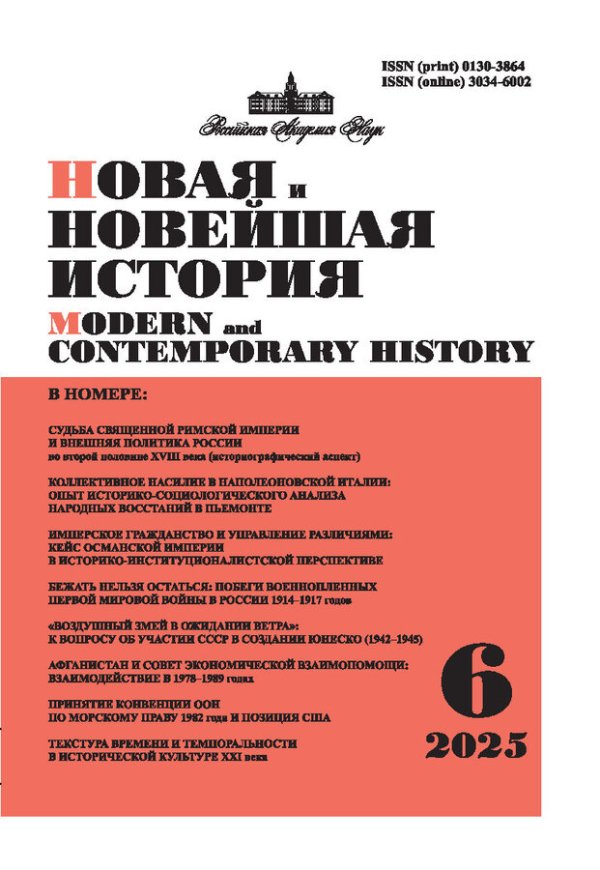
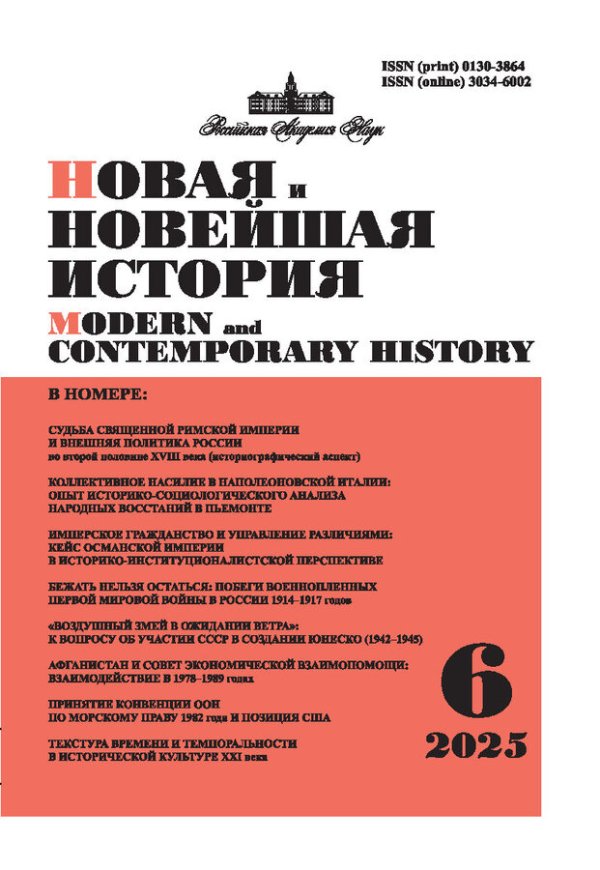
The Fate of the Holy Roman Empire and Russian Foreign Policy in the Second Half of the Eighteenth Century: A Historiographical Perspective
- Authors: Petrova M.A1
-
Affiliations:
- Institute of World History of the Russian Academy of Sciences
- Issue: No 6 (2025)
- Pages: 5-18
- Section: Theory and methodology of history
- URL: https://ogarev-online.ru/0130-3864/article/view/360453
- DOI: https://doi.org/10.7868/S0130386425060017
- ID: 360453
Cite item
 Open Access
 Access granted
 Subscription Access

Abstract
This article analyses historiographical approaches to the transformation of the Holy Roman Empire of the German Nation after the Peace of Westphalia in 1648. Scholars have generally interpreted this process as the gradual decline of imperial institutions under the pressure of territorial particularism, the dualism of Austria and Prussia, dynastic conflicts within the Habsburg Monarchy, and the external shocks of the European wars of succession and the French Revolution. The study highlights a factor that has received less systematic attention: the emergence of the Russian Empire in 1721 as a new imperial actor in the European diplomatic and legal order. Russia initially sought equality with the Holy Roman Empire and later positioned itself as a guarantor of its constitutional integrity. Drawing on existing historiography, the article reviews research on the German orientation of Russian foreign policy, the recognition of the Russian imperial title, the Holstein question and the legitimisation of the Grand Dukes Peter Feodorovich and Paul Petrovich as Dukes of Holstein-Gottorp, as well as Russia’s role in guaranteeing the Peace of Teschen (1779). The author concludes that the interaction between Russia and the institutions of the Holy Roman Empire remains insufficiently studied. Further examination of this relationship is essential for understanding both the late history of the Empire and Russia’s integration into the European state system of the eighteenth century.
About the authors
M. A Petrova
Institute of World History of the Russian Academy of Sciences
Author for correspondence.
Email: maria.petrova@bk.ru
Scopus Author ID: 57211014068
ResearcherId: V-2400-2019
Moscow, Russia
References
- Анисимов М.Ю. Россия в системе великих держав в царствование Елизаветы Петровны (1741–1761 гг.). М., 2020.
- Бантыш-Каменский Н.Н. Обзор внешних сношений России (по 1800 год): в 4-х ч. Ч. 2. Германия и Италия. М., 1896.
- Елисеева О.И. Геополитические проекты Г.А. Потемкина. М., 2000.
- Кампманн К. Леопольд I: имперская политика, династические цели и испанское наследство // Исторические исследования. 2017. № 7. C. 69–89. URL: http://www.historystudies.msu.ru/ojs2/index.php/ISIS/article/view/121 (дата обращения: 30.05.2025).
- Колесников И.Н., Дарендорф М.В. Русские дипломаты в государствах Германии XVIII века: Франкфурт-на-Майне, германские княжества и города // Вопросы истории. 2019. № 10. С. 124–130.
- Колесников И.Н., Дарендорф М.В., Александрова И.Н. Русские дипломаты XVIII в. в государствах Германии: Пруссия, Саксония, Голштиния // Вопросы истории. 2019. № 8. С. 106–118.
- Лиштенан Ф.-Д. Россия входит в Европу: императрица Елизавета Петровна и война за Австрийское наследство, 1740–1750. М., 2000.
- Мартенс Ф.Ф. Собрание трактатов и конвенций, заключенных Россиею с иностранными державами. Т. I, II, V, VI. СПб., 1874–1883.
- Нелипович С.Г. Союз двуглавых орлов: русско-австрийский военный альянс второй четверти XVIII в. М., 2010.
- Нерсесов Г.А. Политика России на Тешенском конгрессе (1778–1779). М., 1988.
- Петрова М.А. Герман Карл фон Кейзерлинг и признание императорского титула российских государей Священной Римской империей германской нации в 1745–1746 гг. // Вестник МГИМО-Университета. 2021. Т. 14. № 6. С. 89–109.
- Петрова М.А. Екатерина II и Иосиф II: формирование российско-австрийского союза. 1780–1790. М., 2011.
- Петрова М.А. Легитимация великого князя Петра Федоровича как герцога Гольштейн-Готторпского в Священной Римской империи // Новая и новейшая история. 2023. № 6. С. 34–48. DOI: https://doi.org/10.31857/S013038640026774-9
- Петрова М.А. Признание императорского титула российских государей Священной Римской империей: проблема и пути ее решения (первая половина 1740-х годов) // Новая и новейшая история. 2022. № 6. С. 43–59. DOI: https://doi.org/10.31857/S013038640021151-4
- Петрова М.А. Проблема голштинского опекунства во внешней политике Екатерины II в 1762–1764 гг. // Электронный научно-образовательный журнал «История». 2024. Т. 15. Вып. 12 (146). Ч. 1. DOI: https://doi.org/10.18254/S207987840033543-6
- Стегний П.В. Голштинский вопрос в дипломатии Екатерины II // Российская дипломатия: история и современность. Материалы научно-практической конференции, посвященной 450-летию создания Посольского приказа. М., 2001. С. 169–198.
- Стегний П.В. Разделы Польши и дипломатия Екатерины II. 1772. 1793. 1795. М., 2002.
- Трачевский А.С. Союз князей и немецкая политика Екатерины II, Фридриха II и Иосифа II. 1780–1790. СПб., 1877.
- Шарф К. Екатерина II, Германия и немцы / пер. с нем. И. Карташева, М. Лавринович. М., 2015.
- Anisimov M.Yu. Russia in the system of great powers during the reign of Elisabeth Petrovna (1741–1761). Moscow, 2020. (In Russ.)
- Bantysh-Kamenskij N.N. Review of the Russian foreign relations till 1800. Vol. 2. Germany and Italy. Moscow, 1896. (In Russ.)
- Eliseeva O.I. Geopolitical projects of G.A. Potemkin. Moscow, 2000. (In Russ.)
- Kampmann K. Imperial Policy, dynastic claims and Spanish Succession // History studies. 2017. № 7. P. 69–89. URL: http://www.historystudies.msu.ru/ojs2/index.php/ISIS/article/view/121 (access date: 30.05.2025). (In Russ.)
- Kolesnikov I.N., Dahrendorf M.V. Russian diplomats in the German states of the 18th century: Frankfurt am Main, German principalities and cities // Questions of History. 2019. № 10. P. 124–130. (In Russ.)
- Kolesnikov I.N., Dahrendorf M.V., Aleksandrova I.N. Russian diplomats in the German states of the 18th century: Prussia, Saxony, Holstein // Questions of History. 2019. № 8. P. 106–118. (In Russ.)
- Lishtenan F.-D. Russia enters Europe: Empress Elisabeth Petrovna and the War of Austrian Succession, 1740–1750. Moscow, 2000. (In Russ.)
- Martens F.F. Collection of treaties and conventions which Russia concluded with foreign powers. T. I, II, V, VI. Saint-Petersburg, 1874–1883. (In Russ.)
- Nelipovich S.G. Union of double-headed Eagles: Russian-Austrian military alliance of the second quarter of the 18th century. Moscow, 2010. (In Russ.)
- Nersesov G.A. Russian policy at the Teschen Congress. Moscow, 1988. (In Russ.)
- Petrova M.A. Catherine II and Joseph II: Formation of the Austro-Russian Alliance. 1780–1790. Moscow, 2011. P. 190–194. (In Russ.)
- Petrova M.A. Hermann Karl von Keyserling and the Recognition of the Imperial Title of Russian Sovereigns by the Holy Roman Empire of the German Nation in 1745–1746 // Bulletin Moscow State Institute of International Relations. 2021. Vol. 14. № 6. P. 89–109. (In Russ.)
- Petrova M.A. Legitimation of Grand Duke Peter Fedorovich as Duke of Holstein-Gottorp in the Holy Roman Empire // Novaya i Novejshaya Istoriya. 2023. № 6. P. 34–48. DOI: https://doi.org/10.31857/S013038640026774-9 (In Russ.)
- Petrova M.A. The Problem of Holstein Guardianship in the Foreign Policy of Catherine II in 1762–1764 // Istoriya. 2024. Vol. 15. Iss. 12 (146). Pt. 1. DOI: https://doi.org/10.18254/S207987840033543-6 (In Russ.)
- Petrova M.A. The Recognition of the Imperial Title of Russian Sovereigns by the Holy Roman Empire: The Problem and Its Solutions (first half of the 1740s) // Novaya i Novejshaya Istoriya. 2022. № 6. Р. 43–59. DOI: https://doi.org/10.31857/S013038640021151-4 (In Russ.)
- Sharf K. Catherine II, Germany and Germans / translated from German I. Kartasheva, M. Lavrinovich. Moscow, 2015. (In Russ.)
- Stegnij P.V. The Holstein Question in the Diplomacy of Catherine II // Russian Diplomacy: History and Modernity. Materials of the scientific-practical conference dedicated to the 450th anniversary of the creation of the Ambassadorial Chancery. Moscow, 2001. P. 169–198. (In Russ.)
- Stegnij P.V. The Partitions of Poland and diplomacy of Catherine II. 1772. 1793. 1795. Moscow, 2002. (In Russ.)
- Trachevskij A.S. The League of Princes and the German policy of Catherine II, Frederick II and Joseph II. Saint-Petersburg, 1877. (In Russ.)
- Anderson M.S. The War of the Austrian Succession, 1740–1748. London, 2014.
- Aretin K.O.F. von. Das Alte Reich. 4 Bde. Stuttgart, 1993–2000.
- Aretin K.O.F. von. Heiliges Römisches Reich 1776–1806: Reichsverfassung und Staatssouveränität. 2 Bde. Wiesbaden, 1967.
- Aretin K.O.F. von. Russland und die Reichspolitik Kaiser Josephs II // Katharina II., Russland und Europa: Beiträge zur internationalen Forschung / Hrsg. C. Scharf. Mainz, 2001. S. 121–133.
- Beales D. Joseph II. Vol. 2. Against the World, 1780–1790. Cambridge, 2009.
- Bérenger J. Die Habsburger und ihre Erbfolgekrisen als Formationsphase des neuen europäischen Staatensystems // Das europäische Staatensystem im Wandel: Strukturelle Bedingungen und bewegende Kräfte seit der frühen Neuzeit / Hrsg. P. Krüger. München, 1996. S. 63–88.
- Bernard P.P. Joseph II and Bavaria: Two Eighteenth-Century Attempts at German Unification. The Hague, 1965.
- Croxton D. The Peace of Westphalia of 1648 and the Origins of Sovereignty // The International History Review. 1999. Vol. 21. № 3. P. 569–591.
- Deutsche Geschichte. Bd. 3. Die Epoche des Übergangs vom Feudalismus zum Kapitalismus von den siebziger Jahren des 15. Jahrhunderts bis 1789 / Hrsg. A. Laube, G. Vogler. Berlin, 1983.
- Dickmann F. Der Westfälische Frieden. Münster, 1959.
- Droysen J.G.B. Geschichte der preußischen Politik. T. 5. Leipzig, 1855–1886.
- Duchhardt H. Das Reich in der Mitte der Staatensystems. Zum Verhältnis von innerer Verfassung und internationaler Funktion in den Wandlungen des 17. und 18. Jahrhunderts // Das europäische Staatensystem im Wandel: Strukturelle Bedingungen und bewegende Kräfte seit der frühen Neuzeit / Hrsg. P. Krüger. München, 1996. S. 1–9.
- Duffy Ch. Russia’s Military Way to the West: Origins and Nature оf Russian Military Power, 1700–1800. London; Boston, 1981.
- Hintze O. Historische und politische Aufsätze. 10 Bde. Berlin, 1908.
- Hochedlinger M. Austria’s Wars of Emergence. War, State and Society in the Habsburg Monarchy, 1683–1797. London, 2003.
- Hübner E. Staatspolitik und Familieninteresse: die gottorfische Frage in der russischen Aussenpolitik, 1741–1773. Neumünster, 1984.
- Kampmann Ch. Das Heilige Römische Reich deutscher Nation – das nominelle Imperium? // Imperien und Reiche in der Weltgeschichte: epochenübergreifende und globalhistorische Vergleiche / Hrsg. S. Fick, M. Gehler. Bd. 1. Imperien des Altertums, mittelalterliche und frühneuzeitliche Imperien. Wiesbaden, 2014. S. 711–724.
- Kordel J. Zur Genese der Mission Nikolaj Petrovič Rumjancevs in Frankfurt am Main. Ein Beitrag zur russischen Deutschlandpolitik in den 1780er Jahren // Zapiski historyczne. 2022. T. 87. Z. 3. S. 69–100.
- Krasner S.D. Westphalia and All That // Ideas and Foreign Policy: Beliefs, Institutions and Political Change / eds J. Goldstein, R.O. Keohane. London, 1993. P. 235–264.
- Kulenkampf A. Österreich und das alte Reich. Die Reichspolitik des Staatskanzlers Kaunitz unter Maria Theresia und Joseph II. Köln, 2005.
- Liechtenhan F.-D. La Russie entre en Europe: Elisabeth Ire et la succession d’Autriche (1740–1750). Paris, 1997.
- Madariaga I. de. The Secret Austro-Russian Treaty of 1781 // Slavonic and East-European Review. 1959. Vol. 38. № 90. P. 114–145.
- Mazohl-Wallnig B. Zeitenwende 1806: Das Heilige Römische Reich und die Geburt des modernen Europas. Wien, 2005.
- Mediger W. Moskaus Weg nach Europa. Der Aufstieg Russlands zum europäischen Machtstaat im Zeitalter Friedrichs des Grossen. Braunschweig, 1952.
- Mraz G. Das Ende des Heiligen Römischen Reichs: Ursachen und Folgen für die österreichische und deutsche Geschichte // Das Heilige Römische Reich und sein Ende 1806: Zäsur in der deutschen und europäischen Geschichte / Hrsg. von P.C. Hartmann, F. Schuller. Regensburg, 2006. S. 78–86.
- Nersesov G.A. Russland, die bayerische Erbfolge und der Frieden von Teschen / trans. C. Scharf. München, 2021.
- Oberländer E. “Ist die Kaiserin von Rußland Garant des Westfälischen Friedens?” Der Kurfürst von Trier, die Französische Revolution und Katharina II. 1789–1792 // Jahrbücher für Geschichte Osteuropas. Neue Folge. 1987. Bd. 35. S. 218–231.
- Osiander A. Sovereignty, International Relations and the Westphalian Myth // International Organization. 2001. Vol. 55/2. P. 251–287.
- Press V. Das Alte Reich. Ausgewählte Aufsätze / Hrsg. von J. Kunisch. Berlin, 2000.
- Press V. Kriege und Krisen. Deutschland. 1600–1715. München, 1991.
- Ranke L. Die deutschen Mächte und der Fürstenbund. Deutsche Geschichte von 1780–1790. 2 Bde. Leipzig, 1871–1872.
- Reichsstadt, Reich, Europa: Neue Perspektiven auf den Immerwährenden Reichstag zu Regensburg (1663–1806) / Hrsg. H. Rudolph, A. von Schlachta. Regensburg, 2015.
- Scharf C. Katharina II, Deutschland und die Deutschen. Mainz, 1996.
- Schindling A. Kaiser, Reich und Reichsverfassung 1648–1806. Das neue Bild vom Alten Reich // Altes Reich, Frankreich und Europa: Politische, philosophische und historische Aspekte des französischen Deutschlandbildes im 17. und 18. Jahrhundert / Hrsg. O. Asbach, K. Malettke, S. Externbrink. Berlin, 2001. S. 25–54.
- Schmidt A. Geschichte des preußisch-deutschen Unionsbestrebungen seit der Zeit Friedrichs des Großen. Berlin, 1851.
- Schmidt A. Preußens deutsche Politik. 1785. 1806. 1849. 1866 / Umgearbeitet und bis auf die Gegenwart geführte Auflage. Leipzig, 1867.
- Schmidt G. Geschichte des alten Reiches. Staat und Nation in der frühen Neuzeit, 1495–1806. München, 1999.
- Srbik H.R. von. Deutsche Einheit. Idee und Wirklichkeit vom Heiligen Reich bis Königgrätz. 4 Bde. München, 1935–1942.
- Stollberg-Rilinger B. Das Heilige Römische Reich Deutscher Nation. Vom Ende des Mittelalters bis 1806. München, 2006.
- Stollberg-Rilinger B. Des Kaisers alte Kleider. Verfassungsgeschichte und Symbolsprache des Alten Reiches. München, 2008.
- Treitschke H. von. Deutsche Geschichte im Neunzehnten Jahrhundert. Bd. 1. Bis zum zweiten Pariser Frieden. Leipzig, 1879.
- Wrede M. Der Kaiser, das Reich, die deutsche Nation und ihre “Feinde”: Nationsgenese, Reichsidee und der “Durchbruch des Politischen” im Jahrhundert nach dem Westfälischen Frieden // Historische Zeitschrift. 2005. Bd. 280. S. 83–116.
Supplementary files
