




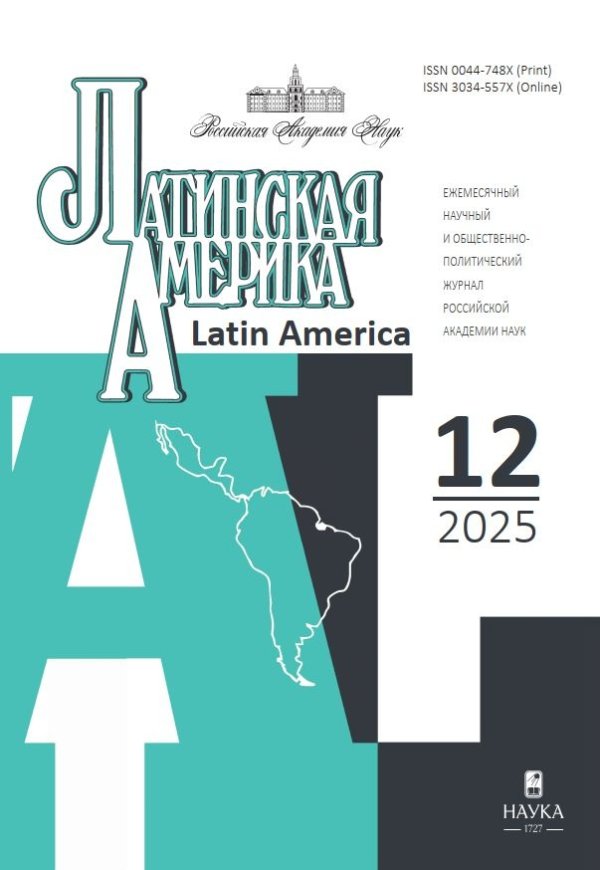
Latinskaya Amerika
The peer-review scientific monthly journal comprising research papers and articles on social and political problems.
Founded in 1969.
Media registration certificate: № 0110358 от 02.03.1993
Founders
- Russian Academy of Sciences
- Institute of Latin America
Publisher
- Russian academy of sciences
Published under the authority of the Global Problems and International Relations Department of the RAS
About the journal
«Latinskaya Amerika» journal is:
- a unique for Russia and the CIS professional multidisciplinary edition in Russian, which analyses the current theoretical, scientific and practical problems of Ibero-America;
- gives readers a wide panorama of the Ibero-American world, publishes exclusive interviews of heads of state, ministers, politicians, diplomats, parliamentarians and public figures, prominent representatives of science, business, culture and art, works of world-famous writers of Latin America, Spain and Portugal;
Indexation
- the list of peer-reviewed journals recommended by the Higher Attestation Commission for the publication of works of applicants for scientific degrees;
- Russian Science Citation Index (RSCI).
Distribution
- worldwide among scientists, professors and students of higher educational institutions, as well as among the service staff, parliamentarians and business persons.
In the Journal
- Politics
- Economy
- Social problems
- History
- International relationships
- Iberian aspect
- Culture
- Art and literature
- Reviews of new editions
The authors of the Journal are leading scientists of the ILA RAS; researchers from other Russian academic and non-academic research institutes studying international affairs; industry analysts; professors of specialized universities and postgraduate students; foreign researchers.
Our readership is international affairs experts: economists, political scientists, sociologists, cultural scientists, historians; professors, postgraduate students and students of specialized universities; heads and staff of federal and regional government bodies.


Current Issue
 Open Access
 Access granted
 Subscription Access
No 12 (2025)

Economy
Central-West Region as a Phenomenon of Regional Development in Brazil
Abstract
The Central-West region of Brazil emerged in the second half of the 20th century, when Brasilia, built on previously empty land, became the country's capital. Its economic specialization has been driven by the development of the Cerrado savannas and the expansion of an agro-industrial complex, a process comparable to agricultural colonization campaigns in the United States, Argentina, the Russian Empire and the Soviet Union. While parts of the region have since lost their characteristics of frontier (pioneer zone) and now function as peripheral areas related to the South and Southeast, the agrarian colonization frontier continues to advance into the Amazon and the Northeast.
 6-24
6-24


International relations
Asian Migration to Latin America: Patterns of Mobility in the Sailing Ships Age
Abstract
The article treats the features of trans-Pacific migration, when mobility was carried out using sailing vessels. Manila galleons became a key element of commodity exchange during the colonial period and a symbol of two-way communication between New Spain and the Philippines. In the 16th and 17th centuries, Asian migration was expressed in the slave trade, but the prohibition of “indio-chino” slavery in 1672 limited this form of human traffic. After gaining independence, Latin American states faced a shortage of workers. Based on the example of Peru, the peculiarities of the transformation of the trans–Pacific transport communication, the quantitative dynamics of the importation of contracted Chinese coolie workers, and their working conditions are considered. It is concluded that the coolie phenomenon was a transitional form of labor relations on plantations, which ended at the same time as the decline of the sailing age as the dominant form of transoceanic communication.
25-40
Intercultural integration and adaptation of teaching Russian in Latin American countries (Republic of Cuba, Bolivarian Republic of Venezuela, Republic of Nicaragua)
Abstract
Goal
To design a model of intercultural integration and adaptation of Russian language teaching in three Latin American countries: the Republic of Cuba, the Bolivarian Republic of Venezuela, and the Republic of Nicaragua.
Methods
The work uses such a method of system research as structural analysis, which allows us to determine the structure of the system, including its elements and their interaction.
Results
A brief retrospective analysis of the situation with the study of the Russian language in three Latin American countries is carried out: the Republic of Cuba, the Bolivarian Republic of Venezuela, and the Republic of Nicaragua. The model proposed by the authors of the article includes four interrelated blocks: value, structural, procedural and methodological. The contents of these blocks are presented. The value block defines social and personal values, based on which the student's value orientation is formed. It, in turn, determines the motivation of the student. The structural block examines the existing government and educational structures, as well as the links between them, which contribute to the processes of intercultural integration and adaptation of Russian language teaching in these countries. All the processes under study are divided into management and development processes, main processes and auxiliary processes. The authors believe that the linguistic and cultural approach should be used in the teaching of Russian as a foreign language. The competence formed as a result of such training will have four components: linguistic, ethnocultural, semiotic and axiological.
Conclusions
The analysis of scientific papers carried out by the authors showed that the problems of intercultural integration and adaptation of Russian language teaching, taking into account the modern educational context of Latin American countries, have not been sufficiently developed and need additional research. The conceptual model proposed by the authors will help determine the content and forms of methodological support for the training of Russian language teachers in these Latin American countries.
41-54
History pages
The Impact of Modern Military Formats on Regional Identity in the State of Yucatan (1847-1853)
Abstract
The article deals with a theorization of the impact of novel military format (mobilized conscript forces) on regional identities in Latin American context. The State of Yucatan, due to its isolation and magnitude of the Caste War, a social conflict that lasted between 1847 and 1901, emerged as a sort of military and social laboratory, which made possible a use of new, modern principles of war as well as a case study of its impact on self-identification of various social groups and society in a whole.
55-63
Competition of yuong scientists
Barbados' Strategic Partnership with the Global South: Motivations, Mechanisms, and Prospects for Regional and International Policy.
Abstract
The article analyzes the foreign policy of Barbados as a small island nation which actively engages in cooperation with countries in the Global South. It highlights key fields such as the environmental agenda, participation in South-South mechanisms, and the reform of international financial institutions. The article also focuses on Prime Minister Mia Mottley's initiatives, including the «Bridgetown Initiative», and the importance of women's leadership and small-state diplomacy in promoting global justice.
64-71
Culture
Funny “vanilla people” who fly. The past and present of the totonaki people and their ancient memorials
Abstract
The article examines the most famous archaeological sites, artifacts, and traditions of the Totonaks as an example of the synthesis of common civilizational and unique manifestations of this Mesoamerican culture. An important place is given to the analysis of the fate of the Totonak heritage in modern conditions. The author notes the increasing pace and volume of archaeological research, points out the importance and relevance of issues regulating the legal aspects of the interests of science and indigenous people. The article also examines various forms of using cultural monuments for educational, tourist, commercial, and entertainment purposes. Mexican scientists are concerned about the tendency of archaeological sites to turn into Disneyland elements.
72-83
Scientific life
New Iberoamerican studies festival at the Neva River
Abstract
For almost a quarter of a century the northern capital of Russia has hosted the best representatives of different schools of Russian and foreign Ibero-American studies at the Saint-Petersburg University. Time is moving forward, the topics are changing, and the forms of events are varying, but one thing remains unchanged: interest in participating in the International Forum "Russia and Iberoamerica in a Turbulent World: from common Challenges to joint Solutions", which has converted into the largest meeting of researchers from the Iberoamerican world. This year the forum had about 900 speakers from 30 countries, numerous keynote speakers and a lot of thematic panels and round tables reflecting the key issues of contemporary Ibero-American studies. The ever-growing interest of young people in research work in the field of Ibero-American studies is another peculiarity of this academic event.
84-91
Thinking about read
"Herald of Freedom," or the phenomenon of Javier Miley
Abstract
The review examines the monograph by the professor of the King Juan Carlos University in Madrid Philipp Bagus, dedicated to the life, philosophy and rising to power of the present Argentinian president Javier Milei. The monograph gives the picture of the economic policy of Argentina during the last 50 years and sets the main theorical aspects of the libertarian ideology, which is being used by J. Milei as the basis for the future “economic miracle” of Argentina. The review analyzes some aspects of this ideology, which give possibility to judge as for the perspectives of the Argentinian economic growth.
92-98
The price paid for carelessness and mistakes. A new history of the Mexican communists
Abstract
The authors analyze the contents of the book of memoirs by Rodolfo Echeverria Martinez, a prominent character in the activities of the Mexican Communist Party. The assessments made by the author of the memoirs provide a fundamentally new perspective on a number of key episodes in the complex history of the PCM. The review shows the importance of these memoirs for updating the historiography devoted to the history of the Leftist movement in Mexico.
99-104