



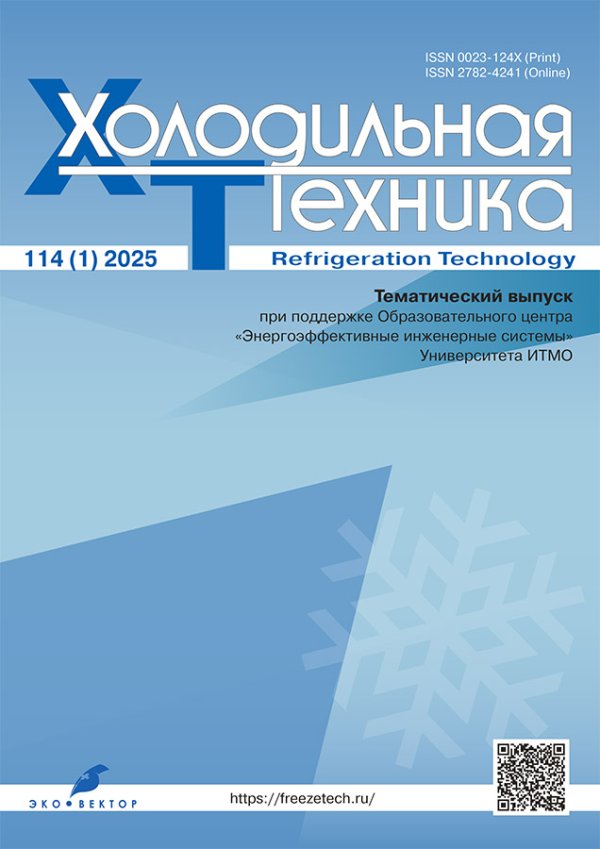
Refrigeration Technology
Peer-review quarterly journal.
About
The journal publish fundamental and applied research and reviews also with informational and analytical articles on all areas of refrigeration, cryogenic engineering and technology, air conditioning and ventilation, automation and control, re-transport, food production processes and equipment, working substances, environmental problems and energy saving.
The journal is the primary source of information on fundamental and applied works of leading scientists.
Founder & Publisher
- Eco-Vector
WEB: https://eco-vector.com/
Editor-in-Chief
- Maxim S. Talyzin
ORCID: 0000-0001-7244-1946
Indexing
- Russian Science Citation Index
- Agris
- Google Scholar
- WorldCat
- Ulrich's Periodicals Directory
APC, Publication & Distribution
- Articles in English and Russian
- quarterly issues
- continuously publication online in Online First
- Hybrid Access (Subscription or Open Access with CC BY-NC-ND 4.0 License)
- No Article Processing Charges and/or Article Publication Charges (APC)
Types of accepted articles
- reviews
- systematic reviews and metaanalyses
- original research
- letters to the editor
- short communications
Current Issue
 Open Access
 Access granted
 Subscription Access
Vol 114, No 1 (2025)

Reviews
Evolution of liquid nitrogen supply modules in cooling systems for cryotherapy units
Abstract
For over 25 years now, single cryotherapy units (cryosaunas) have been produced and used in clinical practice in the Russian Federation. Cryotherapy is a type of physiotherapy based on short-term contact of the entire surface of the human body's skin with a gaseous medium cooled to cryogenic temperatures. Reducing skin temperature through intensive heat transfer to the cryogenic gas (coolant) stimulates the skin's cold receptors and creates conditions for the treatment of some socially significant diseases, including rheumatoid arthritis, psoriasis, asthma, allergy, etc. The main operational issue with such units is that the patient's skin releases a large amount of accumulated heat in contact with cryogenic gas. The most effective method to remove this heat flow is to use liquid nitrogen as a heat-receptive medium (cryogen). The world's first cryotherapy unit based on liquid nitrogen was used to discover and prove the effectiveness of cryotherapy. Then, the effectiveness of nitrogen refrigeration systems was questioned and they were replaced by compression refrigeration systems in some countries. In Russia, nitrogen refrigeration technology was developed and adapted to the design of single cryotherapy units. Thus, this cryosauna offers the highest cryotherapy efficacy with the lowest consumption of liquid nitrogen.
This work aimed to analyze liquid nitrogen supply units in the cryosauna refrigeration system and identify the most effective technology.
It was found that nitrogen refrigeration systems allow to remove a greater amount of heat with the lowest energy consumption. Moreover, no additional refrigeration equipment is required. Contact nitrogen refrigeration systems have lower thermal inertia and higher efficiency of liquid cryogen. It is proposed to use of an alternative cryogen in multi-seat cryotherapy units. Contact nitrogen refrigeration systems in single cryotherapy units is the most reasonable option in terms of power and technology.
 5-16
5-16


Refrigeration technologies ensuring food security: scientific school of professor Valentina S. Kolodyaznaya. In memory of scientist and teacher
Abstract
The paper is dedicated to the memory of the scientist and teacher, Doctor of Engineering, Professor Valentina S. Kolodyaznaya (1937–2023).
Preservation of quality, nutritional value, reduction of storage losses, increasing the shelf life of raw materials and food products by refrigeration is one of the main tasks of contemporary food technologies.
The article presents a review of long-term researches of Prof. Kolodyaznaya's scientific school on the use of refrigeration technologies to provide food security. The projects supervised by Valentina Kolodyaznaya involved designing of recipes for healthy food products, demonstrated the feasibility of process and storage parameters, created new types of packaging and barrier nanocoatings, allowing to preserve food products for a long time and ensure their high quality and safety. The research papers addressed a pressing national economic problem of reducing losses associated with microbial spoilage of food ingredients, developed freezing and low-temperature storage technologies, proposed biocontrol methods based on the study of microbial communities, and introduced technologies for comprehensive use of all types of both basic and side ingredients.
The paper presents an overview of some studies led by Valentina S. Kolodyaznaya. It is shown that the growth rate of indicator bacteria is much lower during storage of small-piece semi-finished veal products with different coatings, including solutions of organic acids and gelatin and chitosan; sodium alginate and chitosan guar and chitosan in different ratios and in polyethylene packaging.
The paper presents the studies of biofungicides, a set of biocontrol agents used to develop biopreparations reducing the pathogen load on plants during storage at low positive temperatures. Evaluation of antagonistic activity against phytopathogenic microorganisms of fruits and vegetables revealed that some pseudomonad strains (RF13H, RF14J, RM14B, RF12C) have biocontrol and adaptive properties characterised by metabolic and protective activity.
Various methods of freezing plants in air medium, liquid coolants, and vapour nitrogen medium at different temperatures were studied under the supervision of Professor Kolodyaznaya, including studies of partial dehydration by microwave vacuum dehydration and freezing of garden strawberries, blackcurrants, and chokeberries.
Graduates of Kolodyaznaya scientific school continue to work both in research and educational centres and large Russian and foreign industrial companies.
17-26
Liquid cooling system performance analysis: free cooling opportunities in Saint Petersburg
Abstract
This paper presents an analysis and comparison of the energy and cost effectiveness of year-round liquid cooling systems that could be used in the climate of Saint Petersburg. An analysis of average monthly outdoor air temperatures over the past 10 years and the calculation of the seasonal energy performance ratio of a standard chiller and a chiller with an integrated free cooling system allowed to calculate the cost effectiveness of the free cooling technology.
The study showed that a chiller with an integrated free cooling system has a significantly higher (by approximately 30%) seasonal energy performance ratio compared to a standard chiller. A cost estimate has confirmed that, despite higher initial capital costs, the free cooling system provides annual energy savings of approximately 1.5 million RUB. Economic benefits (return on additional investment) are already achieved in the first year of operation due to a significant reduction in operating costs.
This study analyzes and provides design solutions for cooling systems based on real-life climate data for Saint Petersburg (average annual temperature = 7.1 °C) and the parameters of specific systems, enhansing the applicability of the findings in desiging energy-efficient systems in this region.
27-34
Creating a scroll compressor using Archimedean spiral as generator (part 1)
Abstract
The first paper in this series describes the global history of scroll compressors (SCs), provides a brief analysis of the advantages of SCs over other compressor types, and defines the operating principle of scroll compressors. The paper presents the basic theoretical construction premises for elements of a scroll compressor based on the Archimedean spiral as a generator and reasons for selecting the Archimedean spiral as a generator. It describes some methods for constructing a spiral pen, including a correction method allowing to construct a mathematical algorithm that describes a way to obtain one generator of a spiral pen in the case where the second generator is an Archimedean spiral. This method allows for a high degree of conformity of compressor elements. The following parts of the study describe a theoretical method for obtaining the second generator of the spiral pen using the principles of differential geometry and the envelope curve method. It allowed to obtain equations describing the external generator of the SC element provided that the internal generator is an Archimedean spiral. The paper discusses methods for joining the ends of the scrolls in the central part of the compressor and determines the relative issues. Further, other methods of scroll profiling based on the Archimedeean curve will be presented. In conclusion, there are a brief overview of existing SC modeling methods and a review of relative publications and main areas and trends in this branch of technology.
35-42
Original Study Articles
Cryogenic tank configuration and capacity of centrifugal boil-off gas compressors
Abstract
BACKGROUND: During the marine transportation of liquefied natural gas, the transported energy carrier constantly changes its physical state as the gas partly condenses becoming liquid and partly evaporates becoming gas, increasing the pressure in the cargo tanks. The amount of evaporated gas determines the required capacity of the boil-off gas compressors in the boil-off gas reliquefaction unit, which allows the evaporatedliquefied natural gasLNG components to return back to the storage tank.
AIM: To assess and analyze the influence of liquefied natural gas tanker geometry on the intensity of liquefied natural gas evaporation and the capacity of centrifugal boil-off gas compressors.
METHODS: The calculation method compares the liquefied natural gas evaporation rate with the cross-sectional area of filled tanks of various configurations based on heat exchange and thermal insulation, which is a key aspect in the design of cryogenic tanks. The authors use an example of three types of isolated tanks of different shape and height-to-diameter ratio, allowing to evaluate the influence of geometry on the evaporation intensity and to calculate the estimated capacity of centrifugal boil-off gas compressors.
RESULTS: To assess the influence of tank shape on liquefied natural gas volumetric losses, the authors use a model to consider heat gain through insulation and convective heat exchange with the environment. The findings allow to evaluate the influence of the tank design on the amount of generated boil-off gas, improve their design, and reduce the capacity of centrifugal boil-off gas compressors.
CONCLUSION: The analysis and calculations showed that the evaporation surface area directly affects the amount of evaporated boil-off gas and the power consumption of the boil-off gas compressor. The study may be useful for the design and improvement of cryogenic liquefied natural gas storage and transportation systems and for assessing the capacity of centrifugal boil-off gas compressors.
43-51
Theoretical substantiation of the efficiency of a screw single-rotor compressor with a new type of in-built capacity regulator
Abstract
BACKGROUND: The need for energy conservation is caused by the global social, environmental, and economic agenda. Refrigeration equipment is a significant consumer of power; thus, ensuring energy efficiency of cooling systems for various applications is an urgent task. This area can benefit from regulating the compressor displacement, which in turn is the main energy consumer of refrigeration systems.
AIM: To explain the efficiency of single screw compressor with novel built-in displacement regulator.
MATERIALS AND METHODS: We studied the single screw compressor equipped with a built-in displacement regulator (a rotary adjustment ring). Single screw compressor displacement during its regulation was calculated based on the developed mathematical model automated in the Python programming environment and ANSYS tools. In this case, single screw compressor efficiency was evaluated by two parameters, including volumetric efficiency λ and specific power consumption Ns.
RESULTS: The paper compares the efficiency of single screw compressor for frequency displacement regulation and regulation with a rotary adjustment ring. It was found that regulation with a rotary adjustment ring is preferable.
CONCLUSION: The study revealed the preferable operating range of single screw compressor at the highest values of λ, approximately corresponding to the operation at 1500–3000 rpm. This range can be considered as optimal. Displacement regulation by its reduction using a frequency control outside the selected range will be ineffective. In the regulation range of actual displacement Va ≈ 10%–40%, Ns increases. However, this value in the considered range is lower in regulation with an adjustment ring compared to the frequency regulation (up to 23.7% more effective for air-operated and up to 13.6% more effective for ammonia-operated control ring).
52-64