




 Open Access
 Access granted
 Subscription Access
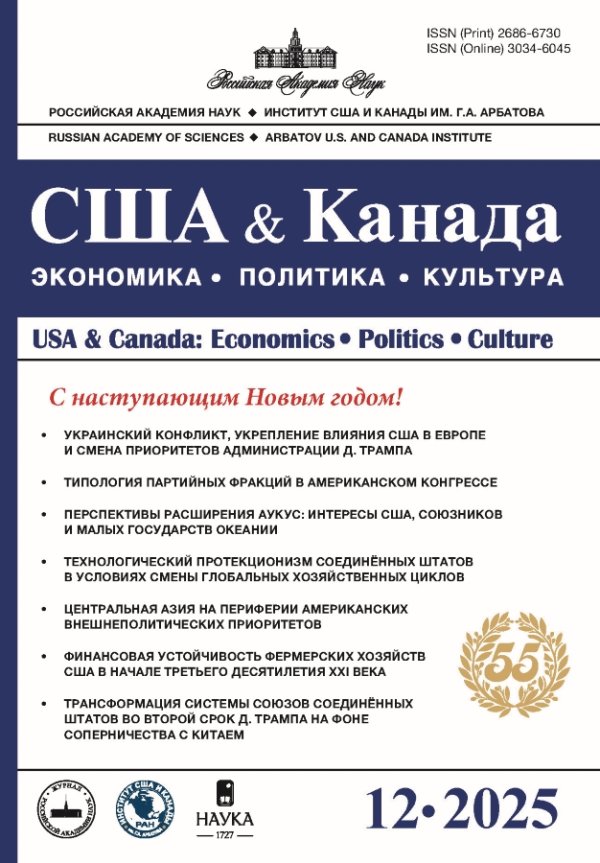
No 12 (2025)

Foreign Policy
Debate in the United States over a new trade war with China: basic arguments Pro et Contra
Abstract
The tariff issue was put in focus of the internal political discussion of the pro-liberal Democratic and pro-Trump wings in America. Facing the exacerbating of polemics and struggle with the Democrats, D. Trump is in need to present his arguments about tariffs in a more scientific, rather than politicized, populist way. The United States, according to this modified version, plays a special role in the world economy and world trade, providing two key pillars for their functioning. The first is the strategic pillar - the military-strategic role of the United States as a guarantor of the security of the democratic world. The second is the financial pillar, stemming from the role of the dollar as a reserve, exchange and accumulation currency. These two pillars - strategic and financial - are significantly costly and burdensome for America, and must be compensated by the trade partners of the United States. Critics of D. Trump's tariff policy note, that protective tariffs, first of all, are hitting the American consumers, damaging the purchasing power of the households and fueling inflation. For the successful restructuring of the world trading system, in addition to tariff policy, deeper and more comprehensive measures are needed. These include the coordination of exchange rates and trade agreements of various countries, investment in new technologies, coordination of trade policies among allied countries, strengthening trade alliances, and keeping the WTO system afloat. The main negative impact of the tariff policy of the new administration, according to its critics, is that it leads to the destruction of the stabilizing and system-forming role of the United States as a pillar of the open markets in the world economy, that developed after World War II.
USA & Canada: Economics, Politics, Culture. 2025;(12):5–17
 5–17
5–17


Current U.S. Policy in Central Asia: From the First to the Second D. Trump Administrations
Abstract
Over the past few years, the geopolitical and economic landscape of Central Asia has been changing due to the influence of both internal and external dynamics. This creates conditions, but, as demonstrated in the article, has not lead to Central Asia become one of priority regions in U.S. foreign policy. The article aims to identify the determinants, constants and changes in U.S. policy in Central Asia in the period from 2017 to early 2025. The article characterizes the role of Central Asia in US foreign policy calculus, demonstrates the motivation, approaches and tools of the Trump and Biden administrations in expanding American presence in the region, and assesses the prospects for US regional policy under the second term of Trump.
USA & Canada: Economics, Politics, Culture. 2025;(12):18–29
18–29
Prospects for AUKUS Expansion under the Second Trump Administration
Abstract
The article is devoted to the analysis of the prospects for the expansion of AUKUS through the inclusion of new members, as well as the alliance’s overall activity following the return of Donald Trump’s administration to power. The authors examine recent trends and outcomes of cooperation within AUKUS framework and conclude that the alliance’s agenda generally aligns with U.S. interests under D. Trump, despite such challenges as the slow pace of nuclear submarine construction and what the Trump administration sees as insufficient Australian defense spending. At the same time, AUKUS members and potential candidates for joining the alliance hold different views on its expansion and activities: positive (Canada), neutral (South Korea, Japan), mostly critical (New Zealand), and ambivalent (Australia). The article pays special attention to how AUKUS is perceived by the Pacific Island States, which are concerned about the alliance’s nuclear component, environmental risks, and the lack of regional consultation. The authors conclude that, despite current U.S. support, the long-term sustainability of AUKUS will depend on the ability of its members to share responsibilities and find mutually beneficial solutions for implementing future projects under the Pillar 2 agenda.
USA & Canada: Economics, Politics, Culture. 2025;(12):30–43
30–43
U.S. and the World
Transformation of the US Alliance System under Trump 2.0
Abstract
Alliance is a vital tool for great powers to achieve their foreign policy objectives. After the Cold War, the alliance system established by the United States to counterbalance the USSR gradually evolved into a bidirectional alliance system aimed at hegemonic maintenance, rooted in unipolar dominance and shared values, and consisting of the transatlantic alliance and the transpacific alliance. After Trump came to power again in 2025, he explicitly defined the goal of the alliance system as competing with China. While weakening the material and ideological foundations of the US alliance system, he has established reciprocal economic and trade relations as the new basis for alliances. Trump is driving the US alliance system toward a phase of reconstructive dynamism by shifting the structural focus to the Indo-Pacific region, which will have profound implications for American hegemony, regional dynamics, and international order. In the context of the US alliance system increasingly being instrumentalized to serve the objectives of American foreign policy toward China during Trump’s second term, the transformation of the US alliance system has intensified China-US tensions in security affairs. However, centrifugal forces have emerged within the US alliance system, leaving some room for maneuver in China-US relations. The underlying motivation for the US to adjust its alliance system is still to maintain American hegemony, which will lead to an overall trend of conservatism in China-US relations over the long term. Currently, academic research on American alliance policy tends to focus on the adjustment of alliance system objectives driven by changes in external threats. However, Trump’s second term not only made concentrated adjustments to alliance system objectives but also involved changes in the foundations and structures of the US alliance system, which reflect domestic political changes such as shifts in the ideas of American political elites and strategic community perceptions. These changes provide an important case study to understand changes in American foreign policy as well as to analyze the evolution of alliance functions in the international system.
USA & Canada: Economics, Politics, Culture. 2025;(12):44–55
44–55
Global Security
The Consequences of the Conflict in Ukraine for American Military Policy in Europe
Abstract
The conflict in Ukraine has allowed the United States to strengthen its influence in Europe. Sweden and Finland succeeded in joining the North Atlantic Alliance, and trade and economic ties between the EU and the Russian Federation (ties that have caused such irritation in Washington) were seriously damaged. Finally, the American ruling elites have succeeded in achieving their long-standing goal of increasing defense spending by their European NATO allies. At the same time, the United States has failed to achieve the goal of a “strategic defeat” of Russia. The new Trump administration sees no point in American involvement in the conflict in Ukraine at a time when, from its point of view, the United States has much higher foreign policy priorities, especially in the Indo-Pacific region. Hence the desire of the new administration to achieve a truce in Ukraine as soon as possible, in order to direct the freed American resources to address other foreign policy tasks.
USA & Canada: Economics, Politics, Culture. 2025;(12):56–69
56–69
Domestic Politics
The Typology of Factions within the U.S. Political Parties During Donald J. Trump’s Second Administration
Abstract
The paper analyzes current trends in the Republican and Democratic parties of the United States, which are radicalization and factionalism. Those trends have deepened after D. Trump’s victory in the 2024 general elections and might heavily influence the next electoral cycle. Based on an analysis of the political, economic, and social agendas, as well as the human assets of Democrats and Republicans, the authors propose an original typology of factions. These are very likely to influence the further internal transformation of both parties in 2026–2028.
USA & Canada: Economics, Politics, Culture. 2025;(12):70–83
70–83
Economic Survey
Legalization of US Technological Protectionism in the New Geoeconomic Reality
Abstract
The increased competition for leadership in the global economy between the United States of America and "non-Western" countries has acquired special features with the overlay of a number of global economic cycles: the third technological megacycle, the sixth innovation wave and descending stage of the long Kondratiev cycle. The decisive factor in acquiring or retaining economic initiative is the availability of material, human and financial resources. In order to setup control over the global resource base and intensify the inflow of these resources, the United States have activated a policy of legalized technological protectionism. It is characterized by an increasing spread of aggressive instruments of pressure upon the economic systems of competitors, legally formalized at the national level and agreed upon at the level of international organizations and multinational companies. The article identifies the key reasons for the emergence of new forms of technological protectionism, analyzes the main instruments and considers the manifested aftereffects of this policy. The double-edged nature of modern technological protectionism for the initiating countries is proven. Its negative consequences for the global economy as a whole are revealed.
USA & Canada: Economics, Politics, Culture. 2025;(12):84–97
84–97
Agriculture
The U.S. Agricultural Economy at the Beginning of the Third Decade of the 21st Century
Abstract
Agriculture forms the basis of the U.S. agro-food complex, which occupies a leading position in the current agricultural world. As a result of long-term development, the farming sector of the American economy has evolved into a highly efficient industry, which is reflected in the main financial and economic indicators of its functioning. This article analyzes a number of reports generated by the U.S. Department of Agriculture, characterizing various aspects of the country's agriculture at the beginning of the third decade of the 21st century. These include reports on the commodity structure of agricultural production, calculation of net cash and farm income, balance sheet, and other related reports. The financial performance and sustainability of the functioning of the farming sector of the country's economy as a whole are estimated.
USA & Canada: Economics, Politics, Culture. 2025;(12):98–112
98–112
The Institute's Books (2025)
USA & Canada: Economics, Politics, Culture. 2025;(12):113–115
113–115
Soderzhanie za 2025 god
USA & Canada: Economics, Politics, Culture. 2025;(12):116–120
116–120
Contents-2025
USA & Canada: Economics, Politics, Culture. 2025;(12):121-124
121-124
Informatsiya dlya avtorov
USA & Canada: Economics, Politics, Culture. 2025;(12):127–128
127–128
In Memoriam to a Colleague
Batyuk V. I.
USA & Canada: Economics, Politics, Culture. 2025;(12):125–126
125–126