



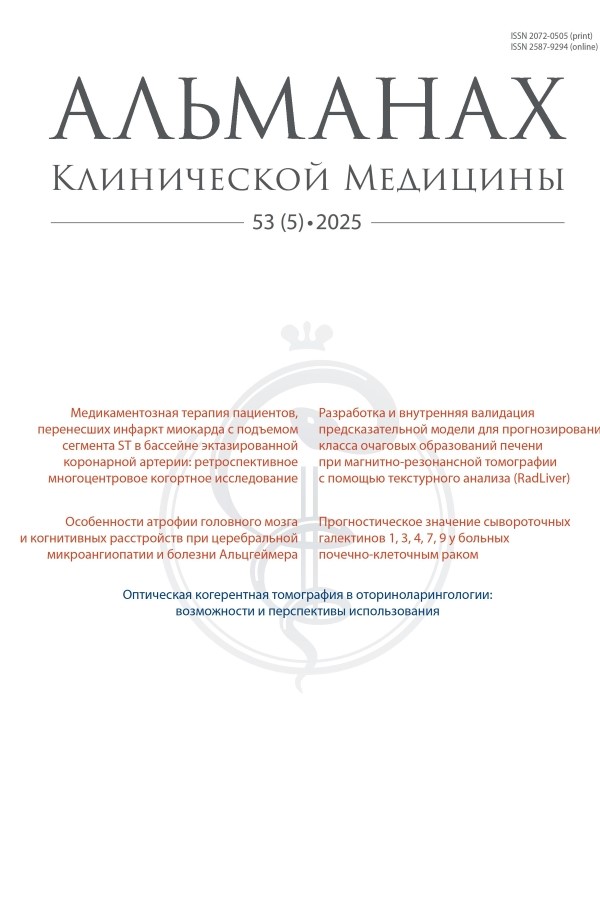
Almanac of Clinical Medicine
Scientific and practical peer-reviewed journal
“Almanac of Clinical Medicine” deals with issues of development of relevant research in diagnostics, treatment and prevention of various disorders, development and implementation into medical practice of new technologies, devices and pharmaceuticals, as well as with organizational problems of public healthcare. Publications in the journal mirror perspective developments of modern medical science in more than 45 areas.
The journal publishes articles on all aspects of clinical medicine: results of original, special, fundamental studies with clinical significance; review articles on relevant medical problems; clinical case descriptions; clinical guidelines. Publications in the journal are free.
“Almanac of Clinical Medicine” is in the List of leading reviewed scientific journals, where main scientific results of theses for a scientific degree of candidate of medical sciences and doctor of medical sciences must be published (VAK list).
The journal is indexed in Scopus, Russian Science Citation Index (RSCI).
Current Issue
Vol 53, No 5 (2025)

ARTICLES
Medical treatment of patients with ST-elevation myocardial infarction involving an ectatic coronary artery: a retrospective multicenter cohort study
Abstract
Background: Coronary artery ectasia (CAE) complicates the course of ST segment elevation myocardial infarction (STEMI) by increasing the risk of thrombotic complication, which is commonly associated with increased infarction area. The optimal choice of antihypertensives and anticoagulants may potentially improve clinical outcomes in these patients.
Aim: To assess the impact of various antihypertensive and anticoagulant regimens on long-term clinical outcomes in patients with STEMI and ectasia of the index artery.
Methods: This retrospective multicenter study included 80 patients with STEMI and angiographically confirmed CAE of the index artery, hospitalized from January 2014 to February 2022. All patients received standard treatment (dual antiplatelet therapy, statins, and β-blockers). Additional medications included angiotensin-converting enzyme inhibitors (ACEi), angiotensin II receptor blockers (ARB), calcium channel blockers (CCB), and direct oral anticoagulants (DOAC). Clinical endpoints were followed up to December 31, 2024. Kaplan–Meier analysis was used to evaluate the primary combination endpoint, i. e. major adverse cardiovascular events (MACE), which included overall mortality, stroke, recurrent myocardial infarction, hospitalizations due to chronic heart failure (CHF), and secondary endpoints (overall mortality, stroke, recurrent myocardial infarction, recurrent revascularization of the index artery, and hospitalizations due to CHF).
Results: The cohort of the patients admitted with STEMI and CAE of the index artery (n = 80) consisted mostly of men (81.3%), and the mean age was 61 years. Arterial hypertension and hyperlipidemia were present in 71.3% of the patients each; diabetes mellitus in 18.8%, and 50% of the patients were smokers. Most patients (86.3%) were admitted without signs of severe acute heart failure (Killip class I), with median SYNTAX score of 11. The median follow-up duration was 58 months. The use of ACEi did not reduce the MACE rate (35.6% vs 33.3%; p = 0.860), but was associated with a reduction in hospitalizations for CHF (6.8% vs 23.8%; p = 0.044). The use of ARB was not associated either with a reduction in the MACE rates (23.1% vs 37.3%; p = 0.790) or hospitalizations for CHF (15.4% vs 10.4%; p = 0.371). There was a non-significant trend toward a lower MACE rates (20% vs 37.1%; p = 0.11) and hospitalizations for CHF (0% vs 12.9%; p = 0.09) among patients taking CCB. The use of DOAC was not associated with a significant clinical benefit in MACE frequency (42.9% vs 34.2%; p = 0.261) or hospitalizations for CHF (0% vs 12.3%; p = 0.439).
Conclusion: In patients with CAE, particularly those with STEMI, the use of ACEi as a component of antihypertensive therapy should be considered to reduce the risk of heart failure decompensation, provided there are no contraindications. The potential benefits of CCB and DOAC warrant further investigation.
 227-240


Specifics of cerebral atrophy and cognitive impairment in cerebral small vessel disease and Alzheimer's disease
Abstract
Background: Cerebral small vessel disease (cSVD) and Alzheimer's disease (AD) are the most common causes of cognitive impairment (CI) in older adults. In some cases, they are difficult to be differentiated due to similar clinical, MRI, and laboratory manifestations, as well as comorbidity associated with accelerated CI progression.
Aim: To compare specific characteristics of cerebral atrophy and their association with the type and severity of CI in cSVD and AD patients.
Methods: This was a single-center observational cross-sectional study with consecutive patient recruitment conducted from December 2020 to December 2023. It included 45 cSVD patients (48.9% women, mean age 64.6 ± 5.7 years) and 26 AD patients (61.5% women, mean age 66.1 ± 7.9 years). All participants underwent a comprehensive neuropsychological examination and brain MRI (3 Tesla) with calculation of volumetric indices (gray and white matter volumes, white matter hyperintensities, and cerebrospinal fluid), ventriculocranial coefficients for assessing internal atrophy, and surface morphometry.
Results: No statistically significant sex, age, or education level differences were found between cSVD and AD patients (p > 0.05); however, arterial hypertension and obesity were more prevalent in cSVD (p = 0.003). Most cSVD patients were diagnosed with cognitive dysfunction with impairment of executive function (33.3%) and of the mixed (55.6%) type, whereas in AD, an isolated amnestic type (96.3%) dominated (p < 0.001). The results of neuropsychological tests showed significant between-group differences for the MoCA scale scores and memory tests (p = 0.002 and p < 0.001, respectively), but not for executive functions (p > 0.05). In cSVD, cognitive test results correlated with all intracranial volumetric indices and internal atrophy coefficients (r > 0.25, p < 0.05), while in AD, they correlated only with gray matter volume (for MoCA R = 0.436, p = 0.02). Moderate CI in AD was characterized by the temporoparietal cortex atrophy (p = 0.006 for the left middle temporal gyrus, and p = 0.051 for the right upper parietal gyrus), while in cSVD, it was associated with insular atrophy from both sides (p = 0.014 for the right and p = 0.058 for the left insula). Dementia manifested as atrophy extending beyond these regions. Binary logistic regression allowed for the differentiation between mild CI and dementia by regional atrophy thresholds: in AD, of the right parahippocampal gyrus (AUC = 0.753; 95% confidence interval 0.557 to 0.949, p = 0.033) and in cSVD, of the isthmus of the left cingulate gyrus (AUC = 0.778; 95% confidence interval 0.637 to 0.919, p = 0.001).
Conclusion: cSVD and AD significantly differ by the CI and cerebral atrophy profile. Region-specific atrophy markers can be used for the differential diagnostics of the pathologies and their mixed forms, and for monitoring of CI progression.
241-251
Prognostic value of serum galectins-1, -3, -4, -7, -9 in renal cell carcinoma patients
Abstract
Background: Renal cell carcinoma (RCC) is a highly immunogenic neoplasm and a promising target for the development of new approaches to immunotherapy. Galectins can modulate immune response, actively participating in inflammation, and help the tumor cells to escape host immune reaction. Some members of the galectin family could further become promising diagnostic or prognostic markers of various malignancies. However the data obtained are not unambiguous, and in some observations are extremely contradictory. We have demonstrated previously a significant increase of soluble galectins-1, -3 and -9 levels in serum of RCC patients before the initiation of anti-tumor therapy.
Aim: To analyze an association between serum galectins-1, -3, -4, -7, -9 levels and overall survival of RCC patients with various stages of the tumor process.
Methods: We retrospectively analyzed the impact of baseline soluble galectins-1, -3, -4, -7, -9 levels on overall survival of 129 patients with primary RCC who had undergone examination and treatment at the N. N. Blokhin National Medical Research Center of Oncology from 2019 to 2023. Surgery had been performed in all patients, and 10 of them had systemic target treatment or immunotherapy after surgery. Serum galectins concentrations were measured before the start of specific treatment with standard enzyme immunoassay kits.
Results: The patients (n = 129) were followed up for 0.3 to 64.6 months (median, 39.3 months) after surgery. During this follow-up 32 (24.8%) patients died. They survived from 0,3 to 50.8 months (median, 20.2 months) after the initiation treatment. The patient groups selected depending on the corresponding marker levels (above or below the median) were not different in their clinical and pathologic characteristics and the treatment performed. Only pre-treatment serum galectin-3 and galectin-9 levels were associated with overall survival rates. Serum concentrations of galectin-3 and galectin-9 above the median level (10.1 ng/mL and 9.2 ng/mL) significantly decreased the 5-years overall survival of RCC patients by 21.1% and 17.6% respectively.
Conclusion: Measurement of serum galectin-3 and galectin-9 concentrations can be used as supplementary criteria for the assessment of overall survival prognosis in patients with RCC.
252-259
Development and internal validation of a model to predict the class of focal liver lesions at magnetic resonance imaging by texture analysis
Abstract
Rationale: The differential diagnosis of focal liver lesions remains challenging, particularly in situations where the use of contrast agents in magnetic resonance imaging (MRI) is contraindicated (e. g., due to renal failure or allergy) or when the findings on T2-weighted images (T2WI) lack any pathognomonic signs. In these scenarios, an additional diagnostic tool is required to support decision-making, and a clinical-radiomic model capable of accurately classifying focal lesions based on T2WI data with accuracy and precision could be relevant.
Aim: To develop and perform internal validation of a clinical-radiomic model for the differential diagnosis of focal liver lesions based on T2WI.
Methods: This was a retrospective cross-sectional single-center study with an open anonymized WORC-Liver dataset, containing T2WI abdominal MRI images of patients with focal liver lesions (the original data collection performed at Erasmus Medical Center (Rotterdam, the Netherlands) between 2002 and 2018 using 1.5T Siemens, Philips, and General Electric scanners). Image processing included normalization (SimpleITK, Z-score) and interpolation to isotropic 1 × 1 × 1 mm³ voxels. Radiomic feature extraction was performed using intensity histograms and gray-level matrices (PyRadiomics). The characteristics were classified using the XGBoost algorithm with an 80:20 train-validation split.
Results: From the initial dataset of 186 cases, 146 patients (72 with malignant and 74 with benign lesions) were selected for analysis. On the internal validation set (n = 30), the model showed high diagnostic performance: ROC-AUC 96% (95% confidence interval [CI]: 0.89–1.00), sensitivity 87% (95% CI: 77–97), specificity 93% (95% CI: 85–100). The analysis of variable importance revealed the largest contributions from the following ones: patient age (SHAP +0.88), manufacturer: GE (SHAP +0.35), patient sex (SHAP +0.29), and original_gldm_DependenceNonUniformity (SHAP +0.17).
Conclusion: We were able to develop a high-accuracy clinical-radiomic model for the non-invasive differential diagnosis of focal liver lesions using native T2WI. The results demonstrate the model's potential for clinical application, particularly when the contrast administration is contraindicated. Its implementation would require further validation in larger and more diverse datasets.
260-267
REVIEW ARTICLE
Optical coherence tomography in otolaryngology: current opportunities and perspectives for use
Abstract
The development of new strategies to treatment of ENT disorders makes it necessary to implement non-invasive diagnostic methods into clinical practice; these methods should be able to provide the information on the biological tissues and be applicable to the intra-operational use. The aim of this review is to summarize the data on the use of optical coherent tomography (OCT) in the otolaringology. This method gives two- and three-dimensional images of a biological tissue with resolution of 1 mcm up to the depth of 2 mm. The use of this method in the ENT practice is associated with the development of specialized OCT modifications and special probes, including those compatible with standard endoscopes and/or intraoperational microscopes. OCT diagnostics may proved unique information for the solution of the following clinical tasks: the differential diagnosis between tumours and non-tumours, including their early stages, assessment of particular pathomorphological characteristics in inflammatory disorders, monitoring of tissue response to treatment. The addition of OCT to standard diagnostic algorithms would facilitate an improvement in the differential diagnosis and optimisation of treatment choice in a number of clinically significant ENT disorders. Multi-mode OCT equipment which allow both structural and functional information, as well as machine learning methods for image interpretation is a promising area of the OCT techniques.
268-284