

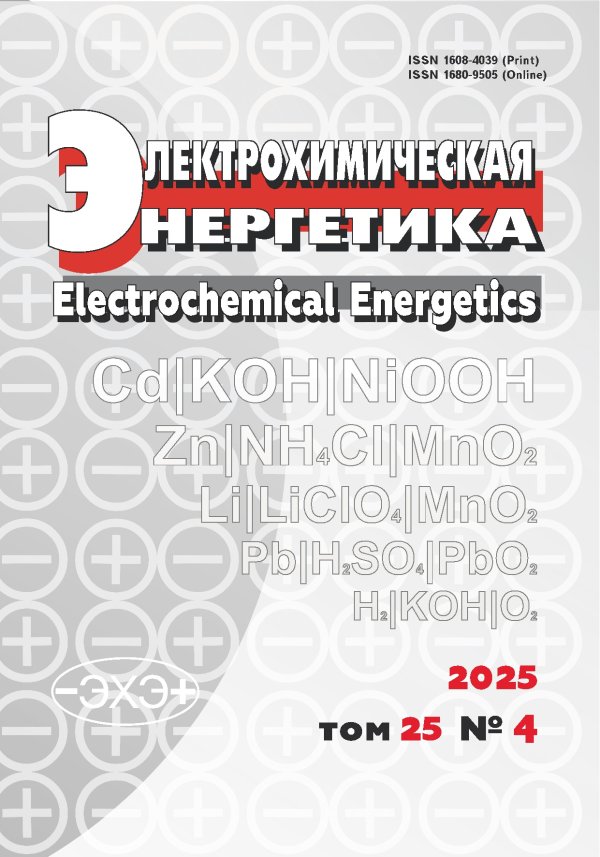
Electrochemical Energetics

The journal "Electrochemical Energetics" (Elektrokhimicheskaya Energetica) is a scientific periodical dedicated to the most dynamic branch of applied electrochemistry - chemical power sources.

ISSN 1608-4039 (print) ISSN 1680-9505 (online)

Frequency - 4 issues per year. Publication languages ​​are Russian and English.

The publisher of the journal is Saratov State University, Saratov, Russia.

The founders of the magazine are

Saratov State University, Saratov, Russia https://www.sgu.ru 

National Research University "Moscow Power Engineering Institute", Moscow https://mpei.ru

National Association of Manufacturers of Current Sources "RUSBAT", Moscow  http://www.rusbat.com

The mass media registration certificate: PI No 77-15569 of 20 May, 2003. It was re-registered by the Federal Service for Supervision in the Sphere of Mass Communications and Protection of Cultural Heritage due to the change in founders—Certificate PI No FS77-30820 of December 27, 2007.

Subscription index of publication 20844 in the United Catalog "Press of Russia", section 30 "Scientific and technical publications. Proceedings of the RAS. University News ".

Subscription online in the online catalog “Subscription Press” http://www.akc.ru.

Aims and Scope 

The aim of the journal is to highlight the results of research in the field of developing new and improving traditional electrochemical systems for chemical current sources.

The journal’s objectives are

  • publication of original scientific papers, surveys, reviews, reports;
  • coverage of the situation in the power sources industry (primary cells, batteries and electrochemical capacitors, fuel cells);
  • developing research and pilot-plans in the field of power sources in Russia and abroad;
  • information on the operation of enterprises, institutes, laboratories and departments;
  • information on conferences and meetings, exhibitions and training.

Research Areas of Elektrokhimicheskaya Energetica (Electrochemical Energetics):

1. Fundamental problems of energy conversion in lithium electrochemical systems;

2. Fundamental problems of the improvement of traditional electrochemical systems (lead-acid, nickel-cadmium, nickel-metal hydride);

3. Electrochemical capacitors;

4. Fuel cells and power installations on their basis;

5. Physicochemical problems of electrolytes and electrolyte systems (solid, non-aqueous, polymeric, and gel-like ones);

6. Scientific basis of modern technologies of production of chemical power sources; new materials, including composite and nano-scale ones.

7. Scientific bases of processing and recycling of chemical power sources.

Since 2007, by a decision of the Presidium of the Higher Attestation Commission of the Ministry of Education and Science of the Russian Federation, the journal was included in the List of peer-reviewed scientific publications (No. 1901 in the Higher Attestation Commission List in accordance with the order of the Russian Ministry of Education and Science dated December 28, 2018 No. 90-p based on the recommendations of the Higher Attestation Commission under the Russian Ministry of Education and Science http://http://vak.ed.gov.ru/87) in which the main scientific results of dissertations for the degree of candidate of sciences, for the degree of doctor of sciences, in scientific specialties and the corresponding branches of science should be published:

02.00.04 - Physical chemistry (chemical sciences),

02.00.05 - Electrochemistry (chemical sciences),

05.17.03 - Technology of electrochemical processes and corrosion protection (chemical sciences),

05.17.03 - Technology of electrochemical processes and corrosion protection (technical sciences)

Publications are free of charge.

The electronic version of the journal is Open Access. 

The content is published under the terms of the Creative Commons Attribution 4.0 International License (CC-BY 4.0)

最新一期

卷 25, 编号 4 (2025)

Articles

Study of electrode materials based on La0.65Ca0.35Co0.2Fe0.8 – xNixO1 – δ oxides used in solid oxide fuel cells and electrolyzers
Khokhlova M., Shubnikova E., Bragina O., Nemudry A., Cherendina O.
摘要
The effect of iron substitution with nickel cations in La0.65Ca0.35Co0.2Fe0.8−xNixO1−δ oxide on the structural and transport properties of electrode materials for solid oxide fuel cells and electrolyzers was studied in this work. It was shown that Ni3+ cations isomorphically replace Fe3+ /Fe4+ cations in the structure of perovskite. The total conductivity of La0.65Ca0.35Co0.2Fe0.8−xNixO1−δ (x = 0, 0.05) materials was measured in air in the temperature range from 100 to 850°C using the Van der Pauw method. Nickel doping results in improving of the total conductivity without changing the activation energy values.
Electrochemical Energetics. 2025;25(4):168-172
pages 168-172 views
Optimization of synthesis conditions of Na4Nb8P4O32 electrode material for sodium-ion batteries
Skachilova M., Shindrov A.
摘要
The optimal conditions for the synthesis of Na4Nb8P4O32 were found and the phase composition, morphology and electrochemical properties were studied in this work. The effect of the temperature and the synthesis time on the phase composition of Na4Nb8P4O32 were shown. According to the X-ray phase analysis data the optimal synthesis conditions were 900°C and 2.5 hours. The values of ionic and electronic conductivity were 2.7 · 10−7 S/cm and 6.1 · 10−6 S/cm, respectively. The obtained values of the charge and discharge capacities were 43 mA·h/g and 44 mA·h/g, respectively.
Electrochemical Energetics. 2025;25(4):173-177
pages 173-177 views
Synthesis and thermodynamic properties of new cathode materials for solid oxide fuel cells based on lanthanum strontium cobaltite
Vlasov S., Gongola M., Popov M., Nemudry A.
摘要
Doped with tantalum cations a new prospective cathode material for solid oxide fuel cells of lanthanum strontium cobaltite was synthesized. High-temperature oxygen desorption was studied using the quasi-equilibrium oxygen release method, the ranges of oxygen nonstoichiometry were determined, and the values of thermodynamic functions of the system were obtained in the temperature ranges (600–850°C) and oxygen partial pressures (∼10−5– 0.2 atm).
Electrochemical Energetics. 2025;25(4):178-182
pages 178-182 views
Influence of fabrication method on the microstructure of La0.6Sr0.2Ba0.2Fe0.7Co0.2Ni0.1O3 – δ microtubular membranes
Cherendina O., Laptev E., Shubnikova E., Tropin E., Bragina O., Nemudry A.
摘要
Microtubular membranes with the composition of La0.6Sr0.2Ba0.2Fe0.7Ni0.1Co0.2O3−δ were fabricated using phase inversion and dip- coating methods, followed by sintering in air. The obtained microtubular membranes were characterized by X-ray diffraction analysis and scanning electron microscopy. The optimal sintering temperature was selected taking into account the target application of the microtubular membranes and the corresponding microstructural requirements. The comparative analysis was performed based on the following parameters: inner and outer diameter, shrinkage, and the dimensions of the gas-tight and porous layers.
Electrochemical Energetics. 2025;25(4):183-188
pages 183-188 views
Development and testing of highly porous anodes of microtubular solid oxide fuel cells
Kovalev I., Tropin E., Popov M., Nemudry A.
摘要
A modification of the phase inversion method that enables high-precision control of the geometric parameters (diameter, wall thickness, and degree of alignment) of anode microtubular substrates of solid oxide fuel cells was proposed. Due to unique properties of the phase inversion process, which occurs simultaneously with solvent melting, anode microtubes with increased porosity and gas permeability were obtained compared to the microtubes obtained by traditional phase inversion extrusion method.
Electrochemical Energetics. 2025;25(4):189-193
pages 189-193 views
Inkjet 3D printing of a YSZ-based ceramic interconnect for microtubular solid oxide fuel cells
Frolenkova A., Titkov A., Perova E., Tolstobrov I.
摘要
A new design of the interconnect for tubular solid oxide fuel cells was presented. The functions of electrical connection and mechanical/gas distribution were separated in this interconnect. The electrical connection of the elements was provided by a separate metal wire laid around the frame. The paste composition and parameters for inkjet 3D printing, as well as the sintering regime, were optimized, enabling the production of dense samples with high microhardness. This approach allows for the use of Zr0.9Y0.1O1.95 (YSZ) material, which is chemically and thermally compatible with the electrolyte, eliminating the conductivity and corrosion problems taking place in traditional interconnects.
Electrochemical Energetics. 2025;25(4):194-199
pages 194-199 views
Polyurethane elastomer-based solid polymer electrolytes for solid-state supercapacitors
Podgornova O., Fedorov N., Uvarov N.
摘要
Solid polymer electrolytes are one of the promising materials for solid-state supercapacitors. In this work, the solid polymer electrolytes PU-PFL100 were obtained based on polyurethane elastomer filled with LiBF4 solution in N-methyl-2-pyrrolidone. Using cyclic voltammetry and galvanostatic charge/discharge methods, it was shown that Ti3C2/AC//PU-PFL100//Ti3C2/AC symmetrical supercapacitor cells, in which the composite based on Ti3C2 with activated carbon is used as electrodes, and PU-PFL100 is used as electrolyte and separator, exhibit specific capacitance of 34.5 F/g at a scan rate of 5 mV/s at the room temperature.
Electrochemical Energetics. 2025;25(4):200-204
pages 200-204 views
Binary system [N22pip]BF4-LiBF4 doped with Al2O3 as a composite lithium electrolyte
Izmodenova A., Ulihin A., Uvarov N.
摘要
Solid polymer electrolytes are one of the promising materials for solid-state supercapacitors. In this work, the solid polymer electrolytes PU-PFL100 were obtained based on polyurethane elastomer filled with LiBF4 solution in N-methyl-2-pyrrolidone. Using cyclic voltammetry and galvanostatic charge/discharge methods, it was shown that Ti3C2/AC//PU-PFL100//Ti3C2/AC symmetrical supercapacitor cells, in which the composite based on Ti3C2 with activated carbon is used as electrodes, and PU-PFL100 is used as electrolyte and separator, exhibit specific capacitance of 34.5 F/g at a scan rate of 5 mV/s at the room temperature.
Electrochemical Energetics. 2025;25(4):205-208
pages 205-208 views
Ceramics based on magnesium-aluminate spinel for solid oxide fuel cells
Ustyuzhaniov I., Dubovtsev D., Vepreva A., Pugacheva A., Saetova N., Kuzmin A.
摘要
Hot slip casting was applied to produce parts from magnesium-aluminate spinel for the ceramic gas flow distribution system for tubular solid oxide fuel cells. The developed system was sealed using glass sealants. The tubular oxide fuel cells was assembled using a gas unit made by hot slip casting.
Electrochemical Energetics. 2025;25(4):209-213
pages 209-213 views
Study of the effect of cobalt content on the stability of nickel composite anode materials for solid oxide fuel cells in high humidity
Ivanov A., Chikishev S., Bobro M., Vorotnikov V., Duvakin A., Kuzmin A.
摘要
In this work, the effect of humidity on the microstructural degradation of nickel-based metal– ceramic composite materials containing 0, 10, 20, 40, and 60 wt.% of cobalt in the metallic phase was investigated. The increase in cobalt concentration was found to have a beneficial effect on the stability of the microstructure and the long-term electrical conductivity, indicating the perspective of cobalt alloying as an approach to improve the performance and durability of SOFC anodes.
Electrochemical Energetics. 2025;25(4):214-219
pages 214-219 views
In situ high-temperature X-ray diffraction of La0.6Sr0.4Co1 – xMoxO3 – δ (x = 0.0–0.10) oxides used as cathodes for solid oxide fuel cells
Gongola M., Vlasov S., Popov M., Nemudry A.
摘要
The dependence of thermal expansion on the composition and atmosphere for molybdenumdoped lanthanum-strontium cobaltite La0.6Sr0.4Co1−xMoxO3−δ (х = 0–0.10) was studied by in situ hightemperature X-ray diffraction method (HTXRD). The linear coefficients of thermal expansion (CTE) were determined in air in the temperature range of 30–750°C. The linear dependence of the unit cell parameters on the molybdenum content was observed for the entire range of compositions, which obeys Vegard’s law and indicates the formation of solid solutions. The influence of the dopant concentration on the CTE value was analyzed.
Electrochemical Energetics. 2025;25(4):220-224
pages 220-224 views

Согласие на обработку персональных данных


Используя сайт https://journals.rcsi.science, я (далее – «Пользователь» или «Субъект персональных данных») даю согласие на обработку персональных данных на этом сайте (текст Согласия) и на обработку персональных данных с помощью сервиса «Яндекс.Метрика» (текст Согласия).