






 Email this article
FEATURES OF LEGAL REGULATION OF THE FUNCTIONING OF THE JUDICIAL SYSTEM IN SPECIAL CONDITIONS (CIRCUMSTANCES)
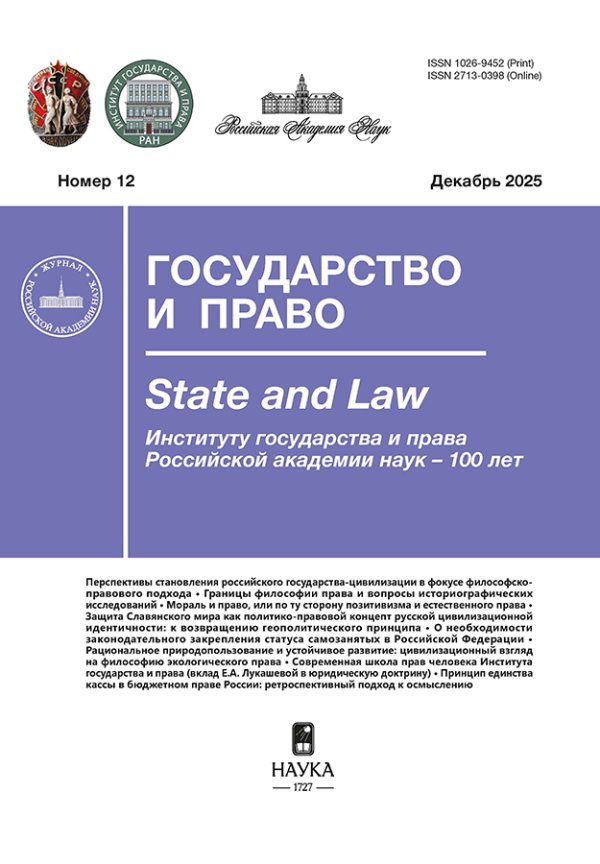
- Authors: Bolshakova V.M1
-
Affiliations:
- Nizhny Novgorod Institute of Management — Branch of the Russian Presidential Academy of National Economy and Public Administration
- Issue: No 12 (2025)
- Pages: 55-63
- Section: Court, prosecutor’s office, bar, notarial system
- URL: https://ogarev-online.ru/1026-9452/article/view/355791
- DOI: https://doi.org/10.7868/S3034543X25120065
- ID: 355791
Cite item
 Open Access
 Access granted
 Subscription Access

Abstract
The functioning of the judicial system must be ensured under conditions different from the usual (normal) ones. These are conditions in the event of an emergency (or the threat of its occurrence), the introduction of the legal regime of a counter-terrorist operation, a state of emergency or martial law, as well as the announcement of mobilization. The right to legal proceedings and dispute resolution by court is one of the fundamental human rights that cannot be violated under any circumstances, regardless of external conditions or the behavior of the subject of legal relations. At the same time, along with the fact that the right to judicial protection is a constitutionally significant value, the federal legislator is given the opportunity by constitutional provisions to establish a certain procedure and method of seeking judicial protection depending on the conditions of the situation and the behavior of a person. The subject of the research is the knowledge of the order and features of the functioning of the judicial system when introducing special legal regimes or the emergence of special conditions, the purpose of the research is comparative legal and systemic knowledge of the legislative order and methods of implementing judicial protection when introducing special legal regimes in special conditions, as well as the development of proposals for amending the current legislation. The knowledge of the order and features of the functioning of the judicial system in special conditions was carried out using a systemic and comparative legal study as a methodological platform. The use of such a methodology determined the coordinated application of the methods of analysis and synthesis, induction and deduction, historical and dialectical methods, as well as structural, component and functional study within the framework of the systems approach. By describing and substantiating the order and features of the functioning of the judicial system in special conditions, the work reveals the dynamics of the functions of the judicial system depending on its conditions. Based on the results of the study, the author propose amendments to the legislation on the activities of military courts, counter-terrorism, emergency situations and circumstances, which are aimed at organizational and procedural improvement of the rules governing the functioning of the judicial system when introducing special legal regimes or in emergency (other special) circumstances.
About the authors
V. M Bolshakova
Nizhny Novgorod Institute of Management — Branch of the Russian Presidential Academy of National Economy and Public Administration
Author for correspondence.
Email: valentinabolshakova@rambler.ru
Nizhny Novgorod, Russia
References
- Bolshakova V. M. The development of the judicial system as a subject of research in post-non-classical science // State and Law. 2024. No. 1. Pp. 197–204. DOI: 10.31857/ S1026945224010193 (in Russ.).
- Bolshakova V. M., Naumov P. Yu., Bakalkin S. V. Norma¬tive legal characteristics of special legal regimes in Rus¬sian law // Plevako Tambov Legal readings: proceedings of the V International Scientific and Practical Conferen-ce: in 2 vols, Tambov, May 28–29, 2021. Tambov, 2021. Pp. 341– 344 (in Russ.).
- Gasanov K. K., Kalamkaryan R. A., Migachev Yu. I. O. V. Ziborov. Administrative and legal concept of mar¬tial law // State and Law. 2019. No. 7. Pp. 204–206. doi: 10.31857/S013207690005896-7 (in Russ.).
- Gorban V. S. The system of courts of general jurisdiction in Germany and its effectiveness // Journal of Foreign Legis¬lation and Comparative Jurisprudence. 2023. Vol. 19. No. 1. Pp. 82–92. doi: 10.12737/jzsp.2023.009 (in Russ.).
- Ziborov O. V., Pavlichev I. S. The regulatory framework of the DIA in special conditions // Herald of the Moscow Univer¬sity of the Ministry of Internal Affairs of Russia. 2018. No. 2. Pp. 82–85 (in Russ.).
- Isaev V. I. Towards an optimal structure of the judicial sys¬tem: A review of the book by V. M. Bolshakova “The dy¬namics of judicial transformations in Russia in the se-cond half of the 19th – early 21st century (historical and le¬gal research)” // Legal Studies. 2021. No. 11. Pp. 108–116 (in Russ.).
- Kolokolov N. A. The conceptual way of understanding judi¬cial transformations in Russia (Review of the monograph by V. M. Bolshakova “Dynamics of judicial transformations in Russia in the second half of the 19th – early 21st centu¬ry (historical and legal research)”. RANEPA, Derzhavinsky Publishing House, 2021. 660 pp.) // Law and Politics. 2022. No. 1. Pp. 42–52. doi: 10.7256/2454-0706.2022.1.37376 (in Russ.).
- Kolokolov N. A. The role of judicial systems in social and public administration at the present stage // Law and Management. XXI century. 2008. No. 1 (6). Pp. 38–44 (in Russ.).
- Kolokolov N. A. Evolution of judicial power: historical and legal aspect. The Court in modern conditions // History of the state and law. 2016. No. 12. Pp. 60–63 (in Russ.).
- Krasinsky V. V. A modern view of a strong state // State and Law. 2017. No. 5. Pp. 122, 123 (in Russ.).
- Salomatin A. Yu. State and legal security in the light of global ethnic migrations (a comparative study using the example of the USA and Germany) // Izvestiya vuzov. The Volga region. Social sciences. 2021. No. 1 (57). Pp. 13–25. doi: 10.21685/2072-3016-2021-1-2 (in Russ.).
- Khabrieva T. Ya. Constitutional reform in Russia: in search of national identity // Herald of the Russian Academy of Sciences. 2020. Vol. 90. No. 5. Pp. 403–414. DOI: 10.31857/ S0869587320050035 (in Russ.).
- Khabrieva T. Ya. “The jurisprudence of the pandemic”: the territory of emergency // Journal of Foreign Legislation and Comparative Jurisprudence. 2022. Vol. 18. No. 1. Pp. 5–9. doi: 10.12737/jflcl.2022.001 (in Russ.).
- Kholikov I. V. Characteristics of the development of the domestic judicial system. Review of the monograph by V. M. Bolshakova “Dynamics of judicial transformations in Russia in the second half of the 19th – early 21st century (his¬torical and legal research)” // Legal science and law enforce-ment practice. 2021. No. 4 (58). Pp. 114–120 (in Russ.).
- Kholikov I. V., Bolshakova V. M., Naumov P. Yu., Zelepukin R. V. Values and meanings of the main judicial act of the XX century: axiological concepts of the book by A. N. Savenkov “Nuremberg: Verdict for name of Peace” (Materials of the discussion) // State and Law. 2022. No. 10. Pp. 51–62. DOI: 10.31857/ S102694520021788-7 (in Russ.).
- Kholikov I. V., Shishko A. A. The formation of international legal protection of cultural property in the event of an armed conflict // Military Law. 2021. No. 6 (70). Pp. 326– 334 (in Russ.).
Supplementary files
